
Please wait as we load hundreds of rigorously documented facts for you.
Please wait as we load hundreds of rigorously documented facts for you.

For example:

* As defined by government agencies and academic publications, government “social spending” pays for programs that provide healthcare, income security, education, nutrition, housing, and cultural services.[1] [2] [3] [4] [5] [6] [7] [8] [9]
* From broadest to narrowest, some measures of government social spending are:
|
Measure |
Latest Data |
Source |
Portion of Government Spending |
|
|
Federal |
Federal, State & Local |
|||
|
1995 |
U.S. Social Security Administration |
58%[10] |
||
|
2021 |
White House Office of Management & Budget |
71%[11] |
||
|
2020 |
Just Facts (based on the sources above and below) |
73% |
68%[12] |
|
|
2020 |
U.S. Bureau of Economic Analysis |
55% |
46%[13] |
|
* From 1960 to 2020, the portion of government outlays consumed by various measures of social spending increased by 2.2–3.5 times:

* During 2020 and early 2021, federal politicians enacted six “Covid relief” laws that will cost a total of about $5.2 trillion over the course of a decade. This amounts to an average of $40,444 in spending per U.S. household.[15]
* “Social welfare expenditures”—a measure of social spending published by the U.S. Social Security Administration until 1995—includes:
* During 100+ years for which data on social welfare expenditures are available, the following factors had major impacts on such spending:
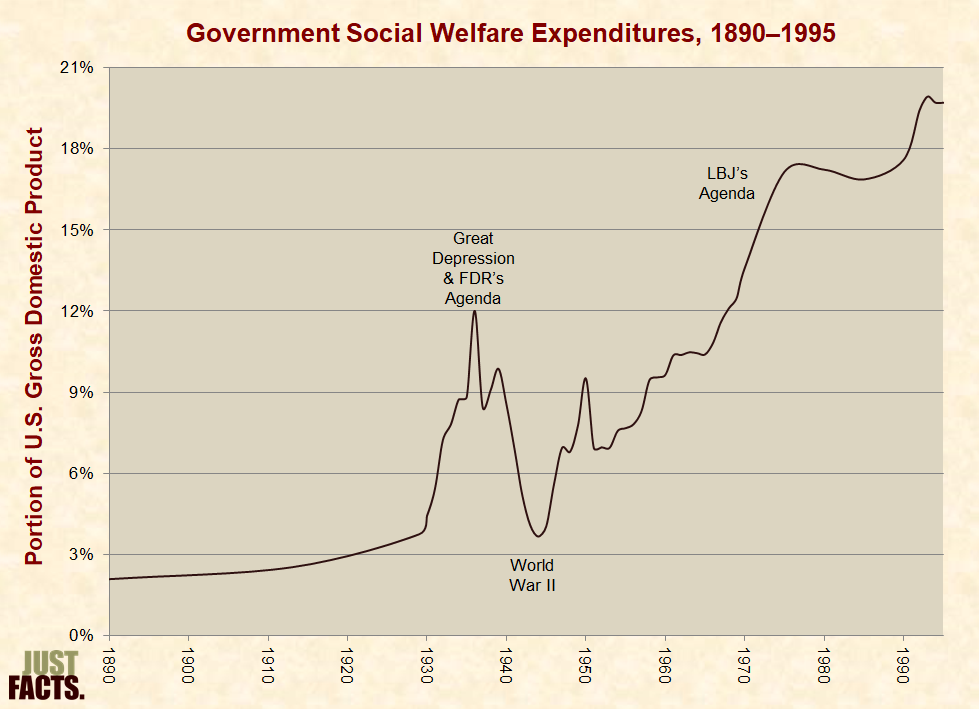
* From 1890 to 1995, government social welfare expenditures increased from 2% of the U.S. economy to 20%:
* “Human resources”—a measure of social spending published by the White House Office of Management & Budget—includes spending on:
* This measure does not include spending on the Covid-19 Paycheck Protection Program and certain other pandemic spending programs.[38]
* In 2021, the federal government spent $4,808 billion on human resources.[39] This amounts to:
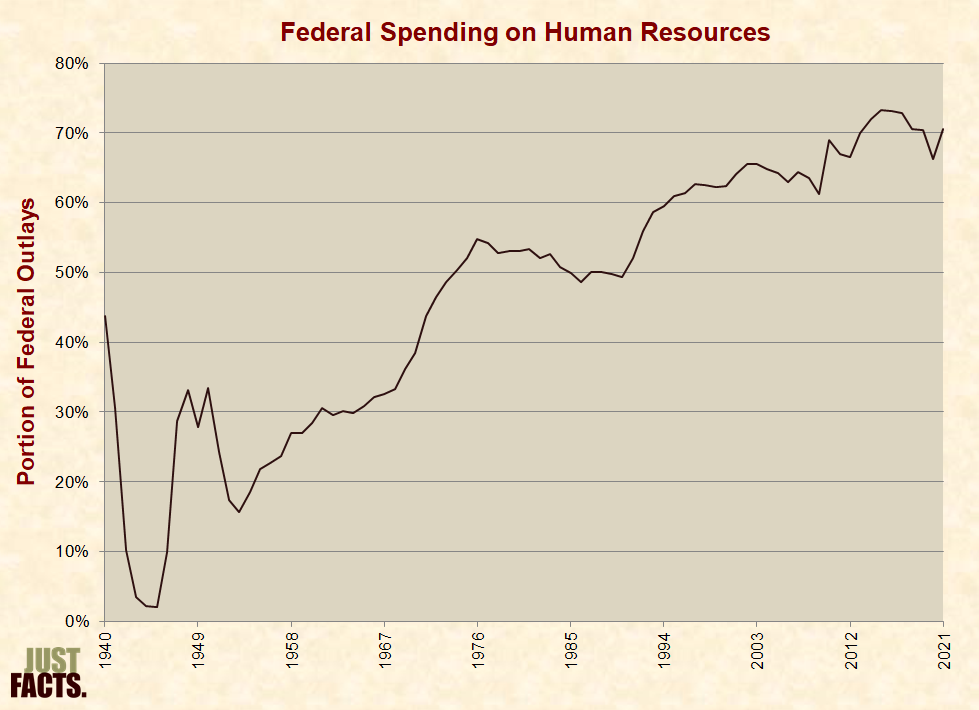
* From 1940 (shortly after the Great Depression[44]) to 2021, spending on human resources increased from 44% of all federal outlays to 71%:
* “Social programs”—a measure of social spending published by Just Facts based on data from the U.S. Bureau of Economic Analysis and White House Office of Management & Budget—includes:
* This measure does not include:
* In 2020, the federal government spent $4,966 billion on social programs.[54] This amounts to:
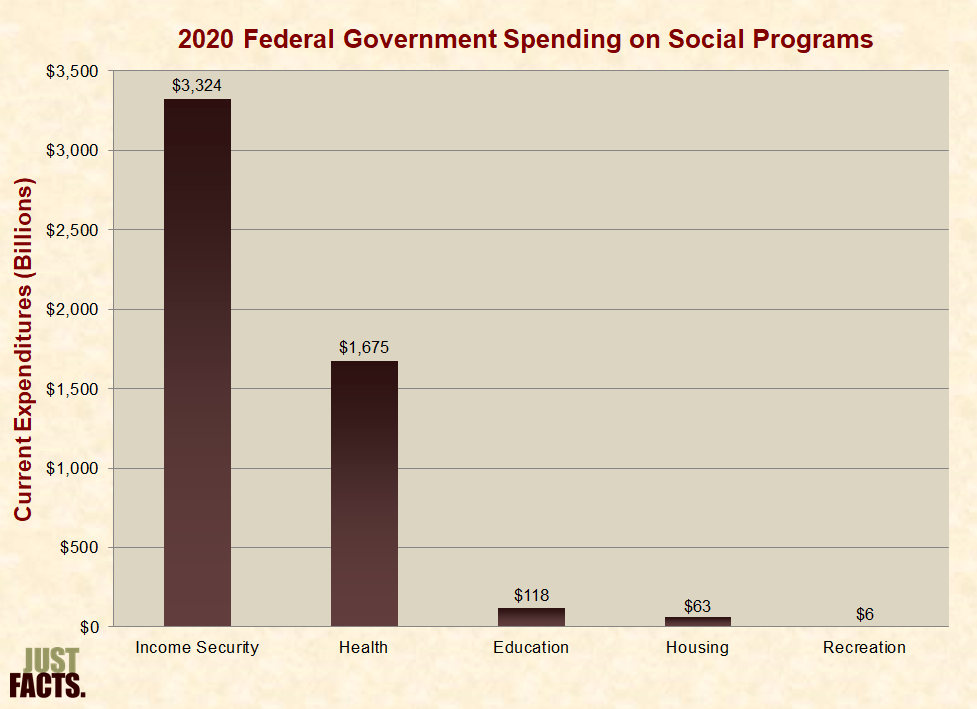
* In 2020, federal government spending on social programs was comprised of:
* In 2020, federal, state, and local governments spent $6,054 billion on social programs.[60] This amounts to:
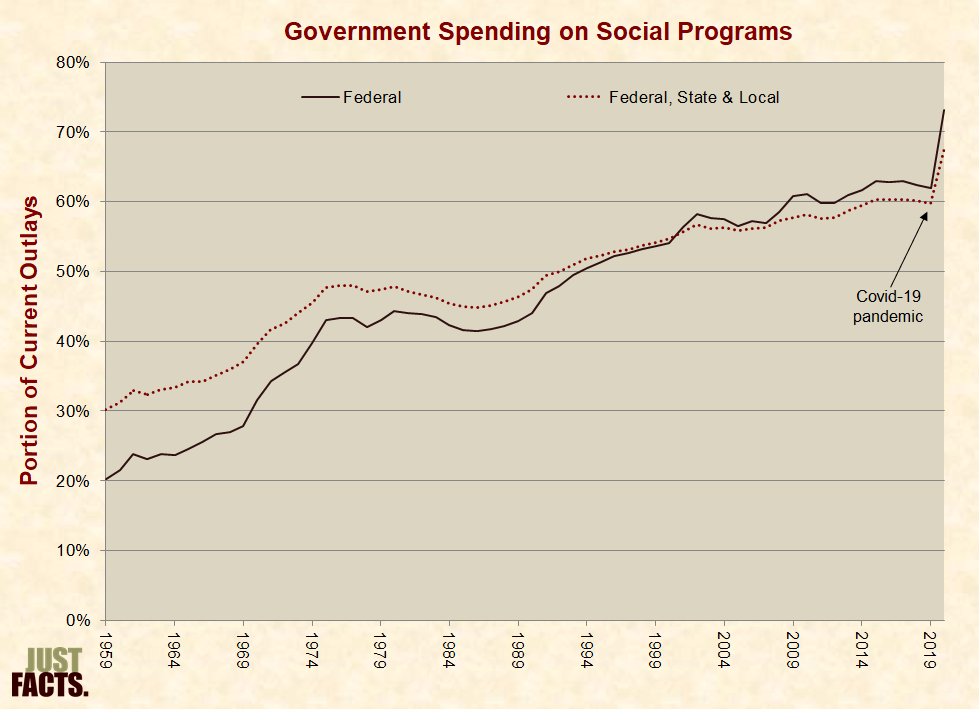
* From 1959 to 2020, spending on social programs increased from:
* “Social benefits”—a measure of social spending published by the U.S. Bureau of Economic Analysis—includes:
* This measure does not include:
* In 2020, the federal government spent $3,785 billion on social benefits.[84] This amounts to:
* In 2020, federal, state, and local governments spent $4,214 billion on social benefits.[89] This amounts to:
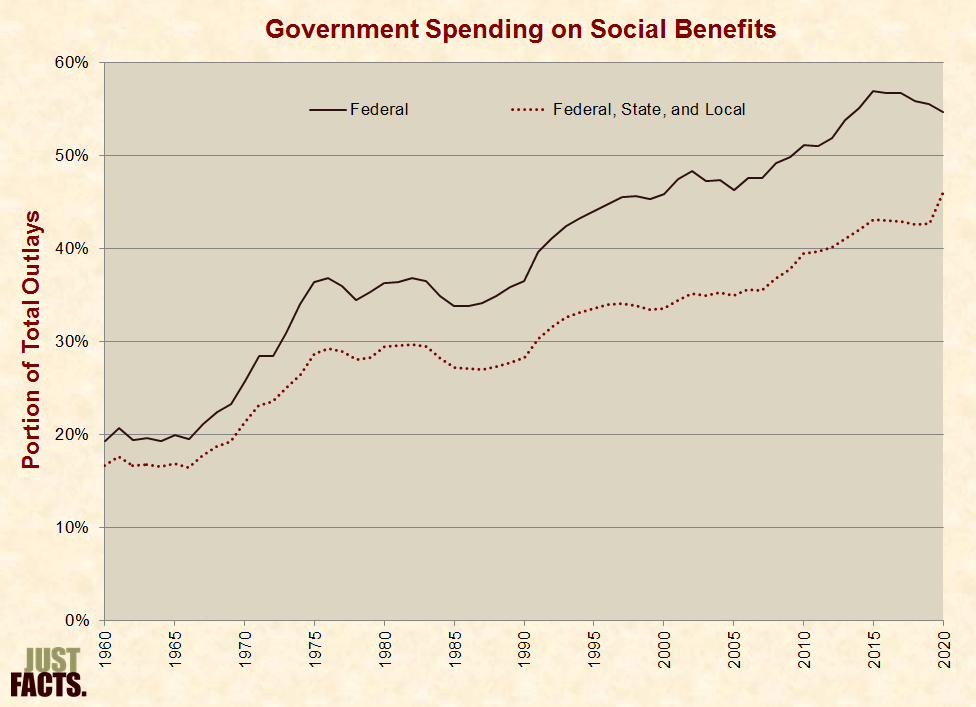
* From 1960 to 2020, spending on social benefits increased from:
* Each year, the U.S. government issues a “Publication of Assistance Listings” that provides a “compendium of federal programs, projects, services, and activities that provide assistance or benefits to the American public.”[95] The 2021 Publication of Assistance Listings is 3,877 pages and describes 2,268 programs.[96]
* Some programs in the Publication of Assistance Listings that serve social purposes are not included in various measures of social spending. Examples of these include certain types of environmental initiatives, affirmative action programs, and corporate subsidies.[97]
* “Means-tested welfare” programs provide cash and other benefits to people with incomes and/or assets below certain thresholds. Examples of these include:
* In 2015, the U.S. Government Accountability Office identified 82 federal means-tested welfare programs.[103]
* Seven of the 10 largest federal means-tested welfare programs are “mandatory.”[104] [105] [106] This means they are often funded by laws that require spending to continue indefinitely unless Congress and the president pass new laws to change the status quo. In contrast, Congress and the president typically fund “discretionary” programs for one year at a time.[107] [108]
* In 2021, the federal government spent $1,583.6 billion on means-tested welfare.[109] This amounts to:
* In notes that Thomas Jefferson wrote in the 1780s, he described how Americans cared for each other if they became poor or sick:
* In the 1830s, a French historian and political scientist named Alexis de Tocqueville visited the U.S. and wrote a famous work entitled Democracy in America.[117] In it, he stated that what “I most admire in America” is how people were personally engaged in advancing the welfare of society:
* Federal, state, and local government social welfare expenditures were:
* From 1968 to 2004, average inflation-adjusted federal, state, and local government spending per U.S. resident on means-tested welfare multiplied by more than four times.[131]
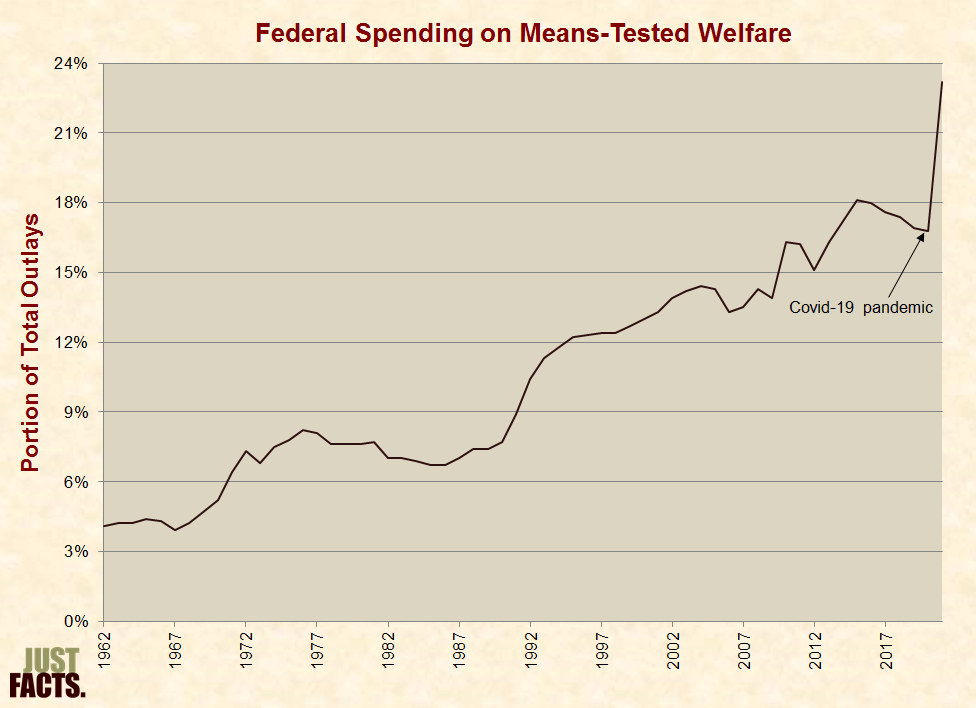
* From 1962 to 2021, spending on means-tested welfare increased from 4% of all federal outlays to 23%:
* Current government “social insurance” programs in the U.S. include:[135]
* Social insurance programs generally have the following characteristics:
* In 1932 during the Great Depression, the state of Wisconsin created the nation’s first unemployment insurance program.[147] [148]
* Later in the 1930s, as the Great Depression continued, the federal government began creating social insurance programs under Democratic President Franklin Delano Roosevelt (FDR). These programs were modeled primarily after European social welfare programs that began in Germany under Otto von Bismarck, a forefather of National Socialism (a.k.a Nazism).[149] [150] [151] [152] [153]
* In 1941, Luther Gulick, one of FDR’s economic advisors, told FDR that a national sales tax was an economically sounder way to fund Social Security than payroll taxes. FDR replied:
* In keeping with FDR’s political calculus, some people believe that Social Security and other social insurance programs save their payroll taxes for them, and thus, they have a right to the benefits.[155] [156] [157]
* Per the Social Security Administration:
* In 1960, the U.S. Supreme Court ruled (5 to 4) that entitlement to Social Security benefits is not a contractual right.[159]
* Social Security is mainly a “pay-as-you-go” program, which means that it pays most of its benefits by taxing people who are currently working.[160] [161] [162] Per the Social Security Administration:
* From the start of the Social Security program in 1937 through the end of 2021:
* Per the Social Security Administration:
* After the federal government pays back with interest all of the money it has borrowed from Social Security, the program’s current claim against the earnings of future generations is $45.7 trillion. This is larger than the national debt and amounts to an average of $254,931 for every person who paid Social Security payroll taxes in 2021.[166] [167]
* Medicare payroll taxes and the interest they generate funded 34% of Medicare’s outlays during 2021.[168]
* After the federal government pays back with interest all of the money it has borrowed from Medicare, the program’s current claim against the earnings of future generations is $47.8 trillion. This is larger than the national debt and amounts to an average of $183,614 from every U.S. resident aged 16 or older.[169] [170]
* In 2021, the federal government spent $2,227 billion on the three most-costly social insurance programs (Social Security, Medicare, and unemployment).[171] [172] This amounts to:
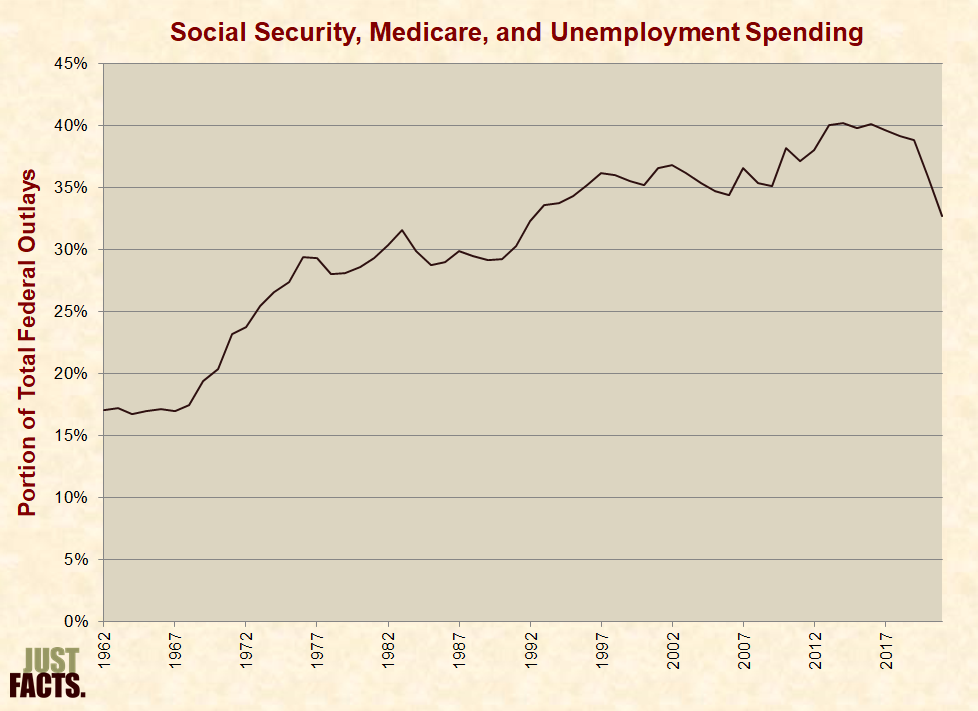
* From 1962 to 2021, spending on the three largest social insurance programs increased from 17% of all federal outlays to 33%:
* The largest federal healthcare programs are:[178]
* In 2020, federal, state, and local governments in the U.S. spent $1,900 billion on health and healthcare programs.[186] This amounts to:
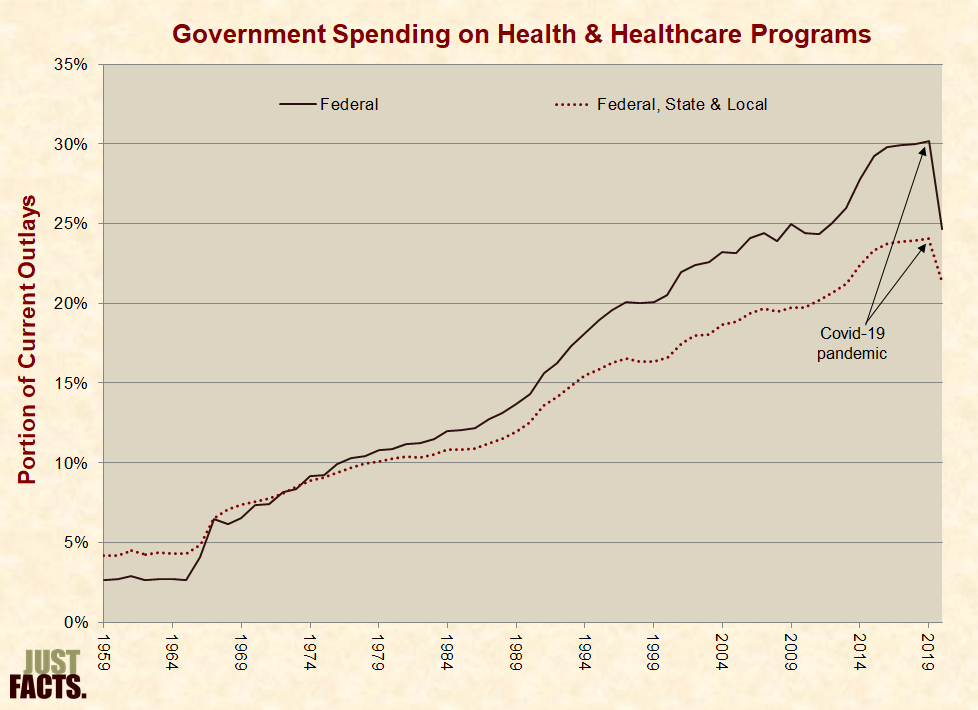
* From 1959 to 2020, spending on health and healthcare programs rose from:
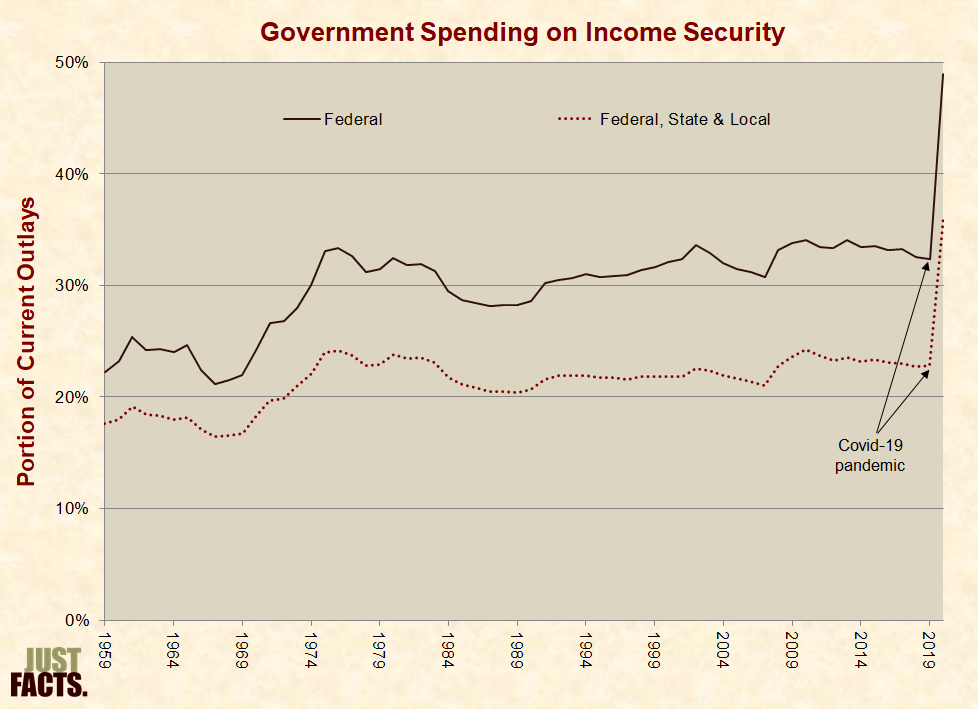
* Government income security programs include a mix of social insurance and means-tested welfare programs, such as:
* In 2020, federal, state, and local governments in the U.S. spent $3,236 billion on income security.[201] This amounts to:
* From 1959 to 2020, spending on income security increased from:
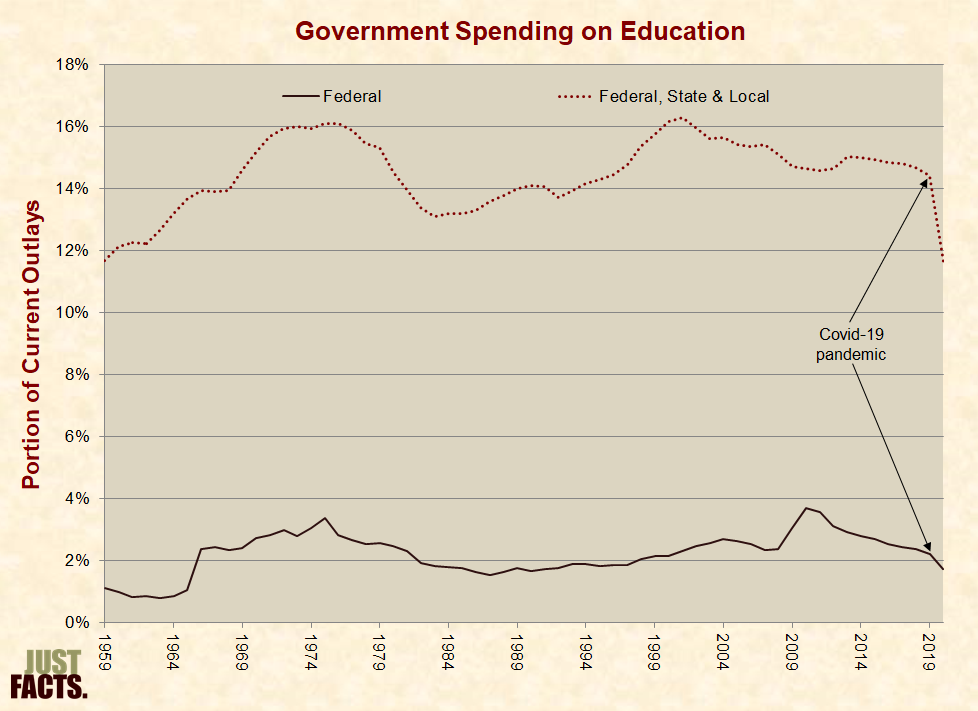
* In 2020, federal, state, and local governments in the U.S. spent $1,036 billion on education.[209] This amounts to $8,069 for every household in the U.S.,[210] 5.0% of the U.S. gross domestic product,[211] and 12% of government current expenditures.[212] [213] These figures do not include:
* Government education spending in 2020 was comprised of:
* From 1959 to 2020, spending on education increased from:
* For more facts about education spending, visit Just Facts’ comprehensive research on education.
* Tax preferences are provisions of the tax code that reduce taxes for certain people in certain cases.[227]
* Per the U.S. Joint Committee on Taxation, tax preferences are “usually … designed to encourage certain kinds of economic behavior as an alternative to employing direct expenditures or loan programs to achieve the same or similar objectives.”[228] [229]
* Many tax preferences have the same effects as government spending. For example, if the government were to repeal the child tax credit and instead send checks to households with children, the effective result would be the same.[230] [231] [232] [233]
* Per the Organization for Economic Cooperation and Development:
* Some tax preferences are refundable, and low-income households with tax credits that exceed their income tax liabilities receive the difference as cash payments from the federal government.[235] [236] [237] [238]
* Due to refundable tax credits, the lowest-income 20% of U.S. households paid an average effective federal income tax rate of –6.6% in 2019 prior to the Covid-19 pandemic.[239] This amounted to an average payment from the federal government of $2,600 per household.[240] [241] [242] [243]
* Due to refundable tax credits, the lowest-income 20% of U.S. households paid an average effective federal income tax rate of –14.2% in 2020—amid Covid-19 government lockdowns and intensified social spending.[244] [245] [246] This amounted to an average payment from the federal government of $6,000 per household.[247] [248] [249] [250]
* With regard to tax preferences, a report by the IRS’s Taxpayer Advocate Service states that the “IRS no longer is just a revenue collection agency but is also a benefits administrator.”[251]
* For more facts about this issue, see Just Facts’ research on tax preferences.
* Though not typically recorded in the above measures of social spending, governments sometimes shift the costs of their social policies to the private sector. For example:
* Federal law requires most hospitals with emergency departments to provide an “examination” and “stabilizing treatment” for anyone who comes to such a facility and requests care for an emergency medical condition or childbirth, regardless of their ability to pay and immigration status. This is mandated under a federal law called the Emergency Medical Treatment and Active Labor Act (EMTALA).[261] [262] [263] With regard to this law:
* Federal law give unions a monopoly over the labor supply of unionized bargaining units.[266] [267] In these workplaces:
* Federal law requires all nonprofit hospitals to treat Medicare and Medicaid patients.[270] During 2019:
* Since 2014, the Affordable Care Act (a.k.a. Obamacare) has required private health insurers to:
* The added costs of insuring people after they become ill raises the premiums of other customers.[276] [277] [278] [279] Per a 2016 report by Blue Cross Blue Shield (BCBS):
* The U.S. Constitution is the supreme legal authority in the United States. It is the written pact that established the U.S. government and vested it with certain powers. All presidents, governors, and federal/state judges and legislators are “bound by Oath or Affirmation, to support” it.[281] [282]
* Early during the convention at which the Constitution was written, Roger Sherman, a delegate from Connecticut and signatory to the Declaration of Independence, stated that the principal duties of a federal government should be to defend against foreign danger and internal uprisings, establish treaties, and regulate and tax trade with foreign nations.[283] [284]
* In response to Sherman, James Madison—who would later author the Bill of Rights and become known as the “Father of the Constitution” for his central role in its formation—stated that the items Sherman mentioned are all “important and necessary objects,” but they must be combined with “providing more effectually for the security of private rights and the steady dispensation of Justice.” He said that violations of these ideals “had more perhaps than any thing else, produced this convention.”[285] [286] [287]
* Continuing, Madison stated that all civilized societies are “divided into different sects, factions, and interests,” and “where a majority are united by a common interest or passion, the rights of the minority are in danger.” He then declared that:
* Towards that end, the framers of the Constitution developed a system of checks and balances on the powers of the government that they formed.[289] Guarding this system while giving it flexibility is Article V, which allows the Constitution to be amended with the approval of three-quarters of the states.[290] These provisions were designed to prevent a bare majority of people from oppressing all others.[291]
* In his farewell address to the nation, George Washington, the president of the Constitutional Convention and the first U.S. President,[292] [293] stated:
* After the Constitution was signed by the framers, it was submitted to the individual states for ratification. Written into the Constitution are the conditions that it would only be binding on the states that ratified it and would not become effective until at least nine of the states did so.[295] [296] During this ratification process, which lasted for three years,[297] there was opposition to the Constitution on several grounds, one of which was that it concentrated too much power in the hands of the federal government.[298] [299] [300]
* In an effort to build support for ratification of the Constitution,[301] three prominent statesmen collaborated in a series of essays known as the Federalist Papers, which explained the Constitution and addressed objections to it. These essays originally appeared in New York newspapers and were later assembled into book form and published throughout the states. The three authors were:
* Although the Federalist Papers were written by three individuals, all were signed with a single pen name: “Publius.” The book version of the Federalist Papers was edited by Alexander Hamilton, and the author’s name was given as “a Citizen of New York.”[303]
* Several of the objections voiced against the Constitution pertained to Article I, Section 8, which reads:
* One of the objections to this article was that the phrase, “provide for the common Defense and general Welfare,” gave the federal government broad powers to do whatever it felt was appropriate towards these ends.[305] In Federalist Paper 41, James Madison addressed this objection by stating that the phrase applied to and was limited by the specific powers detailed in the clauses that followed it (such as coining money, establishing federal courts, etc.). He said that to interpret the Constitution in any other way was “an absurdity.” He also wrote:
* In Federalist Paper 33, Alexander Hamilton addressed the objection that the last clause of Article 8, which grants the authority to make “all Laws” needed to carry out the powers vested in the Constitution, gave the federal government “comprehensive” power to tax citizens for a “vast number of” purposes.[307] In response, Hamilton wrote that the clause was “perfectly harmless” and only served to declare “a truth” that is a natural consequence of forming “a federal government and vesting it with certain specified powers.” He also wrote that it was an exaggeration to refer to this language as “sweeping,” and “if there is any thing exceptionable, it must be sought for in the specific powers upon which this general declaration is predicated.”[308]
* Between December 1787 and January 1791, the Constitution was ratified by all of the states.[309]
* Less than a year after the last state ratified the Constitution, Alexander Hamilton wrote a letter in which he asserted that the phrase “general Welfare” granted authority to the federal government beyond the specific powers detailed in Article 8. He said this phrase was “as comprehensive as any that could have been used” and it “embraces a vast variety of particulars, which are susceptible neither of specification nor of definition.”[310]
* Hamilton’s changed stance on federal power gave rise to a clash that led to the formation of the first two political parties in the United States: the Federalists led by Alexander Hamilton, and the Republicans led by James Madison and Thomas Jefferson, the primary author of the Declaration of Independence and third President of the United States. The Republicans later came to be called the “Democratic-Republicans,” and the modern Democratic Party traces their roots to this party and called Thomas Jefferson “the first Democratic President.”[311] [312] [313] [314] [315] [316] [317] [318]
* Conflict regarding the interpretation of the “general Welfare” clause spilled over into the 1800’s, during which it was a recurring issue whether or not the federal government had the authority to subsidize various projects on the grounds they promoted the general welfare. The name used for such activities was “internal improvements,” and this entailed items such as building roads and constructing canals on lands that were not federally owned.[319] [320]
* In 1817, James Madison, as President of the United States, vetoed an act “to set apart and pledge certain funds for internal improvements.” In doing so, he stated that the federal government did not have this power and to allow for it would require a distorted interpretation of the Constitution.[321] [322]
* When Madison vetoed this act, Thomas Jefferson wrote a letter praising this action and stating it was always “our tenet” that Congress does not have:
* In the same letter, Jefferson wrote he thought it was “fortunate” that Madison had the opportunity to veto such a bill because it:
* In 1824, John Quincy Adams was elected President of the United States. While in office, he proposed and signed various laws that appropriated federal funds for building roads, improving harbors, and subsidizing the arts and sciences.[326] [327] [328] While campaigning for President, he wrote the following to a voter who had asked about his view on internal improvements:
* In 1844, Democrat James Polk was elected President of the United States.[330] The argument was then being made that the following language in Article 8 of the Constitution gave the federal government authority to spend money on improving harbors and rivers:
* In a message to Congress, Polk responded that the phrase, “to regulate commerce” does:
* In 1848, the Democratic Party adopted a platform stating that the “federal government is one of limited powers” and:
* Three weeks after this platform was adopted, Abraham Lincoln, who was at the time a U.S. Congressman and a member of the Whig Party, gave a speech criticizing the Democratic Party’s stance on this issue. He briefly reviewed the opinions of past Presidents and jurists both pro and con, noted that the matter has not yet been brought under judicial consideration, and asserted there was no reason to worry about the constitutionality of such acts. He also stated:
* In 1856, Abraham Lincoln joined a new party that had been formed two years earlier on the basis of opposition to slavery.[336] [337] The name “Republican” was chosen for the party because the founders of it considered their principles to be aligned with that of Thomas Jefferson and the party he originally formed.[338] [339] The first Republican platform (1856) called for “restoring the action of the Federal Government to the principles of Washington and Jefferson.” It also stated that:
* In 1887, Congress passed a bill to supply seeds to drought-stricken farmers in Texas. Democratic President Grover Cleveland vetoed it, stating:
* In 1900, the Republican Party adopted a platform that voiced approval for “the improvement of the roads and highways,” but referred the matter to the states.[343]
* In 1900, the Democratic Party adopted a platform stating that the President and Congress derived their “existence” and “powers” from the Constitution and denounced the idea that they could “exercise lawful authority beyond it or in violation of it.” It also criticized a Republican-backed subsidy for the shipping industry and called for a “return to the time-honored Democratic policy of strict economy in governmental expenditures.”[344]
* In 1933, Franklin Delano Roosevelt, the Democratic governor of New York, became President of the United States.[345] The Great Depression had begun in 1929,[346] and upon accepting the nomination of the Democratic Party, Roosevelt promised a “new deal” for Americans. This entailed the elimination of nonessential government functions, an increase in government projects to stimulate employment, shortened working hours, and increased prices for agricultural goods to benefit the farming industry. In this acceptance speech, Roosevelt stated:
* As President, Roosevelt proposed a variety of bills to Congress. The House and Senate contained large Democratic majorities and passed most of Roosevelt’s proposals.[349] [350] [351] This included, among other measures:
* Much of this legislation was challenged in court, and between January 1935 and May 1936, the Supreme Court ruled on ten such major cases. In eight of these, the laws were struck down in part or whole for overstepping the bounds of power granted to the federal government in the Constitution.[361] Four of the nine justices generally ruled against the New Deal programs, three generally ruled in favor of them, and two of the justices were swing votes.[362]
* In Carter v. Carter Coal Company, the Supreme Court (voting 6–3) struck down a federal law that placed taxes on coal, fixed coal prices, paid money to coal producers who agreed to follow federal edicts, and established provisions for industry-wide wage requirements.[363] The majority ruling stated that the Constitutional Convention:
* In Schechter Poultry Corporation v. United States, the Supreme Court unanimously struck down a law that gave the President the power to enact separate “codes of fair competition” for wide-ranging industries and trades. This included the authority to fix the prices of goods and services, set minimum wages, set maximum working hours, and at the discretion of the President, revoke the business license of anyone he judged to be incompliant with these codes.[365] [366] [367]
* In Schechter, seven of the nine justices joined in the majority ruling, and the two remaining justices concurred with differing language. In this decision, the majority cited the Tenth Amendment, which affirms that any powers not granted to the federal government by the Constitution belong to the States or to the people. The ruling stated:
* Four days after this decision was issued, Roosevelt held a press conference in which he asserted that the “implications of this decision are much more important than certainly any decision of my lifetime or yours,” and that the Supreme Court had “relegated” the U.S. to a “horse and buggy” interpretation of the Constitution. When a reporter asked him if there was any suggestion as to how to resolve the matter outside of a Constitutional Amendment, Roosevelt replied, “No; we haven’t gotten to that yet.”[369]
* Four months before this press conference, Roosevelt’s Secretary of the Interior, Harold L. Ickes, recorded the following in his diary:
* The following year, Roosevelt won reelection by a broad margin, and the Democratic Party expanded its majorities in the House and Senate. [371] [372] After his term began, Roosevelt proposed a bill that would have granted him provisions to appoint up to six more justices to the Supreme Court.[373] [374] [375] At the press conference in which he announced this proposal, he stated:
* Seven years before this, as the governor of New York, Roosevelt stated:
* In the four months after Roosevelt proposed his bill to alter the composition of the Supreme Court,[378] the Court ruled in six cases concerning New Deal legislation. In all of these decisions, the Court voted to uphold the acts under consideration. Five of these cases were decided by a 5 to 4 margin, with the two swing justices casting the determinative votes.[379] [380] [381] [382] [383] [384] [385]
* In Steward Machine Company v. Davis, the Supreme Court (voting 5–4) upheld a federal law imposing new taxes that were ultimately given to unemployed people.[386] [387] In this decision, the majority cited unemployment statistics and stated:
* The two swing justices, Charles Evan Hughes and Owen J. Roberts joined in this decision.[388] [389]
* One year earlier, Justice Roberts joined in a decision that stated the Constitution:
* One year before this, Justice Roberts joined in a decision written by Justice Hughes that stated:
* In the same month that the last of these decisions was issued, one of the justices who generally ruled against the New Deal programs announced his retirement. The next month, Roosevelt’s bill to add justices to the Supreme Court was defeated in the Senate Judiciary Committee by a vote of 10 to 8.[392] [393] Seven of the ten Senators voting against this bill were Democrats.[394]
* Over the next two years, all of the justices that generally found the New Deal programs to be unconstitutional either retired or passed on.[395] In 1938, Roosevelt stated:
* By 1944, seven of the nine justices on the Supreme Court had been appointed by Roosevelt.[397] Over the next half century, the Supreme Court did not rule any major social spending program to be unconstitutional.[398]
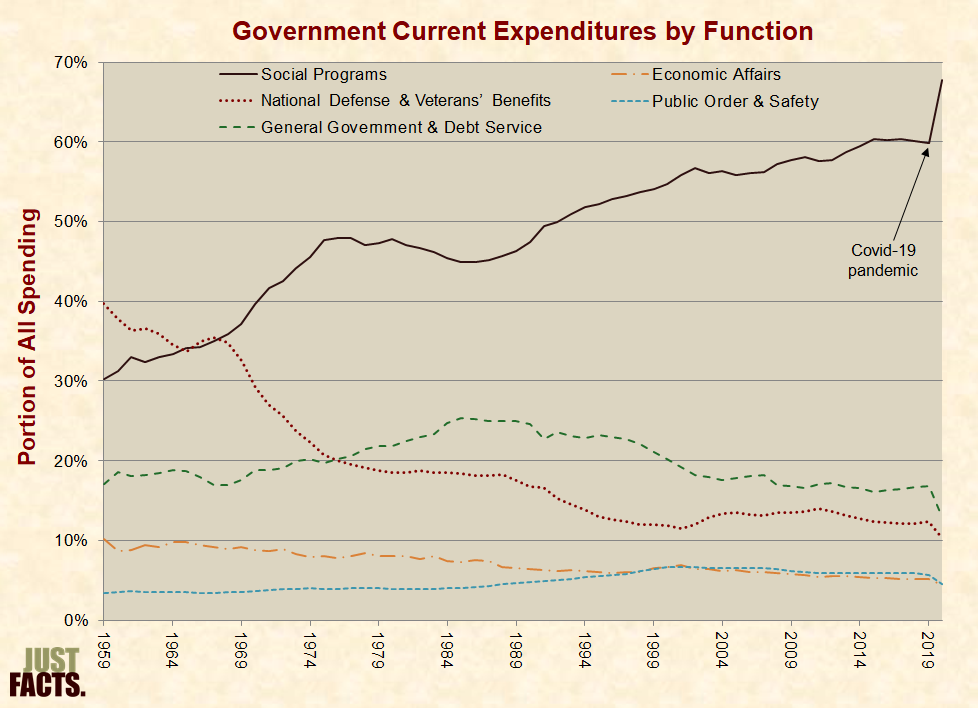
* In 2020, the federal government spent 73% of its finances on social programs, including income security, healthcare, education, housing, and recreation. This amounts to $5.0 trillion or an average of $38,662 for every household in the U.S.[399]
* From 1959 to 2020, the portion of federal outlays that were spent on:
* A scientific, nationally representative survey commissioned in 2020 by Just Facts found that 50% of voters believe social spending is not the main cause of rising national debt.[404] [405] [406]
[1] Article: “Social Welfare Program.” Encyclopædia Britannica. Accessed May 11, 2018 at <www.britannica.com>
“Social welfare program, any of a variety of governmental programs designed to protect citizens from the economic risks and insecurities of life. The most common types of programs provide benefits to the elderly or retired, the sick or invalid, dependent survivors, mothers, the unemployed, the work-injured, and families.”
[2] Report: “Social Welfare Expenditures Under Public Programs, Fiscal Year 1977.” By Alma McMillan. Social Security Administration, Office of Research and Statistics Social Security Bulletin, June 1979. <www.ssa.gov>
Page 7:
Public social welfare expenditures are defined in this series as cash and medical benefits, services, and administrative costs for all programs operating under public law that are of direct benefit to individuals and families. Included are programs providing income maintenance and health benefits through social insurance and public aid, and those providing public support of health, education, housing, and other welfare services.
[3] Article: “Social Welfare Expenditures in the United States, 1956–57.” By Ida C. Merriam (Director, Division of Program Research, Office of the Social Security Commissioner). Social Security Bulletin, October 1958. Pages 22–33. <www.ssa.gov>
Page 22:
Whatever definition of social welfare programs or activities is used, there are several different contexts in which it is desirable to look at social welfare expenditures. The primary one around which the series has been organized is that of program expenditures. This classification identifies total expenditures, including costs of administration, under designated programs—in this instance, civilian public programs of income maintenance, health, education, public housing, and other welfare services. The data thus compiled give a measure of the shares of the total national output and of all public expenditures that have been going to these designated programs.
[4] The Oxford Handbook of U.S. Social Policy. Edited by Daniel Beland, Christopher Howard, and Kimberly J. Morgan. Oxford University Press, 2015.
Chapter 1: “The Fragmented American Welfare State: Putting the Pieces Together.” By Daniel Beland, Christopher Howard, and Kimberly J. Morgan. Pages 3–22.
Page 4:
Social policy refers to programs that redistribute resources across society and often seek to cushion people against life’s socioeconomic risks. These programs usually take the form of cash transfers or in-kind benefits such as medical care. Taken together, social programs constitute the welfare state, a term that implies uniformity and coherence but in fact often conceals a tremendous amount of variation in terms of programmatic design and political dynamics.
… Modern social programs span a multitude of policy areas, including programs for the unemployed, retirees, the sick, the disabled, the poor, and families with children (Beland 2010). All of these policy areas are explicitly analyzed in this handbook. Some, such as retirement pensions and health care, are represented by several chapters each, a reflection of the programmatic complexity and fragmentation of the American welfare state.
[5] Working paper: “Is the European Welfare State Really More Expensive? Indicators on Social Spending, 1980–2012; and a Manual to the OECD Social Expenditure Database (SOCX).” By Willem Adema, Pauline Fron, and Maxime Ladaique. Organization for Economic Cooperation and Development, 2011. <www.oecd-ilibrary.org>
Page 90:
II.2. Defining the Social Domain
68. To facilitate cross-country comparisons of social expenditure, the first step is to demarcate what spending is ‘social’ and what is not. The OECD [Organization for Economic Cooperation and Development] defines social expenditures as: “The provision by public and private institutions of benefits to, and financial contributions targeted at, households and individuals in order to provide support during circumstances which adversely affect their welfare, provided that the provision of the benefits and financial contributions constitutes neither a direct payment for a particular good or service nor an individual contract or transfer.”
69. Since only benefits provided by institutions are included in the social expenditure definition, transfers between households—albeit of a social nature, are not in the social domain.10
70. Social benefits include cash benefits (e.g., pensions, income support during maternity leave and social assistance payments), social services (e.g., childcare, care for the elderly and disabled) and tax breaks with a social purpose (e.g., tax expenditures towards families with children, or favourable tax treatment of contributions to private health plans).
71. There are two main criteria which have to be simultaneously satisfied for an expenditure item to be classified as social. First, the benefits have to be intended to address one or more social purposes. Second, programmes regulating the provision of benefits have to involve either a) inter-personal redistribution, or b) compulsory participation.
II.2.1. Towards a Social Purpose
72. The OECD Social Expenditure Database groups benefits with a social purpose in nine policy areas (see also section II.3.1 for more detail):
• Old-age – pensions (see Box II.2), early retirement pensions, home-help and residential services for the elderly;
• Survivors – pensions and funeral payments;
• Incapacity-related benefits – care services, disability benefits, benefits accruing from occupational injury and accident legislation, employee sickness payments;
• Health – spending on in- and out-patient care, medical goods, prevention;
• Family – child allowances and credits, childcare support, income support during leave, sole parent payments;
• Active labour market policies – employment services, training, employment incentives integration of the disabled, direct job creation, and start-up incentives;
• Unemployment – unemployment compensation, early retirement for labour market reasons;
• Housing – housing allowances and rent subsidies; and,
• Other social policy areas – non-categorical cash benefits to low-income households, other social services; i.e., support programmes such as food subsidies, which are prevalent in some non-OECD countries.
10 Social spending does not include remuneration for work, as it does not cover market transactions, i.e., payments in return for the simultaneous provision of services of equivalent value. Employer costs such as allowances towards transport, holiday pay, etc. are part of remuneration in this sense.
[6] Appendix: “Estimating Public Social Expenditure 2014/15–2016, Sources and Methods.” Organization for Economic Cooperation and Development, October 12, 2016. <www.oecd.org>
Page 3:
Social transfers in kind consist of individual goods and services provided as transfers in kind to individual households by government units. They include:
Social benefits in kind (D.631). Social benefits in kind are social transfers in kind intended to relieve the household from the financial burden of social risks or needs. They include the following cases:
• Social security benefits, reimbursements (D.6311). These benefits consist of reimbursement by social security funds of approved expenditures made by households on specific goods or services.
• Other social security benefits in kind (D.6312). These consist of transfers in kind provided to households by government units that are similar in nature to social security benefits in kind but are not provided in the context of social insurance schemes. Social assistance benefits in kind include, if not covered by a social insurance scheme, for instance social housing, dwelling allowances, and reduction of transport prices (provided that there is a social purpose).
Transfers of individual non-market goods or services (D.632). Transfers of individual non-market goods or services consist of goods or services provided to individual households free or at prices which are not economically significant, by non-market producers of government units. They cover for instance education and cultural services.
[7] Article: “Social Welfare Expenditures, 1929–67.” By Ida C. Merriam (Assistant Commissioner, Office of Research and Statistics, Social Security Administration). Social Security Bulletin, December 1967. Pages 3–16. <www.ssa.gov>
Page 3:
The long-time upward trend in social welfare expenditures, both in absolute amounts and as a percent of the gross national product, continued in the fiscal year 1967. So did the increasing importance of the Federal sector. Total social welfare expenditures for the first time passed the $100 billion mark and amounted to 13 percent of the gross national product ($763 billion). Federal funds accounted for 54 percent of all social welfare expenditures. The largest single increase was the $3.3 billion for health insurance for the aged under the Social Security Act (Medicare).
Just before the turn of the century, total social welfare expenditures amounted to about 2.4 percent of the gross national product with expenditures for education—almost entirely from State and local funds—making up almost half the total. Veterans’ benefits, more than one third of the total, were the only significant Federal social welfare expenditures. The great depression of the 1930’s brought the Federal Government into the area of social welfare activities in a major way. Significant growth in the population and in the number of risks covered by social insurance, as well as an accelerating Federal involvement in health and education programs, has been largely responsible for the rising trends in social welfare expenditures since the late 1950’s. The increasing number of children and older persons in the population, accompanied by the prolonging of school years and a trend toward early retirement have had their effect on both transfer payments and service programs.
Pages 5–6:
Ten years from today programs now omitted from the social welfare series may appear to be obviously an aspect of social welfare policy that should be included. For the present, the general boundary line of programs designed specifically to deal with individual welfare has been retained, and the series continues to exclude such community services as urban transportation, city planning and urban renewal, water and sewer works, preservation of law and order, and parks and recreation. Admittedly, the dividing line is arbitrary. Some legal aid services are included with the special OEO [Office of Economic Opportunity] programs and some juvenile delinquency services with child welfare. But the maintenance of courts, police departments, reform schools, and prisons seem better treated as a general function of government and omitted from this series. Similarly, one can recognize the importance of urban transportation in assuring access to jobs and steady earnings without classifying it as a social welfare program. Recreational facilities, or at least organized recreational services, and library services may be regarded as closer to the borderline. They continue to be omitted, however, except where they may be hidden in expenditures for schools or other activities. Unless such distinctions were retained, the series would become almost a listing of government expenditures for nondefense purposes and lose much of its intended character and usefulness.
The series continues to relate to direct expenditures and to exclude such indirect types of subsidy or support as loans, loan guarantees, or income-tax exemptions. The basic series relates to public programs. Related private expenditures for health, education, and income maintenance and welfare services are brought together in the regular Bulletin series, as heretofore.
Table l.—Social Welfare Expenditures Under Public Programs, Selected Fiscal Years, 1928–29 Through 1966–67 …
Social insurance
Old-age, survivors, and disability insurance [Social Security]
Health insurance for the aged [Medicare]
Railroad retirement
Public employee retirement
Unemployment insurance and employment service
Railroad unemployment insurance
Railroad temporary disability insurance
State temporary disability insurance
Hospital and medical benefits
Workmen’s compensation
Hospital and medical benefits
Public aid
Public assistance
Vendor medical payments
Other
Health and medical programs
Hospital and medical care
Civilian programs
Defense Department
Maternal and child health programs
Medical research
School health (educational agencies)
Other public health activities
Medical-facilities construction
Defense Department
Other
Veterans’ programs
Pensions and compensation
Health and medical programs
Hospital and medical care
Hospital construction
Medical and prosthetic research
Education
Life insurance
Welfare and other
Education
Elementary and secondary
Construction
Higher
Construction
Vocational and adult
Housing
Public housing
Other
Other social welfare
Vocational rehabilitation
Medical services
Medical research
Institutional care
School meals
Child welfare
Special OEO programs
Social welfare, not elsewhere classified
[8] Book: Early Childhood Care and Education in Canada: Past, Present, and Future. Edited by Larry Prochner and Nina Howe. UBC Press, 2000.
Chapter 9: “Child Care as a Social Policy Issue.” By Martha Friendly. Pages 252–273.
Page 261:
In the twentieth century, Canadian approaches to social programs have been characterized by two main shifts in perception and treatment. In the nineteenth century, health and education were considered to be private responsibilities; and at the time of Confederation, social welfare had not yet developed as an issue. When there was a need for social assistance outside the nuclear and extended family, it generally fell within the domain of churches; later, non-religious charitable institutions assumed responsibility for assisting the deserving poor and needy. A good example of an early foray into what had previously been in the private realm were mothers’ pensions, originally introduced to provide support to needy mothers of young children who were “deserving” because they had been widowed in the First World War (Guest 1990).
The first conceptual shift was that from the original individualistic, family-centred or, at most, charitable view to one of increased collective responsibility. This first shift occurred between the end of the Second World War and the early 1970s, when Canada’s main social programs—health care, unemployment insurance, pensions, and social welfare—were emerging. Over this period, governments, both federal and provincial, assumed a major responsibility for these functions, with the federal government assuming a policy-shaping role, and the provinces becoming the program managers and deliverers (Doherty, Friendly, and Oloman 1998).
Most of Canada’s health, educational and social programs were developed as universal or inclusive programs (sometimes called “institutional”). National health care, or medicare, is perhaps the best example of the way a social policy has defined its target group as all Canadians, rather than the poor or needy; postsecondary, elementary and secondary education, Unemployment Insurance, and Canada Pension were also developed as universal programs.
[9] Book: Aging and Social Expenditure in the Major Industrial Countries, 1980–2025. By Peter S. Heller, Richard Hemming, Peter Kohnert, and a staff team from the Fiscal Affairs Department. International Monetary Fund, 1986.
Page 1: “The focus is on government expenditure in the different social sectors. Social expenditure is defined to include, as a central core, medical care, education, pensions, welfare payments, unemployment insurance, and family benefits. A smaller residual category of social expenditure is included which differs across countries (see Chapter 11).”
Page 16:
An important problem faced in undertaking this study, particularly given its cross-country focus, was how to define the social expenditure of the government. Clearly, one should include expenditure on education, medical care, pensions, unemployment compensation, and income maintenance for the poor. The dividing line then becomes blurred. Should one include expenditure on family allowances? veterans benefits? workmen’s compensation? Should pensions of central government or public enterprise employees be included or treated analogously to with private sector employees?
[10] Calculated with data from:
a) Report: “Annual Statistical Supplement to the Social Security Bulletin, 2002.” Social Security Administration, February 25, 2003. <www.ssa.gov>
Page 130: “Table 3.A1—Gross domestic product (GDP) and social welfare expenditures under public programs, selected fiscal years 1965–1995 … Amount (millions of dollars) … Total social welfare expenditures b … 1995 [=] 1,505,136”
b) Dataset: “Table 3.1. Government Current Receipts and Expenditures [Billions of Dollars] Seasonally Adjusted at Annual Rates.” U.S. Bureau of Economic Analysis. Last revised May 26, 2022. <apps.bea.gov>
“Total expenditures … 1994 … Q4 [=] 2,544.7 … 1995 … Q1 [=] 2,582.4 … Q2 [=] 2,610.5 … Q3 [=] 2,598.8”
c) United States Code Title 31, Subtitle II, Chapter 11, Section 1102: “Fiscal Year.” Accessed June 21, 2022 at <www.law.cornell.edu>
“The fiscal year of the Treasury begins on October 1 of each year and ends on September 30 of the following year.”
CALCULATION: $1,505,136 million social welfare expenditures / (($2,544.7 + $2,582.4 + $2,610.5 + $2,598.8) /4) billion government spending = 58%
[11] Report: “Fiscal Year 2023 Historical Tables: Budget Of The U.S. Government.” White House Office of Management and Budget, March 2022. <www.whitehouse.gov>
“Table 3.1—Outlays by Superfunction and Function: 1940–2027.” (<www.whitehouse.gov>)
“In millions of dollars … Human resources … 2021 [=] 4,807,912 … As percentages of outlays … Human resources … 2021 [=] 70.5%”
NOTE: Credit for bringing this measure to the attention of Just Facts belongs to Jodie Carroll of Vote Facts (<www.votefacts.org>).
[12] Calculated with data from:
a) Dataset: “Table 3.16. Government Current Expenditures by Function [Billions of Dollars].” U.S. Bureau of Economic Analysis. Last revised October 29, 2021. <apps.bea.gov>
b) Report: “Fiscal Year 2023 Historical Tables: Budget Of The U.S. Government.” White House Office of Management and Budget, March 2022. <www.whitehouse.gov>
“Table 3.1—Outlays by Superfunction and Function: 1940–2027.” (<www.whitehouse.gov>)
NOTES:
[13] Calculated with data from:
a) Dataset: “Table 3.12. Government Social Benefits [Billions of Dollars].” U.S. Bureau of Economic Analysis. Last revised July 30, 2021. <apps.bea.gov>
b) “2018 Actuarial Report on the Financial Outlook for Medicaid.” By Christopher J. Truffer and others. U.S. Department of Health & Human Services, Centers for Medicare and Medicaid Services, Office of the Actuary, 2019. <www.cms.gov>
Page 3: “Medicaid costs are met primarily by Federal and State general revenues, on an as-needed basis; the States may also rely on local government revenues to finance a portion of their share of Medicaid costs.”
c) Email from the U.S. Bureau of Economic Analysis to Just Facts, September 7, 2018.
“The reason we don’t classify them [federal Medicaid outlays] as [federal] ‘Government Social Benefits’ is because the [federal] government doesn’t make these payments directly to individuals, but rather sends money to the states and the states distribute the benefits.”
d) Dataset: “National Health Expenditures by Type of Service and Source of Funds, Calendar Years 1960–2020.” U.S. Department of Health & Human Services, Centers for Medicare and Medicaid Services, December 1, 2021. <www.cms.gov>
e) Dataset: “Table 3.1. Government Current Receipts and Expenditures [Billions of Dollars] Seasonally Adjusted at Annual Rates.” U.S. Bureau of Economic Analysis. Last revised May 26, 2022. <apps.bea.gov>
f) Dataset: “Table 3.2. Federal Government Current Receipts and Expenditures.” U.S. Bureau of Economic Analysis. Last revised May 26, 2022. <apps.bea.gov>
NOTE: An Excel file containing the data and calculations is available upon request.
[14] Full documentation for each of the measures is provided in these sections below:
Social Welfare Expenditures is not included in this chart, because complete historical data for this measure is unavailable.
[15] Calculated with data from:
a) Report: “CBO Estimate for H.R. 6074, the Coronavirus Preparedness and Response Supplemental Appropriations Act, 2020, as Posted on March 4, 2020.” Congressional Budget Office, March 4, 2020. <www.cbo.gov>
b) Report: “Cost Estimate for H.R. 6201, Families First Coronavirus Response Act, Enacted as Public Law 116-127 on March 18, 2020.” Congressional Budget Office, April 2, 2020. <www.cbo.gov>
c) Report: “Cost Estimate for H.R. 748, CARES Act, Public Law 116-136.” Congressional Budget Office, April 16, 2020. <www.cbo.gov>
d) Report: “CBO Estimate for H.R. 266, the Paycheck Protection Program and Health Care Enhancement Act as Passed by the Senate on April 21, 2020.” Congressional Budget Office, April 22, 2020. <www.cbo.gov>
e) Report: “Estimate for Division N—Additional Coronavirus Response and Relief, H.R. 133, Consolidated Appropriations Act, 2021, Public Law 116-260, Enacted on December 27, 2020.” Congressional Budget Office, January 14, 2021. <www.cbo.gov>
f) Report: “Estimated Budgetary Effects of H.R. 1319, American Rescue Plan Act of 2021 as Passed by the Senate on March 6, 2021.” Congressional Budget Office, March 10, 2021. <www.cbo.gov>
g) Dataset: “HH-1. Households by Type: 1940 to Present.” U.S. Census Bureau, Current Population Survey, November 2021. <www.census.gov>
NOTE: An Excel file containing the data and calculations is available upon request.
[16] Report: “Social Welfare Expenditures Under Public Programs, Fiscal Year 1977.” By Alma McMillan. Social Security Administration, Office of Research and Statistics Social Security Bulletin, June 1979. <www.ssa.gov>
Page 7:
Public social welfare expenditures are defined in this series as cash and medical benefits, services, and administrative costs for all programs operating under public law that are of direct benefit to individuals and families. Included are programs providing income maintenance and health benefits through social insurance and public aid, and those providing public support of health, education, housing, and other welfare services.
[17] Report: “Annual Statistical Supplement to the Social Security Bulletin, 2002.” Social Security Administration, February 25, 2003. <www.ssa.gov>
Page 130:
Total social welfare expenditures b …
b Represents program and administrative expenditures from federal, state and local public revenues and trust funds under public law. Includes workers’ compensation and temporary disability insurance payments made through private carriers and self-insurers. Includes capital outlay and some expenditures abroad.
NOTES:
[18] Article: “Great Depression.” By Richard H. Pells and Christina D. Romer. Encyclopedia Britannica, 1998. <www.britannica.com>
“Great Depression, worldwide economic downturn that began in 1929 and lasted until about 1939. It was the longest and most severe depression ever experienced by the industrialized Western world, sparking fundamental changes in economic institutions, macroeconomic policy, and economic theory.”
[19] Article: “Roosevelt, Franklin Delano.” By James T. Patterson (Ph.D., Professor of History, Brown University). World Book Encyclopedia, 2007 Deluxe Edition.
“Roosevelt became president on March 4, 1933, at the age of 51. The inauguration was the last held in March. Under Amendment 20 to the Constitution, all later inaugurations have been held in January.”
[20] Article: “Roosevelt, Franklin Delano.” By James T. Patterson (Ph.D., Professor of History, Brown University). World Book Encyclopedia, 2007 Deluxe Edition.
“On March 9, 1933, Congress began a special session called by Roosevelt. The president at once began to submit recovery and reform laws for congressional approval. Congress passed nearly all the important bills that he requested, most of them by large majorities.”
[21] Table constructed with data from:
a) Webpage: “Party Divisions of the House of Representatives.” Office of the Clerk, United States House of Representatives. Accessed October 25, 2018 at <history.house.gov>
b) Webpage: “Party Division in the Senate, 1789–Present.” Historical Office, United States Senate. Accessed October 25, 2018 at
|
Election Year |
Congress |
House of Representatives |
Senate |
||
|
Democrats |
Republicans |
Democrats |
Republicans |
||
|
1930 |
72nd (1931–33) |
216 |
218 |
47 |
48 |
|
1932 |
73rd (1933–35) |
313 |
117 |
59 |
36 |
|
1934 |
74th (1935–37) |
322 |
103 |
69 |
25 |
|
1936 |
75th (1937–39) |
334 |
88 |
76 |
16 |
|
1938 |
76th (1939–41) |
262 |
169 |
69 |
23 |
|
1940 |
77th (1941–43) |
267 |
162 |
66 |
28 |
[22] Book: The American Constitution: Its Origins and Development (3rd edition). By Alfred H. Kelly and Winfred A. Harbison. W. W. Norton & Company, 1963.
Page 792: “Franklin D. Roosevelt’s administration was the first one to assume that it was the federal government’s duty to assume responsibility for virtually all the important phases of the entire national economy—production, labor, unemployment, social security, money and banking, housing, public works, flood control, and the conservation of natural resources.”
[23] Article: “New Deal.” By David A. Shannon (Ph.D., Former Professor of History, University of Virginia). World Book Encyclopedia, 2007 Deluxe Edition.
“The Federal Emergency Relief Administration provided the states with money for the needy.”
[24] Article: “New Deal.” By David A. Shannon (Ph.D., Former Professor of History, University of Virginia). World Book Encyclopedia, 2007 Deluxe Edition.
“The United States Housing Act of 1937 ‘provided money for more federal public housing projects.’ ”
[25] “The Social Security Act of 1935.” United States Congress, August 14, 1935. <www.ssa.gov>
An act to provide for the general welfare by establishing a system of Federal old-age benefits, and by enabling the several States to make more adequate provision for aged persons, blind persons, dependent and crippled children, maternal and child welfare, public health, and the administration of their unemployment compensation laws; to establish a Social Security Board; to raise revenue; and for other purposes.
[26] Article: “Roosevelt, Franklin D.” Encyclopædia Britannica Ultimate Reference Suite 2004.
“The Home Owners’ Refinancing Act provided mortgage relief for millions of unemployed Americans in danger of losing their homes.”
[27] Article: “New Deal.” By David A. Shannon (Ph.D., Former Professor of History, University of Virginia). World Book Encyclopedia, 2007 Deluxe Edition.
“The Home Owners Loan Corporation (HOLC) provided money at low interest for persons struggling to pay mortgages.”
[28] Article: “Federal Reserve’s Role During WWII.” By Gary Richardson. Federal Reserve Bank of Richmond, Federal Reserve History, November 22, 2013. <www.federalreservehistory.org>
In September 1939, Germany’s invasion of Poland triggered war among the principal European powers. In December 1941, Japan attacked Pearl Harbor. Germany and Italy declared war on the United States. The American “arsenal of democracy” joined the Allied nations, including Britain, France, China, the Soviet Union, and numerous others, in the fight against the Axis alliance. The Allied counteroffensive began in 1942. The Axis surrendered in 1945.
[29] Article: “World War II.” Encyclopædia Britannica Ultimate Reference Suite 2004.
[It was] also called Second World War, a conflict that involved virtually every part of the world during the years 1939–45. The principal belligerents were the Axis powers—Germany, Italy, and Japan—and the Allies—France, Great Britain, the United States, the Soviet Union, and, to a lesser extent, China. The war was in many respects a continuation, after an uneasy 20-year hiatus, of the disputes left unsettled by World War I. The 40,000,000–50,000,000 deaths incurred in World War II make it the bloodiest conflict as well as the largest war in history.
[30] Article: “Great Society.” Encyclopædia Britannica Ultimate Reference Suite 2004.
[A] political slogan used by U.S. President Lyndon B. Johnson (served 1963–69) to identify his legislative program of national reform. … He called for an enormous program of social welfare legislation including federal support for education, medical care for the aged through an expanded Social Security Program, and federal legal protection for citizens deprived of the franchise by certain state registration laws. After a landslide victory for the Democratic Party in the elections of November 1964, a sympathetic Congress passed almost all the president’s bills.
[31] Video: “State of Union Address.” By Lyndon B. Johnson, January 8, 1964. <www.youtube.com>
Time marker 3:00:
Let this session of Congress be known as the session which …
• enacted the most far-reaching tax cut of our time. …
• declared all-out war on human poverty and unemployment in these United States. …
• helped to build more homes and more schools and more libraries and more hospitals than any single session of Congress in the history of our Republic. …
All this and more can and must be done. It can be done by this summer, and it can be done without any increase in spending. In fact, under the budget that I shall shortly submit, it can be done with an actual reduction in federal expenditures and federal employment.
Time marker 12:45:
This budget and this year’s legislative program are designed to help each and every American citizen fulfill his basic hopes. His hope for a fair chance to make good, his hope for fair play from the law, his hope for a full-time job on full-time pay, his hopes for a decent home for his family in a decent community, his hopes for a good school for his children with good teachers, and his hopes for security when faced with sickness, or unemployment, or old age.
Unfortunately, many Americans no longer have hope, some because of their poverty, and some because of their color, and all too many because of both. Our task is to help replace their despair with opportunity, and this administration today here and now declares unconditional war on poverty in America.
Time marker 14:17: “And I urge this Congress and all Americans to join with me in that effort. It will not be a short or easy struggle. No single weapon or strategy will suffice, but we shall not rest until that war is won.”
Time marker 15:30: “Poverty is a national problem requiring improved national organization and support. For this attack to be effective, it must also be organized at the state and the local level and must be supported and directed by state and local efforts.”
Time marker 18:10:
Our aim is not only to relieve the symptom of poverty but to cure it, and above all, to prevent it.
No single piece of legislation, however, is going to suffice. We will launch a special effort in the chronically distressed areas of Appalachia. We must expand our small but our successful area redevelopment program.
We must enact youth employment legislation to put jobless, aimless, hopeless youngsters to work on useful projects.
We must distribute more food to the needy through a broader Food Stamp program. We must create a national service corps to help the economically handicapped of our own country as the Peace Corps now helps those abroad.
We must modernize our unemployment insurance and establish a high-level commission on automation. If we have the brainpower to invent these machines, we have the brainpower to make certain that they are a boon and not a bane to humanity.
We must extend the coverage of our minimum wage laws to more than two million workers now lacking this basic protection of purchasing power.
We must, by including special school aid funds as part of our education program, improve the quality of teaching, and training, and counseling in our hardest hit areas.
We must build more libraries in every area, and more hospitals and nursing homes under the Hill-Burton Act, and train more nurses to staff them.
We must provide hospital insurance for older citizens financed by every worker and his employer under Social Security, contributing no more than $1 a month during the employee’s working career to protect him in his old age in a dignified manner without cost to the Treasury against the devastating hardship of prolonged or repeated illness.
We must, as a part of a revised housing and urban renewal program, give more help to those displaced by slum clearance, provide more housing for our poor and our elderly, and seek as our ultimate goal in our free enterprise system, a decent home for every American family.
We must help obtain more modern mass transit within our communities, as well as low-cost transportation between them.
Above all, we must release $11 billion of tax reduction into the private spending stream to create new jobs and new markets in every area of this land.
[32] Calculated with data from:
a) Book: Historical Statistics of the United States, Colonial Times to 1970 (Part 1). U.S. Census Bureau, September 1975. <fraser.stlouisfed.org>
Page 340: “Series H 1-31. Social Welfare Expenditures Under Public Programs: 1890 to 1970 [In millions of dollars. Years ending June 30 for Federal Government, most States, and some localities]”
b) Report: “Annual Statistical Supplement to the Social Security Bulletin, 2002.” Social Security Administration, February 25, 2003. <www.ssa.gov>
Page 130: “Table 3.A1—Gross domestic product (GDP) and social welfare expenditures under public programs, selected fiscal years 1965–1995”
c) Dataset: “Nominal GDP (Millions of Dollars), 1790–2017.” By Louis Johnston and Samuel H. Williamson. MeasuringWorth. Accessed October 30, 2018 at <www.measuringworth.com>
NOTE: An Excel file containing the data and calculations is available upon request.
[33] Report: “Fiscal Year 2023 Historical Tables: Budget of the U.S. Government.” White House Office of Management and Budget, March 2022. <www.whitehouse.gov>
Table 3.1—Outlays by Superfunction and Function: 1940–2027 (<www.whitehouse.gov>)
Human resources
Education, Training, Employment, and Social Services
Health
Medicare
Income Security
Social Security …
Veterans Benefits and Services
Table 3.2—Outlays by Function and Subfunction: 1940–2027 (<www.whitehouse.gov>)
500 Education, Training, Employment, and Social Services:
501 Elementary, secondary, and vocational education
502 Higher education
503 Research and general education aids
504 Training and employment
505 Other labor services
506 Social services …
550 Health:
551 Health care services
552 Health research and training
554 Consumer and occupational health and safety …
570 Medicare …
600 Income Security:
601 General retirement and disability insurance (excluding social security)
602 Federal employee retirement and disability
603 Unemployment compensation
604 Housing assistance
605 Food and nutrition assistance
609 Other income security …
650 Social Security [officially, Old-Age, Survivors, and Disability Insurance] …
700 Veterans Benefits and Services:
701 Income security for veterans
702 Veterans education, training, and rehabilitation
703 Hospital and medical care for veterans
704 Veterans housing
705 Other veterans benefits and services
NOTE: Credit for bringing this measure to the attention of Just Facts belongs to Jodie Carroll of Vote Facts (<www.votefacts.org>).
[34] Report: “Analytical Perspectives: Budget of the U.S. Government, Fiscal Year 2023.” White House Office of Management and Budget, April 2022. <www.whitehouse.gov>
Page 104: “The budget records refunds of receipts that result from overpayments by the public (such as income taxes withheld in excess of tax liabilities) as reductions of receipts, rather than as outlays. However, the budget records payments to taxpayers for refundable tax credits (such as earned income tax credits) that exceed the taxpayer’s tax liability as outlays.”
[35] Report: “Overview of the Federal Tax System in 2022.” By Molly F. Sherlock and Donald J. Marples. Congressional Research Service. Updated June 8, 2022. <sgp.fas.org>
Page 8: “If a tax credit is refundable, and the credit amount exceeds tax liability, a taxpayer receives the credit (or a portion of the credit) as a refund. … Some [tax] credits are phased out as income rises to limit or eliminate benefits for higher-income taxpayers.”
[36] Report: “Fiscal Year 2023 Historical Tables: Budget of the U.S. Government.” White House Office of Management and Budget, March 2022. <www.whitehouse.gov>
Table 3.1—Outlays by Superfunction and Function: 1940–2027 (<www.whitehouse.gov>)
Human resources …
Income Security
Table 3.2—Outlays by Function and Subfunction: 1940–2027 (<www.whitehouse.gov>)
600 Income Security:
601 General retirement and disability insurance (excluding social security)
602 Federal employee retirement and disability
603 Unemployment compensation
604 Housing assistance
605 Food and nutrition assistance
609 Other income security
NOTE: Credit for bringing this measure to the attention of Just Facts belongs to Jodie Carroll of Vote Facts (<www.votefacts.org>).
[37] Report: “Analytical Perspectives: Budget of the U.S. Government, Fiscal Year 2023.” White House Office of Management and Budget, April 1, 2022. <www.whitehouse.gov>
Supplement: “Table 22-12: Baseline Net Outlays by Function, Category, and Program.” White House Office of Management and Budget, March 2022. <www.whitehouse.gov>
Page 20 (of PDF):
600 Income Security: …
609 Other income security: …
U.S. Coronavirus Payments
[38] Report: “Analytical Perspectives: Budget of the U.S. Government, Fiscal Year 2023.” White House Office of Management and Budget, April 1, 2022. <www.whitehouse.gov>
Page 44:
Net financing disbursements of the direct loan and guaranteed loan financing accounts.—Under the Federal Credit Reform Act of 1990 (FCRA),9 the budgetary program account for each credit program records the estimated subsidy costs—the present value of estimated net losses—at the time when the direct or guaranteed loans are disbursed. The individual cash flows to and from the public associated with the loans or guarantees, such as the disbursement and repayment of loans, the default payments on loan guarantees, the collection of interest and fees, and so forth, are recorded in the credit program’s non-budgetary financing account.
Page 257:
SBA [U.S. Small Business Administration] supported American communities that needed access to low-interest loans to recover quickly in the wake of disaster, especially due to the COVID-19 pandemic. By the end of 2021, the SBA had made approximately $320 billion in COVID Economic Injury Disaster Loans, providing low-interest working capital to small businesses across the country to help address the negative economic impacts of the pandemic. To further assist with COVID-19 relief, Congress created the Paycheck Protection Program (PPP) under the CARES Act [Coronavirus Aid, Relief, and Economic Security Act] to provide small businesses with funds to provide up to 8 weeks of payroll costs, including benefits. In 2021, the PPP provided 6.7 million loans worth more than $277.7 billion. In 2020 and 2021, PPP provided a total of 11.8 million loans worth more than $799.8 billion.†
Page 274: “Table 19–4. Summary of Federal Direct Loans and Loan Guarantees1 … 1 As authorized by statute, this table includes … activity with Federal Reserve 13(3) lending facilities authorized by the 2020 CARES Act.”†
Pages 212–223: “Table 14-2. Federal Grants to State and Local Governments—Budget Authority and Outlays … General Government‡ … Coronavirus Relief Fund§”
NOTES:
[39] Report: “Fiscal Year 2023 Historical Tables: Budget of the U.S. Government.” White House Office of Management and Budget, March 2022. <www.whitehouse.gov>
“Table 3.1—Outlays by Superfunction and Function: 1940–2027” (<www.whitehouse.gov>)
“In millions of dollars … Human resources … 2021 [=] 4,807,912”
NOTE: Credit for bringing this measure to the attention of Just Facts belongs to Jodie Carroll of Vote Facts (<www.votefacts.org>).
[40] Report: “Fiscal Year 2023 Historical Tables: Budget of the U.S. Government.” White House Office of Management and Budget, March 2022. <www.whitehouse.gov>
“Table 3.1—Outlays by Superfunction and Function: 1940–2027” (<www.whitehouse.gov>)
“As percentages of outlays … Human resources … 2021 [=] 71%”
NOTE: Credit for bringing this measure to the attention of Just Facts belongs to Jodie Carroll of Vote Facts (<www.votefacts.org>).
[41] Calculated with the dataset: “Monthly Population Estimates for the United States: April 1, 2020 to December 1, 2022.” U.S. Census Bureau, Population Division, December 2021. <www2.census.gov>
“Resident Population … July 1, 2021 [=] 331,893,745”
CALCULATION: $4,807,912,000,000 human resources / 331,893,745 people = $14,486 per person
[42] Calculated with the dataset: “Table HH-1. Households by Type: 1940 to Present.” U.S. Census Bureau, November 2021. <www.census.gov>
“(Numbers in thousands) … Total households … 2021 [=] 129,931”
CALCULATION: $4,807,912,000,000 human resources / 129,931,000 households = $37,004 per household
[43] Report: “Fiscal Year 2023 Historical Tables: Budget of the U.S. Government.” White House Office of Management and Budget, March 2022. <www.whitehouse.gov>
“Table 3.1—Outlays by Superfunction and Function: 1940–2027” (<www.whitehouse.gov>)
“As percentages of GDP … Human resources … 2021 [=] 22%”
[44] Article: “Great Depression.” By Richard H. Pells and Christina D. Romer. Encyclopedia Britannica, 1998. <www.britannica.com>
“Great Depression, worldwide economic downturn that began in 1929 and lasted until about 1939. It was the longest and most severe depression ever experienced by the industrialized Western world, sparking fundamental changes in economic institutions, macroeconomic policy, and economic theory.”
[45] Report: “Fiscal Year 2023 Historical Tables: Budget of the U.S. Government.” White House Office of Management and Budget, March 2022. <www.whitehouse.gov>
“Table 3.1—Outlays by Superfunction and Function: 1940–2027” (<www.whitehouse.gov>)
NOTE: An Excel file containing the data is available upon request.
[46] Dataset: “Table 3.16. Government Current Expenditures by Function [Billions of Dollars].” U.S. Bureau of Economic Analysis. Last revised October 29, 2021. <apps.bea.gov>
Housing and community services
Health
Recreation and culture
Education
Elementary and secondary
Higher
Libraries and other …
Income security
Disability
Retirement5
Welfare and social services
Unemployment
Other
5 Consists of social insurance funds, including old age, survivors, and disability insurance (social security), and railroad retirement. Excludes government employee retirement plans.
NOTE: The U.S. Bureau of Economic Analysis includes paycheck protection and lockdown relief funds spent during the Covid-19 pandemic within the economic affairs function. Just Facts includes these funds in its measure of social spending because these are income security benefits that give “businesses the resources they need to maintain their payroll, hire back employees who may have been laid off, and cover applicable overhead.” [Webpage: “Paycheck Protection Program.” U.S. Department of the Treasury. Accessed June 8, 2022 at <home.treasury.gov>]
[47] Email from the U.S. Bureau of Economic Analysis to Just Facts, September 6, 2018.
With regard to Table 3.12 [Government Social Benefits], most tax policies and “tax preferences” affect NIPA [National Income and Product Accounts] estimates only by how they affect tax receipts. For example, the tax exclusion for employer-provided health insurance would show up in the NIPAs as lower taxes received from businesses. Only refundable personal tax credits are treated differently—we classify the full amount of these credits as social benefits, not as a reduction in tax receipts.
[48] Report: “Overview of the Federal Tax System in 2022.” By Molly F. Sherlock and Donald J. Marples. Congressional Research Service. Updated June 8, 2022. <sgp.fas.org>
Page 8: “If a tax credit is refundable, and the credit amount exceeds tax liability, a taxpayer receives the credit (or a portion of the credit) as a refund. … Some [tax] credits are phased out as income rises to limit or eliminate benefits for higher-income taxpayers.”
[49] Report: “Preview of the 2015 Annual Revision of the National Income and Product Accounts.” By Stephanie H. McCulla and Shelly Smith. U.S. Bureau of Economic Analysis, June 2015. <apps.bea.gov>
Page 2:
Federal Refundable Tax Credits
Federal income tax credits allow taxpayers who meet certain eligibility criteria to reduce the amount they are required to pay in federal income taxes. A tax credit is considered to be “refundable” if any excess of the tax credit over a taxpayer’s total tax liability is paid to the taxpayer as a refund. In contrast, tax credits are considered to be “nonrefundable” if taxpayers can only claim the credit up to the amount of their tax liability.1 Examples of refundable tax credits include the earned income tax credit and the temporary “Making Work Pay” tax credit (see table C).
|
Table C. Federal Refundable Tax Credit Programs |
|
|
Major Programs |
Program Dates |
|
Earned Income Tax Credit |
1975–present |
|
Additional Child Tax Credit |
1998–present |
|
2008 Economic Stimulus Payments |
2008 |
|
American Opportunity Tax Credit |
2009–present |
|
Making Work Pay Tax Credit |
2010–2011 |
|
Health Insurance Premium Assistance Credits |
2014–present |
Current treatment. In the NIPAs [national income and product accounts], the portion of refundable tax credits that is not directly paid to taxpayers as refunds (that is, the amount up to, but not exceeding, the total liability) is recorded as a reduction in the income taxes paid by persons to the federal government, and the portion that is paid to taxpayers as refunds (that is, any excess of the credit over the liability) is recorded as a government social benefit. This treatment provides an accurate picture of actual tax revenues and payments, but it obscures the full costs and benefits of government tax policies; that is, households not only receive the amount by which tax credits exceed their tax liabilities—but they are also relieved of the associated liabilities. Similarly, the government not only pays the refunds, but it also relinquishes its claim on the associated tax liabilities.
New treatment. As part of this annual revision, the NIPAs will record the full value of the liabilities and the credits associated with refundable tax credit programs administered by the federal government in the accounts for personal income and outlays and for federal government receipts and expenditures.2 This change will improve the consistency of the NIPAs with the System of National Accounts 2008, the international guidelines for national economic accounts, which recommends that the total value of refundable tax credits, not just the amount paid to persons, be recognized as a transfer from the government to the household sector.3 As a result, estimates of federal government social benefit payments to persons will be revised up to reflect the total amount of the refundable tax credits, and estimates of personal current taxes paid to the federal government will be revised up by an equal amount to reflect the total tax liability of taxpayers (which does not include the refunds).
[50] Report: “Estimates of Federal Tax Expenditures.” Joint Committee on Taxation, March 14, 1978. <www.jct.gov>
Pages 1–2:
The Concept of Tax Expenditures
Tax expenditure data are intended to show the cost to the Federal Government, in terms of revenues it has foregone, from tax provisions that either have been enacted as incentives for the private sector of the economy or have that effect even though initially having a different objective. The tax incentives usually are designed to encourage certain kinds of economic behavior as an alternative to employing direct expenditures or loan programs to achieve the same or similar objectives. These provisions take the form of exclusions, deductions, credits, preferential tax rates, or deferrals of tax liability. Tax expenditures also are analogous to uncontrolled expenditures made through individual entitlement programs because the taxpayer who can meet the criteria specified in the Internal Revenue Code may use the provision indefinitely without any further action by the Federal Government. This is possible because provisions in the Internal Revenue Code rarely have expiration dates that would require specific congressional action to continue the availability of the tax provision. For many provisions, the revenue loss is determined by the taxpayer’s level of income and his tax rate bracket. From the viewpoint of the budget process, fiscal policy and the allocation of resources, uncontrollable outlays or receipts restrict the range of adjustments that can be made in public policy. One of the initial purposes of the enumeration of tax expenditures was to provide Congress with the information it would need to select between a tax or an outlay approach to accomplish a goal of public policy.
Pages 4–5:
Under the Joint Committee staff methodology, the normal structure of the individual income tax includes the following major components: one personal exemption for each taxpayer and one for each dependent, the standard deduction, the existing tax rate schedule, and deductions for investment and employee business expenses. Most other tax benefits to individual taxpayers are classified as exceptions to normal income tax law.
The Joint Committee staff views the personal exemptions and the standard deduction as defining the zero-rate bracket that is a part of normal tax law. An itemized deduction that is not necessary for the generation of income is classified as a tax expenditure, but only to the extent that it, when added to a taxpayer’s other itemized deductions, exceeds the standard deduction.
[51] Article: “Spending in Disguise.” By Donald B. Marron (director of the Tax Policy Center and former acting director of the Congressional Budget Office). National Affairs, Summer 2011. <www.nationalaffairs.com>
A great deal of government spending is hidden in the federal tax code in the form of deductions, credits, and other preferences—preferences that seem like they let taxpayers keep their own money, but are actually spending in disguise. …
To illustrate, consider a dilemma that President Obama faced in constructing his 2012 budget. …
… The president thus structured his special, one-time payment as a $250 refundable tax credit for any retiree who did not qualify for Social Security. In Beltway parlance, he offered these men and women a tax cut.
But was it really a tax cut? The president’s $250 credit would have the same budgetary, economic, and distributional effects as his $250 boost in Social Security benefits. Both would deliver extra money to retirees, and both would finance those payments by adding to America’s growing debt. One benefit would arrive as a Social Security check, the other as a reduced tax payment or a refund. These superficial differences aside, however, the proposed tax credit would be, in effect, a spending increase.
[52] Just Facts does not include federal employee retirement and disability benefits in its measure of social spending because these benefits are compensation for services rendered.
[53] Just Facts does not include veterans’ benefits in its measure of social spending because these benefits are compensation for services rendered.
[54] Calculated with data from:
a) Dataset: “Table 3.16. Government Current Expenditures by Function [Billions of Dollars].” U.S. Bureau of Economic Analysis. Last revised October 29, 2021. <apps.bea.gov>
b) Report: “Fiscal Year 2023 Historical Tables: Budget Of The U.S. Government.” White House Office of Management and Budget, March 2022. <www.whitehouse.gov>
“Table 3.1—Outlays by Superfunction and Function: 1940–2027.” (<www.whitehouse.gov>)
NOTES:
[55] Calculated with the dataset: “Table 3.16. Government Current Expenditures by Function [Billions of Dollars].” U.S. Bureau of Economic Analysis. Last revised October 29, 2021. <apps.bea.gov>
“Federal … 2020 [=] $6,794.5”
CALCULATION: $4,966,200,000,000 social programs / $6,794,500,000,000 federal spending = 73%
[56] Calculated with the dataset: “Monthly Population Estimates for the United States: April 1, 2020 to December 1, 2022.” U.S. Census Bureau, Population Division, December 2021. <www2.census.gov>
“Resident Population … July 1, 2020 [=] 331,501,080”
CALCULATION: $4,966,200,000,000 social programs / 331,501,080 people = $14,981 per person
[57] Calculated with the dataset: “Table HH-1. Households by Type: 1940 to Present.” U.S. Census Bureau, November 2021. <www.census.gov>
“(Numbers in thousands) … Total households … 2020 [=] 128,451”
CALCULATION: $4,966,200,000,000 social programs / 128,451,000 households = $38,662 per household
[58] Calculated with the dataset: “Table 1.1.5. Gross Domestic Product [Billions of Dollars].” U.S. Bureau of Economic Analysis. Last revised May 29, 2022. <apps.bea.gov>
“Gross domestic product … 2020 [=] 20,893.7”
CALCULATION: $4,966,200,000,000 social programs / $20,893,700,000,000 GDP = 23.8%
[59] Calculated with data from:
a) Dataset: “Table 3.16. Government Current Expenditures by Function [Billions of Dollars].” U.S. Bureau of Economic Analysis. Last revised October 29, 2021. <apps.bea.gov>
b) Report: “Fiscal Year 2023 Historical Tables: Budget Of The U.S. Government.” White House Office of Management and Budget, March 2022. <www.whitehouse.gov>
“Table 3.1—Outlays by Superfunction and Function: 1940–2027.” (<www.whitehouse.gov>)
NOTES:
[60] Calculated with data from:
a) Dataset: “Table 3.16. Government Current Expenditures by Function [Billions of Dollars].” U.S. Bureau of Economic Analysis. Last revised October 29, 2021. <apps.bea.gov>
b) Report: “Fiscal Year 2023 Historical Tables: Budget Of The U.S. Government.” White House Office of Management and Budget, March 2022. <www.whitehouse.gov>
“Table 3.1—Outlays by Superfunction and Function: 1940–2027.” (<www.whitehouse.gov>)
NOTES:
[61] Calculated with the dataset: “Table 3.16. Government Current Expenditures by Function [Billions of Dollars].” U.S. Bureau of Economic Analysis. Last revised October 29, 2021. <apps.bea.gov>
“Government1 … 2020 [=] 8,934.4”
CALCULATION: $6,054,500,000,000 social programs / $8,934,400,000,000 government spending = 68%
[62] As documented below, government “total expenditures” is a more inclusive measure of spending than “current expenditures,” but the U.S. Bureau of Economic Analysis (BEA)—which provides the only comprehensive and timely estimates of government spending at all levels—does not publish total expenditures broken down by function (e.g., education, healthcare, etc.). Instead, it only publishes current expenditures by function.† ‡
“Current expenditures” include “all spending by government on current-period activities,” such as:
“Total expenditures” include all current expenditures plus:
NOTES:
[63] Calculated with the dataset: “Monthly Population Estimates for the United States: April 1, 2020 to December 1, 2022.” U.S. Census Bureau, Population Division, December 2021. <www2.census.gov>
“Resident Population … July 1, 2020 [=] 331,501,080”
CALCULATION: $6,054,500,000,000 social programs / 331,501,080 people = $18,264 per person
[64] Calculated with the dataset: “Table HH-1. Households by Type: 1940 to Present.” U.S. Census Bureau, November 2021. <www.census.gov>
“(Numbers in thousands) … Total households … 2020 [=] 128,451”
CALCULATION: $6,054,500,000,000 social programs / 128,451,000 households = $47,135 per household
[65] Calculated with the dataset: “Table 1.1.5. Gross Domestic Product [Billions of Dollars].” U.S. Bureau of Economic Analysis. Last revised May 29, 2022. <apps.bea.gov>
“Gross domestic product … 2020 [=] 20,893.7”
CALCULATION: $6,054,500,000,000 social programs / $20,893,700,000,000 GDP = 29.0%
[66] Calculated with data from:
a) Dataset: “Table 3.16. Government Current Expenditures by Function [Billions of Dollars].” U.S. Bureau of Economic Analysis. Last revised October 29, 2021. <apps.bea.gov>
b) Report: “Fiscal Year 2023 Historical Tables: Budget Of The U.S. Government.” White House Office of Management and Budget, March 2022. <www.whitehouse.gov>
“Table 3.1—Outlays by Superfunction and Function: 1940–2027.” (<www.whitehouse.gov>)
NOTES:
[67] “WHO Director-General’s Opening Remarks at the Media Briefing on Covid-19.” World Health Organization, March 11, 2020. <bit.ly>
[Dr. Tedros Adhanom Ghebreyesus:] …
WHO [World Health Organization] has been assessing this outbreak around the clock and we are deeply concerned both by the alarming levels of spread and severity, and by the alarming levels of inaction.
We have therefore made the assessment that COVID-19 can be characterized as a pandemic.
[68] Press release: “COVID-19 and Other Global Health Issues.” World Health Organization, May 5, 2023. <www.justfacts.com>
[Dr. Tedros Adhanom Ghebreyesus:] …
Yesterday, the Emergency Committee met for the 15th time and recommended to me that I declare an end to the public health emergency of international concern. I have accepted that advice. It’s therefore with great hope that I declare COVID-19 over as a global health emergency.
[69] Report: “A Primer on BEA’s [U.S. Bureau of Economic Analysis] Government Accounts.” By Bruce E. Baker and Pamela A. Kelly. U.S. Bureau of Economic Analysis, March 2008. <apps.bea.gov>
Page 34: “Social benefits are payments from social insurance funds, such as social security and Medicare, and payments providing other income support, such as Medicaid and food stamp benefits.”
[70] Dataset: “Table 3.12. Government Social Benefits [Billions of Dollars].” U.S. Bureau of Economic Analysis. Last revised July 30, 2021. <apps.bea.gov>
Government Social Benefits …
Benefits from social insurance funds
Social security1
Medicare2
Unemployment insurance …
Veterans’ benefits …
Supplemental Nutrition Assistance Program (SNAP)5
Black lung benefits
Supplemental security income …
Refundable tax credits6
[71] Email from Just Facts to the U.S. Bureau of Economic Analysis, September 7, 2018.
In Table 3.12 [Government Social Benefits], 2017 federal spending for “Veterans’ benefits” is $97.5 billion. In contrast, OMB [the White House Office of Management & Budget] estimates that FY2017 federal spending for “Veterans Benefits and Services” were $174,957 million. Do you know the reason for this difference?
[72] Email from the U.S. Bureau of Economic Analysis to Just Facts, September 17, 2018.
[V]eterans “benefits” has a federal (line 17) and a state and local (line 42) component. The federal pieces reflect estimates based on outlays for veterans compensation and pensions (line 18) and estimates based on Budget outlays for veterans readjustment benefits (line 19). The line you reference in the OMB [White House Office of Management & Budget] Historical Tables appear to include other expenditures [on veterans] which we do not include in our estimates.
700 Veterans Benefits and Services
701 Income security for veterans
702 Veterans education, training, and rehabilitation
703 Hospital and medical care for veterans
704 Veterans housing
705 Other veterans benefits and services
[73] Email from the U.S. Bureau of Economic Analysis to Just Facts, September 6, 2018.
With regard to Table 3.12 [Government Social Benefits], most tax policies and “tax preferences” affect NIPA [National Income and Product Accounts] estimates only by how they affect tax receipts. For example, the tax exclusion for employer-provided health insurance would show up in the NIPAs as lower taxes received from businesses. Only refundable personal tax credits are treated differently—we classify the full amount of these credits as social benefits, not as a reduction in tax receipts.
[74] Report: “Overview of the Federal Tax System in 2022.” By Molly F. Sherlock and Donald J. Marples. Congressional Research Service. Updated June 8, 2022. <sgp.fas.org>
Page 8: “If a tax credit is refundable, and the credit amount exceeds tax liability, a taxpayer receives the credit (or a portion of the credit) as a refund. … Some [tax] credits are phased out as income rises to limit or eliminate benefits for higher-income taxpayers.”
[75] Report: “Preview of the 2015 Annual Revision of the National Income and Product Accounts.” By Stephanie H. McCulla and Shelly Smith. U.S. Bureau of Economic Analysis, June 2015. <apps.bea.gov>
Page 2:
Federal Refundable Tax Credits
Federal income tax credits allow taxpayers who meet certain eligibility criteria to reduce the amount they are required to pay in federal income taxes. A tax credit is considered to be “refundable” if any excess of the tax credit over a taxpayer’s total tax liability is paid to the taxpayer as a refund. In contrast, tax credits are considered to be “nonrefundable” if taxpayers can only claim the credit up to the amount of their tax liability.1 Examples of refundable tax credits include the earned income tax credit and the temporary “Making Work Pay” tax credit (see table C).
|
Table C. Federal Refundable Tax Credit Programs |
|
|
Major Programs |
Program Dates |
|
Earned Income Tax Credit |
1975–present |
|
Additional Child Tax Credit |
1998–present |
|
2008 Economic Stimulus Payments |
2008 |
|
American Opportunity Tax Credit |
2009–present |
|
Making Work Pay Tax Credit |
2010–2011 |
|
Health Insurance Premium Assistance Credits |
2014–present |
Current treatment. In the NIPAs [national income and product accounts], the portion of refundable tax credits that is not directly paid to taxpayers as refunds (that is, the amount up to, but not exceeding, the total liability) is recorded as a reduction in the income taxes paid by persons to the federal government, and the portion that is paid to taxpayers as refunds (that is, any excess of the credit over the liability) is recorded as a government social benefit. This treatment provides an accurate picture of actual tax revenues and payments, but it obscures the full costs and benefits of government tax policies; that is, households not only receive the amount by which tax credits exceed their tax liabilities—but they are also relieved of the associated liabilities. Similarly, the government not only pays the refunds, but it also relinquishes its claim on the associated tax liabilities.
New treatment. As part of this annual revision, the NIPAs will record the full value of the liabilities and the credits associated with refundable tax credit programs administered by the federal government in the accounts for personal income and outlays and for federal government receipts and expenditures.2 This change will improve the consistency of the NIPAs with the System of National Accounts 2008, the international guidelines for national economic accounts, which recommends that the total value of refundable tax credits, not just the amount paid to persons, be recognized as a transfer from the government to the household sector.3 As a result, estimates of federal government social benefit payments to persons will be revised up to reflect the total amount of the refundable tax credits, and estimates of personal current taxes paid to the federal government will be revised up by an equal amount to reflect the total tax liability of taxpayers (which does not include the refunds).
[76] Report: “Estimates of Federal Tax Expenditures.” Joint Committee on Taxation, March 14, 1978. <www.jct.gov>
Pages 1–2:
The Concept of Tax Expenditures
Tax expenditure data are intended to show the cost to the Federal Government, in terms of revenues it has foregone, from tax provisions that either have been enacted as incentives for the private sector of the economy or have that effect even though initially having a different objective. The tax incentives usually are designed to encourage certain kinds of economic behavior as an alternative to employing direct expenditures or loan programs to achieve the same or similar objectives. These provisions take the form of exclusions, deductions, credits, preferential tax rates, or deferrals of tax liability. Tax expenditures also are analogous to uncontrolled expenditures made through individual entitlement programs because the taxpayer who can meet the criteria specified in the Internal Revenue Code may use the provision indefinitely without any further action by the Federal Government. This is possible because provisions in the Internal Revenue Code rarely have expiration dates that would require specific congressional action to continue the availability of the tax provision. For many provisions, the revenue loss is determined by the taxpayer’s level of income and his tax rate bracket. From the viewpoint of the budget process, fiscal policy and the allocation of resources, uncontrollable outlays or receipts restrict the range of adjustments that can be made in public policy. One of the initial purposes of the enumeration of tax expenditures was to provide Congress with the information it would need to select between a tax or an outlay approach to accomplish a goal of public policy.
Pages 4–5:
Under the Joint Committee staff methodology, the normal structure of the individual income tax includes the following major components: one personal exemption for each taxpayer and one for each dependent, the standard deduction, the existing tax rate schedule, and deductions for investment and employee business expenses. Most other tax benefits to individual taxpayers are classified as exceptions to normal income tax law.
The Joint Committee staff views the personal exemptions and the standard deduction as defining the zero-rate bracket that is a part of normal tax law. An itemized deduction that is not necessary for the generation of income is classified as a tax expenditure, but only to the extent that it, when added to a taxpayer’s other itemized deductions, exceeds the standard deduction.
[77] Article: “Spending in Disguise.” By Donald B. Marron (director of the Tax Policy Center and former acting director of the Congressional Budget Office). National Affairs, Summer 2011. <www.nationalaffairs.com>
A great deal of government spending is hidden in the federal tax code in the form of deductions, credits, and other preferences—preferences that seem like they let taxpayers keep their own money, but are actually spending in disguise. …
To illustrate, consider a dilemma that President Obama faced in constructing his 2012 budget. …
… The president thus structured his special, one-time payment as a $250 refundable tax credit for any retiree who did not qualify for Social Security. In Beltway parlance, he offered these men and women a tax cut.
But was it really a tax cut? The president’s $250 credit would have the same budgetary, economic, and distributional effects as his $250 boost in Social Security benefits. Both would deliver extra money to retirees, and both would finance those payments by adding to America’s growing debt. One benefit would arrive as a Social Security check, the other as a reduced tax payment or a refund. These superficial differences aside, however, the proposed tax credit would be, in effect, a spending increase.
[78] Email from the U.S. Bureau of Economic Analysis to Just Facts, September 17, 2018.
The Educational expenditures you reference in Table 3.12 [Government Social Benefits] are classified under state and local government…. There are some educational social benefits embedded in other social benefits within the federal lines (line 26) which represent student financial assistance (mostly Pell Grants).
[79] Email from Just Facts to the U.S. Bureau of Economic Analysis, September 18, 2018.
The only explicit mention of education in Table 3.12 is in line 40 (state and local). For 2016, this amounts to $35.6 billion. Adding that to the educational social benefits embedded in federal line 26 under “Other” ($69.9), this amounts to a maximum of $106 billion. In contrast, NIPA [National Income and Product Accounts] Table 3.16 (Government Current Expenditures by Function) states that 2016 government current expenditures for “Education” were $922.3 billion. Based on the $800 billion difference between these figures, I’d imagine that Social Benefits do not include certain forms of education spending. Can you tell me what they are?
[80] Email from the U.S. Bureau of Economic Analysis to Just Facts, September 19, 2018.
The education social benefits for state and local governments on line 40 in Table 3.12 is calculated using the GF [Census Bureau Government Finance] “J19” code. A description of J19 can be found in the classification manual on page 5-24/page 145 [of PDF] . (https://www2.census.gov/programs-surveys/govs/about/2006_classification_manual.pdf). Here is a copy/paste of the definition of J19 from that page in the classification manual:
“Definition: State government direct cash payments to individuals for tuition, scholarships, and other financial aid to meet educational expenses (other than loans), whether based on academic merit, financial need, athletic ability, or educational disadvantage. This function also includes direct cash subsidies to private schools and colleges.” …
Line 40 in table 3.12 does not include current operating expenditures like teachers salaries and benefits (compensation), durable goods like pens/pencils, and intermediate services like electricity and gas.
[81] Report: “A Primer on BEA’s [U.S. Bureau of Economic Analysis] Government Accounts.” By Bruce E. Baker and Pamela A. Kelly. U.S. Bureau of Economic Analysis, March 2008. <apps.bea.gov>
Page 34: “Social benefits are payments from social insurance funds, such as social security and Medicare, and payments providing other income support, such as Medicaid and food stamp benefits.”
[82] Email from the U.S. Bureau of Economic Analysis to Just Facts, September 17, 2018.
“You are correct[ed] that federal pensions are not included in Table 3.12 [Government Social Benefits].”
[83] The U.S. Bureau of Economic Analysis categorizes “subsidies related to the PPP [Paycheck Protection Program] and “federal grants-in-aid to state and local government” for “federal pandemic support” as “general economic and labor affairs,” not as “social benefits.” [Email from the U.S. Bureau of Economic Analysis to Just Facts, November 15, 2021.]
[84] Calculated with data from:
a) Dataset: “Table 3.12. Government Social Benefits [Billions of Dollars].” U.S. Bureau of Economic Analysis. Last revised July 30, 2021. <apps.bea.gov>
b) “2018 Actuarial Report on the Financial Outlook for Medicaid.” By Christopher J. Truffer and others. U.S. Department of Health & Human Services, Centers for Medicare and Medicaid Services, Office of the Actuary, 2019. <www.cms.gov>
Page 3: “Medicaid costs are met primarily by Federal and State general revenues, on an as-needed basis; the States may also rely on local government revenues to finance a portion of their share of Medicaid costs.”
c) Email from the U.S. Bureau of Economic Analysis to Just Facts, September 7, 2018.
“The reason we don’t classify them [federal Medicaid outlays] as [federal] ‘Government Social Benefits’ is because the [federal] government doesn’t make these payments directly to individuals, but rather sends money to the states and the states distribute the benefits.”
d) Dataset: “National Health Expenditures by Type of Service and Source of Funds, Calendar Years 1960–2020.” U.S. Department of Health & Human Services, Centers for Medicare and Medicaid Services, December 1, 2021. <www.cms.gov>
e) Dataset: “Table 3.1. Government Current Receipts and Expenditures [Billions of Dollars] Seasonally Adjusted at Annual Rates.” U.S. Bureau of Economic Analysis. Last revised May 26, 2022. <apps.bea.gov>
f) Dataset: “Table 3.2. Federal Government Current Receipts and Expenditures.” U.S. Bureau of Economic Analysis. Last revised May 26, 2022. <apps.bea.gov>
NOTE: An Excel file containing the data and calculations is available upon request.
[85] Calculated with the dataset: “Table 3.2. Federal Government Current Receipts and Expenditures.” U.S. Bureau of Economic Analysis. Last revised May 26, 2022. <apps.bea.gov>
“Total expenditures … 2020 [=] 6,920.1
CALCULATION: $3,785,000,000,000 social benefits / $6,920,100,000,000 spending = 55%
[86] Calculated with the dataset: “Monthly Population Estimates for the United States: April 1, 2020 to December 1, 2022.” U.S. Census Bureau, Population Division, December 2021. <www2.census.gov>
“Resident Population … July 1, 2020 [=] 331,501,080”
CALCULATION: $3,785,000,000,000 social benefits / 331,501,080 people = $11,418 per person
[87] Calculated with the dataset: “Table HH-1. Households by Type: 1940 to Present.” U.S. Census Bureau, November 2021. <www.census.gov>
“(Numbers in thousands) … Total households … 2020 [=] 128,451”
CALCULATION: $3,785,000,000,000 social benefits / 128,451,000 households = $29,466 per household
[88] Calculated with the dataset: “Table 1.1.5. Gross Domestic Product [Billions of Dollars].” U.S. Bureau of Economic Analysis. Last revised May 29, 2022. <apps.bea.gov>
“Gross domestic product … 2020 [=] 20,893.7”
CALCULATION: $3,785,000,000,000 social benefits / $20,893,700,000,000 GDP = 18.1%
[89] Dataset: “Table 3.12. Government Social Benefits [Billions of Dollars].” U.S. Bureau of Economic Analysis. Last revised July 30, 2021. <apps.bea.gov>
“Government social benefits … 2020 [=] 4,214.4”
[90] Calculated with the dataset: “Table 3.1. Government Current Receipts and Expenditures [Billions of Dollars] Seasonally Adjusted at Annual Rates.” U.S. Bureau of Economic Analysis. Last revised May 26, 2022. <apps.bea.gov>
“Total expenditures … 2020 [=] 9,139.8”
CALCULATION: $4,214,400,000,000 social benefits / 9,139,800,000,000 spending = 46%
[91] Calculated with the dataset: “Monthly Population Estimates for the United States: April 1, 2020 to December 1, 2022.” U.S. Census Bureau, Population Division, December 2021. <www2.census.gov>
“Resident Population … July 1, 2020 [=] 331,501,080”
CALCULATION: $4,214,400,000,000 social benefits / 331,501,080 people = $12,713 per person
[92] Calculated with the dataset: “Table HH-1. Households by Type: 1940 to Present.” U.S. Census Bureau, November 2021. <www.census.gov>
“(Numbers in thousands) … Total households … 2020 [=] 128,451”
CALCULATION: $4,214,400,000,000 social benefits / 128,451,000 households = $32,809 per household
[93] Calculated with the dataset: “Table 1.1.5. Gross Domestic Product [Billions of Dollars].” U.S. Bureau of Economic Analysis. Last revised May 29, 2022. <apps.bea.gov>
“Gross domestic product … 2020 [=] 20,893.7”
CALCULATION: $4,214,400,000,000 social benefits / $20,893,700,000,000 GDP = 20.2%
[94] Calculated with data from:
a) Dataset: “Table 3.12. Government Social Benefits [Billions of Dollars].” U.S. Bureau of Economic Analysis. Last revised July 30, 2021. <apps.bea.gov>
b) “2018 Actuarial Report on the Financial Outlook for Medicaid.” By Christopher J. Truffer and others. U.S. Department of Health & Human Services, Centers for Medicare and Medicaid Services, Office of the Actuary, 2019. <www.cms.gov>
Page 3: “Medicaid costs are met primarily by Federal and State general revenues, on an as-needed basis; the States may also rely on local government revenues to finance a portion of their share of Medicaid costs.”
c) Email from the U.S. Bureau of Economic Analysis to Just Facts, September 7, 2018.
“The reason we don’t classify them [federal Medicaid outlays] as [federal] ‘Government Social Benefits’ is because the [federal] government doesn’t make these payments directly to individuals, but rather sends money to the states and the states distribute the benefits.”
d) Dataset: “National Health Expenditures by Type of Service and Source of Funds, Calendar Years 1960–2020.” U.S. Department of Health & Human Services, Centers for Medicare and Medicaid Services, December 1, 2021. <www.cms.gov>
e) Dataset: “Table 3.1. Government Current Receipts and Expenditures [Billions of Dollars] Seasonally Adjusted at Annual Rates.” U.S. Bureau of Economic Analysis. Last revised May 26, 2022. <apps.bea.gov>
f) Dataset: “Table 3.2. Federal Government Current Receipts and Expenditures.” U.S. Bureau of Economic Analysis. Last revised May 26, 2022. <apps.bea.gov>
NOTE: An Excel file containing the data and calculations is available upon request.
[95] Report: “2021 Annual Publication of Assistance Listings.” U.S. General Services Administration and White House Office of Management & Budget, September 2021. <sam.gov>
Page I:
The Annual Publication of Assistance Listings is a government-wide compendium of Federal programs, projects, services, and activities that provide assistance or benefits to the American public. It contains financial and nonfinancial assistance listings administered by departments and establishments of the Federal government. …
As the basic reference source of Federal assistance listings, the primary purpose of the Publication is to assist users in identifying listings that meet specific objectives of the potential applicant, and to obtain general information on Federal assistance listings. In addition, the intent of the Publication is to improve coordination and communication between the Federal government and State and local governments. …
Assistance listings selected for inclusion in the Federal assistance database are defined as any function of a Federal agency that provides assistance or benefits for a State or States, territorial possession, county, city, other political subdivision, grouping, or instrumentality thereof; any domestic profit or nonprofit corporation, institution, or individual, other than an agency of the Federal government.
A “Federal domestic assistance listing” may in practice be called an assistance listing, an activity, a service, a project, a process, or some other name, regardless of whether it is identified as a separate listing by statute or regulation. It will be identified in terms of its legal authority, administering office, funding, purpose, benefits, and beneficiaries.
“Assistance” or “benefits” refers to the transfer of money, property, services, or anything of value, the principal purpose of which is to accomplish a public purpose of support or stimulation authorized by Federal statute. Assistance includes, but is not limited to grants, loans, loan guarantees, scholarships, mortgage loans, insurance, and other types of financial assistance, including cooperative agreements; property, technical assistance, counseling, statistical, and other expert information; and service activities of regulatory agencies. It does not include the provision of conventional public information services.
[96] Calculated with data from the report: “2021 Annual Publication of Assistance Listings.” U.S. General Services Administration and White House Office of Management & Budget, September 2021. <sam.gov>
Pages ALI-1–ALI-47: “Agency Assistance Listing Index”
NOTE: A file containing a list and count of all programs in the Agency Assistance Listing Index is available upon request.
[97] Report: “2021 Annual Publication of Assistance Listings.” U.S. General Services Administration and White House Office of Management & Budget, December 2021. <sam.gov>
Page I:
Assistance listings selected for inclusion in the Federal assistance database are defined as any function of a Federal agency that provides assistance or benefits for a State or States, territorial possession, county, city, other political subdivision, grouping, or instrumentality thereof; any domestic profit or nonprofit corporation, institution, or individual, other than an agency of the Federal government. …
“Assistance” or “benefits” refers to the transfer of money, property, services, or anything of value, the principal purpose of which is to accomplish a public purpose of support or stimulation authorized by Federal statute. Assistance includes, but is not limited to grants, loans, loan guarantees, scholarships, mortgage loans, insurance, and other types of financial assistance, including cooperative agreements; property, technical assistance, counseling, statistical, and other expert information; and service activities of regulatory agencies. It does not include the provision of conventional public information services.
Page 12: “The purpose of BCAP [Biomass Crop Assistance Program] is to encourage the production of biofuels. BCAP accomplishes this by providing funding for agricultural and forest land owners and operators to receive matching payments for certain eligible material sold to qualified biomass conversion facilities for conversion to heat, power, bio based products, or advanced biofuels.”
Page 1832: “Women’s Business Ownership Assistance … To establish women’s business centers (WBCs) for the benefit of small business concerns owned and controlled by women. The services provided by the women’s business centers must include financial, management, procurement and marketing assistance to start-up or established concerns, as well as mentoring and Internet services.”
Page BB-9: “Farm Income Stabilization … Loans, subsidies, and other payments for purposes of stabilizing agricultural prices at an equitable level.”
[98] Report: “Fiscal Year 2023 Historical Tables: Budget of the U.S. Government.” White House Office of Management and Budget, March 2022. <www.whitehouse.gov>
“Introduction to the Historical Tables.” <www.whitehouse.gov>
Page 4 (of PDF): “Means-Tested Entitlements are entitlement programs that limit benefits or payments based on the beneficiary’s income and/or assets and payments from refundable tax credits that are phased out at certain income levels.”
Page 18 (of PDF):
Tables 8.1 through 8.4 include a category called Other Means-Tested Entitlements. Means-tested entitlement programs include Medicaid and a number of other programs that limit benefits or payments based on the beneficiary’s income and/or assets. Also included in this category are payments from refundable tax credits that are phased out at certain income (generally, Adjusted Gross Income) levels. The programs currently categorized as Means-Tested Entitlements are:
• Funds for Strengthening Markets, Income, and Supply (section 32)
• SNAP [Supplemental Nutrition Assistance Program] (formerly the Food Stamp Program), including nutrition assistance for Puerto Rico
• Child Nutrition Programs, including the special milk program
• Student Financial Assistance (mostly Pell Grants)
• Grants to States for Medicaid
• Children’s Health Insurance Program
• Child Enrollment Contingency Fund
• Payments to States for Child Support Enforcement and Family Support Programs
• Temporary Assistance for Needy Families (TANF)
• TANF Contingency Fund
• Payment Where Adoption Credit Exceeds Liability for Tax
• Payments to States for Foster Care and Adoption Assistance
• Child Care Entitlement to States
• Payment Where Recovery Rebate Exceeds Liability for Tax
• Payment Where Earned Income Credit Exceeds Liability for Tax
• Health insurance supplement to earned income credit
• Payment Where Child Credit Exceeds Liability for Tax
• Payment Where Credit to Aid First-Time Homebuyers Exceeds Liability for Tax
• Payment Where American Opportunity Credit Exceeds Liability for Tax
• Payment Where Making Work Pay Credit Exceeds Liability for Tax
• Supplemental Security Income Program (SSI)
• Recovery of Beneficiary Overpayments from SSI Program
• Veterans’ Pensions benefits
• Refundable Premium Tax Credit and Cost Sharing Reductions
• Cost Sharing Reductions
• Payment Where COBRA [Consolidated Omnibus Budget Reconciliation Act] Credit Exceeds Liability for Tax
• U.S. Coronavirus Payments
• U.S. Coronavirus Refundable Credits
• Child and Dependent Care Tax Credit
Payment Where Adoption Credit Exceeds Liability for Tax
[99] Report: “The Distribution of Household Income, 2020.” Congressional Budget Office, November 2023. <www.cbo.gov>
Page 31:
Means-tested transfers are cash payments and in-kind services provided through federal, state, and local government assistance programs. Eligibility to receive such transfers is determined primarily on the basis of income, which must be below certain thresholds. Means-tested transfers are provided through the following programs: Medicaid and the Children’s Health Insurance Program (measured by the average cost to the federal government and state governments of providing those benefits); the Supplemental Nutrition Assistance Program (formerly known as the Food Stamp program); housing assistance programs; Supplemental Security Income; Temporary Assistance for Needy Families and its predecessor, Aid to Families With Dependent Children; child nutrition programs; the Low Income Home Energy Assistance Program; and state and local governments’ general assistance programs. For 2020, CBO included expanded unemployment compensation in means-tested transfers.
[100] Report: “Federal Low-Income Programs: Multiple Programs Target Diverse Populations and Needs.” U.S. Government Accountability Office, July 30, 2015. <www.gao.gov>
Page 6: “The Patient Protection and Affordable Care … established new refundable tax credits for lower-income households to subsidize their purchase of private health insurance on health insurance exchanges.”
[101] Report: “Cash and Noncash Benefits for Persons with Limited Income: Eligibility Rules, Recipient and Expenditure Data, FY2002–2004.” By Karen Spar. Congressional Research Service, March 2006. <digital.library.unt.edu>
Page 2 (of PDF): “More than 80 benefit programs provide aid—in cash and noncash form—that is directed primarily to persons with limited or low income. Such programs constitute the public ‘welfare’ system, if welfare is defined as income-tested or need-based benefits. This definition omits social insurance programs like Social Security and Medicare.”
[102] Webpage: “Economic Impact Payments.” U.S. Department of the Treasury. Accessed June 30, 2022 at <home.treasury.gov>
Starting in March 2020, the Coronavirus Aid, Relief, and Economic Security Act (CARES Act) provided Economic Impact Payments of up to $1,200 per adult for eligible individuals and $500 per qualifying child under age 17. The payments were reduced for individuals with adjusted gross income (AGI) greater than $75,000 ($150,000 for married couples filing a joint return). For a family of four, these Economic Impact Payments provided up to $3,400 of direct financial relief.
The COVID-related Tax Relief Act of 2020, enacted in late December 2020, authorized additional payments of up to $600 per adult for eligible individuals and up to $600 for each qualifying child under age 17. The AGI thresholds at which the payments began to be reduced were identical to those under the CARES Act.
The American Rescue Plan Act of 2021 (American Rescue Plan), enacted in early March 2021, provided Economic Impact Payments of up to $1,400 for eligible individuals or $2,800 for married couples filing jointly, plus $1,400 for each qualifying dependent, including adult dependents. …
Normally, a taxpayer will qualify for the full amount of Economic Impact Payment if they have AGI of up to $75,000 for singles and married persons filing a separate return, up to $112,500 for heads of household, and up to $150,000 for married couples filing joint returns and surviving spouses. Payment amounts are reduced for eligible individuals with AGI above those levels.
[103] Report: “Federal Low-Income Programs: Multiple Programs Target Diverse Populations and Needs.” U.S. Government Accountability Office, July 30, 2015. <www.gao.gov>
Page 10: “We identified 82 federal programs, including several tax expenditures, that target low-income individuals, families, and communities to help them meet basic needs or provide other assistance.”
Page 11:
These programs include those sometimes referred to as “public assistance” programs or “means-tested” programs, but are broader and more diverse than those terms imply.17 For instance, while many of the programs, often referred to as public assistance or means-tested programs, help people with low incomes meet basic needs (income support, health care, food, housing, or utilities), some of the programs in this report provide other types of services, such as child care, services for children in foster care, or support services for older individuals. Other programs provide education assistance or employment and training support with the goal of helping disadvantaged individuals better independently support themselves.
17 Public assistance programs are typically considered those that provide cash assistance or near-cash benefits, such as food assistance. Means-tested programs are generally considered those that provide benefits based on a participant meeting a test of financial need.
[104] Report: “Federal Benefits and Services for People with Low Income: Overview of Spending Trends, FY2008–FY2015.” By Karen Spar and Gene Falk. Congressional Research Service, July 2016. <fas.org>
Page 11:
Among the 10 largest [means-tested welfare] programs, seven are funded by mandatory spending. Of those seven, all but one are open-ended entitlements to individuals, which means their spending levels are determined by how many people are eligible and apply for the program, regardless of the number, rather than a fixed amount that is specified for the program and then apportioned among participants. One mandatory program—TANF [Temporary Assistance For Needy Families]—is a capped entitlement to states (rather than to individuals), which means that states are entitled to receive a fixed amount each year that is established in the authorizing law. The remaining three programs are discretionary, with funding determined annually by Congress through the appropriations process.
Pages 12–13:
|
Table 4. Key Features of the 10 Largest Programs |
|
|
Program |
Key Features |
|
Medicaid |
Mandatory spending, open-ended. |
|
Serves elderly, disabled, families with children, and (in certain states) nonelderly nondisabled adults. |
|
|
Uses federal poverty guidelines to determine eligibility, automatic eligibility for certain groups. |
|
|
Formula grant to states; cost-sharing formula determines federal share. |
|
|
Supplemental |
Mandatory spending, open-ended. |
|
Serves low-income households; limits participation of able-bodied adults without dependents. |
|
|
Uses federal poverty guidelines to determine eligibility, automatic eligibility for certain groups. |
|
|
Direct benefits to individuals; matching grants to states for administrative costs. |
|
|
Benefits adjusted annually for inflation |
|
|
Supplemental Security Income |
Mandatory spending, open-ended. |
|
Serves elderly and disabled. |
|
|
Sets specific dollar thresholds for eligibility. |
|
|
Direct benefits to individuals; states may supplement federal payment. |
|
|
Benefits adjusted annually for inflation. |
|
|
Earned Income Tax Credit |
Mandatory spending, open-ended. |
|
Serves workers with earnings; largest benefits for families with children. |
|
|
Phases out benefits at specific dollar thresholds. |
|
|
Direct benefits to individuals. |
|
|
Maximum benefit phase-out thresholds adjusted annually for inflation. |
|
|
Pell Grants |
Discretionary and open-ended mandatory components. |
|
Serves postsecondary students. |
|
|
No individual income eligibility threshold; benefits based on available resources and cost of education (“need analysis” system). |
|
|
Direct benefits to individuals. |
|
|
Medicare Part D, Low-Income Subsidy |
Mandatory spending, open-ended. |
|
Serves elderly and disabled Medicare beneficiaries. |
|
|
Uses federal poverty guidelines to determine eligibility, automatic eligibility for certain groups. |
|
|
Direct benefits to individuals. |
|
|
Additional Child Tax Credit |
Mandatory spending, open-ended. |
|
Serves families with children. |
|
|
Phases out benefits at specific dollar thresholds. |
|
|
Direct benefits to individuals. |
|
|
Section 8 Housing Choice Vouchers |
Discretionary spending. |
|
Serves families, with priorities defined by local public housing authorities. |
|
|
Uses income limits based on local area median income to determine eligibility. |
|
|
Formula grants to local public housing authorities; allocations based on use and cost of vouchers (voucher costs largely driven by family income and market rents). |
|
|
Temporary Assistance for Needy Families |
Mandatory spending, capped. |
|
Serves families with children. |
|
|
States set their own eligibility criteria. |
|
|
Formula grants to states; national total and state allocations based on historical expenditures (early to mid-1990s) under predecessor program. |
|
|
Title I-A Education for the Disadvantaged |
Discretionary spending. |
|
Serves students in schools with high concentrations of low-income students. |
|
|
No individual income eligibility determination; students need not be low-income. |
|
|
Formula grants to local educational agencies; uses population-based and other allocation factors. |
|
|
Source: Prepared by the Congressional Research Service (CRS). |
|
[105] Report: “Federal Spending on Benefits and Services for People with Low Income: FY2008–FY2020.” By Patrick A. Landers and others. Congressional Research Service, December 8, 2021. <crsreports.congress.gov>
Pages 7–8:
Mandatory and Discretionary Spending
The largest programs providing benefits and services to low-income people are mandatory spending programs. These are programs where spending is controlled by the terms of their authorizing laws—such as entitlements either to individuals or states—rather than the annual appropriation process. Discretionary spending is determined through annual appropriations.
Figure 3 shows federal spending in FY2020 on benefits and services for people with low income by category and budget classification (mandatory, discretionary, or some programs have spending classified as both). The largest categories (health, cash aid, and food aid) are dominated by mandatory spending. Housing is almost entirely discretionary spending, determined through annual appropriations. Education is split between discretionary spending and the Pell Grant program, which has both mandatory and discretionary components. Social services and employment and training have a mix of mandatory spending (much of it coming from the broad-based Temporary Assistance for Needy Families (TANF) block grant) and discretionary funding. Energy assistance is entirely discretionary.
Of the $1.078 trillion spent by the federal government on benefits and services for people with low income in FY2020, $869.3 billion (81%) was spent on programs or activities receiving only mandatory funding and $166.3 billion (15%) was spent on programs or activities receiving only discretionary funding. The remaining $42.3 billion (4%) of spending occurred in programs receiving both mandatory and discretionary funding.8 Health care is a major source of mandatory spending: 94% of all health care spending discussed in this report was mandatory spending in FY2020.
[106] Report: “Federal Mandatory Spending for Means-Tested Programs, 2009 to 2029.” Congressional Budget Office, June 2019. <www.cbo.gov>
Page 1: “The largest means-tested mandatory programs are Medicaid, the earned income and child tax credits (which are refundable and thus affect outlays), the Supplemental Nutrition Assistance Program (SNAP), and the Supplemental Security Income program.”
Page 5:
Table 1. Mandatory Outlays in CBO’s May 2019 Baseline, Adjusted to Exclude the Effects of Timing Shifts … Billions of Dollars … 2019 … Means Tested Programs … Medicaid [=] $405 … Health insurance subsidiesa,b [=] $49 … Medicare Part D low-income subsidiesc [=] $25 … Earned income and child tax creditsb,d [=] $87 … SNAP [=] $65 … Supplemental Security Incomec [=] $56 … Family support and foster caree [=] $32
Page 7: “e Includes Temporary Assistance for Needy Families, Child Support Enforcement, Child Care Entitlement to States, and other programs that benefit children.”
[107] Report: “Common Budgetary Terms Explained.” Congressional Budget Office, December 2021. <www.cbo.gov>
Discretionary spending results from budget authority provided in appropriation acts. (A few mandatory programs are also funded through appropriation acts; those programs are discussed below.) Through the appropriation process, the Congress decides on the amount of funding for a program (such as veterans’ health care) or an activity (such as collecting entrance fees at national parks). Administrative costs—to pay salaries, for example—are usually covered through those appropriations.
As a share of all federal outlays, discretionary spending has dropped from 60 percent in the early 1970s to 30 percent in recent years. Almost all defense spending is discretionary, and about 15 percent of pandemic-related spending was classified as discretionary.
Although statutory limits (often referred to as caps) on most types of discretionary budget authority were in place in many years, none are in effect now. The Budget Control Act of 2011 established caps for fiscal years 2012 to 2021; no caps were established for subsequent years.
Mandatory spending (also called direct spending) consists of outlays for certain federal benefit programs and other payments to individuals, businesses, nonprofit institutions, and state and local governments. That spending is generally governed by statutory criteria and, in most cases, is not constrained by the annual appropriation process. Social Security, Medicare, and Medicaid are the three largest mandatory programs.
Funding amounts for a mandatory program can be specified in law or, as is the case with Social Security, determined by complex eligibility rules and benefit formulas. The authorization laws that specify the amount of funding for mandatory programs may use language such as “there is hereby appropriated [a particular amount of money].”
Funding for some mandatory programs—for example, the Supplemental Nutrition Assistance Program, veterans’ disability compensation and pensions, and Medicaid—is appropriated annually. Spending on those programs is called appropriated mandatory spending. Those programs are mandatory because authorization acts legally require the government to provide benefits and services to eligible people or because other laws require that they be treated as mandatory; however, appropriation acts provide the funds to the agencies to fulfill those obligations.
As discretionary spending’s share of total federal spending has declined, mandatory spending’s share has grown, from about 30 percent in the early 1970s to 60 percent in recent years. The remaining 10 percent of total federal outlays consists of net spending on interest (primarily interest payments on the federal debt).
[108] “A Glossary of Terms Used in the Federal Budget Process.” U.S. Government Accountability Office. September, 2005. <www.gao.gov>
Page 46:
Discretionary
A term that usually modifies either “spending,” “appropriation,” or “amount.” “Discretionary spending” refers to outlays from budget authority that is provided in and controlled by appropriation acts. “Discretionary appropriation” refers to those budgetary resources that are provided in appropriation acts, other than those that fund mandatory programs. “Discretionary amount” refers to the level of budget authority, outlays, or other budgetary resources (other than those which fund mandatory programs) that are provided in, and controlled by, appropriation acts.
Page 66:
Mandatory
A term that usually modifies either “spending” or “amount.” “Mandatory spending,” also known as “direct spending,” refers to budget authority that is provided in laws other than appropriation acts and the outlays that result from such budget authority. Mandatory spending includes entitlement authority (for example, the Food Stamp, Medicare, and veterans’ pension programs), payment of interest on the public debt, and non-entitlements such as payments to states from Forest Service receipts. By defining eligibility and setting the benefit or payment rules, Congress controls spending for these programs indirectly rather than directly through appropriations acts. “Mandatory amount” refers to the level of budget authority, outlays, or other budgetary resources that are controlled by laws other than appropriations acts. Budget authority provided in annual appropriations acts for certain programs is treated as mandatory because the authorizing legislation entitles beneficiaries to receive payment or otherwise obligates the government to make payment. (See also Appropriated Entitlement; Appropriations under Forms of Budget Authority under Budget Authority; Multiple-Year Authority and No-Year Authority under Duration under Budget Authority; Committee Allocation; Direct Spending Authority; Discretionary; Entitlement Authority; Gramm-Rudman-Hollings.)
[109] Calculated with data from the report: “Fiscal Year 2023 Historical Tables: Budget of the U.S. Government.” White House Office of Management and Budget, March 2022. <www.whitehouse.gov>
“Table 8.1—Outlays by Budget Enforcement Act Category: 1962–2027” <www.whitehouse.gov>
“(in billions of dollars) … 2021 … Medicaid [=] 520.6 … Other Means-Tested Entitlements1 [=] 1063.0 … 1 See the Section Notes for Section 8 in the Historical Tables Introduction for a list of mandatory accounts classified as means-tested entitlements.”
CALCULATION: $520.6 billion Medicaid + $1,063.0 billion other means-tested entitlements = $1,583.6 billion
[110] Calculated with data from the report: “Fiscal Year 2023 Historical Tables: Budget of the U.S. Government.” White House Office of Management and Budget, March 2022. <www.whitehouse.gov>
“Table 8.3—Percentage Distribution of Outlays by Budget Enforcement Act Category: 1962–2027” <www.whitehouse.gov>
“2021 … Medicaid [=] 7.6 … Other Means-Tested Entitlements1 [=] 15.6 … 1 See the Section Notes for Section 8 in the Historical Tables Introduction for a list of mandatory accounts classified as means-tested entitlements.”
CALCULATION: 7.6% Medicaid + 15.6% other means-tested entitlements = 23%
[111] Calculated with the dataset: “Monthly Population Estimates for the United States: April 1, 2020 to December 1, 2022.” U.S. Census Bureau, Population Division, December 2021. <www2.census.gov>
“Resident Population … July 1, 2021 [=] 331,893,745”
CALCULATION: $1,583,600,000,000 means-tested welfare / 331,893,745 people = $4,771 per person
[112] Calculated with the dataset: “Table HH-1. Households by Type: 1940 to Present.” U.S. Census Bureau, November 2021. <www.census.gov>
“(Numbers in thousands) … Total households … 2021 [=] 129,931”
CALCULATION: $1,583,600,000,000 means-tested welfare / 129,931,000 households = $12,188 per household
[113] Calculated with data from:
a) Dataset: “The Distribution of Household Income, 2020.” Congressional Budget Office, November 2023. <www.cbo.gov>
“Table 1. Demographics, by Income Group, 1979 to 2020 (Millions) … Lowest Quintile … Number of Households … Year … 2020 [=] 26.1 … Number of People … Year 2020 [=] 61.7”
b) Dataset: “Monthly Population Estimates for the United States: April 1, 2020 to December 1, 2022.” U.S. Census Bureau, Population Division, December 2021. <www2.census.gov>
“Civilian Noninstitutionalized Population … July 1, 2019 [=] 327,167,660”
c) Dataset: “Table 5. Percent of People By Ratio of Income to Poverty Level: 1970–2020.” U.S. Census Bureau. Last revised October 8, 2021. <www2.census.gov>
“All people … 1.50 … Year … 2020 [=] 19.4[%]”
d) Report: “Fiscal Year 2023 Historical Tables: Budget of the U.S. Government.” White House Office of Management and Budget, March 2022. <www.whitehouse.gov>
“Table 8.1—Outlays by Budget Enforcement Act Category: 1962–2027” <www.whitehouse.gov>
“(in billions of dollars) … 2021 … Medicaid [=] 520.6 … Other Means-Tested Entitlements [=] 1,063.0”
CALCULATIONS:
NOTE: Various government agencies use multiples of the Department of Health and Human Services poverty guidelines to determine eligibility for means-tested programs. [Webpage: “Frequently Asked Questions Related to the Poverty Guidelines and Poverty.” U.S. Department of Health and Human Services (HHS). Accessed July 9, 2022 at <aspe.hhs.gov>. “The HHS poverty guidelines, or percentage multiples of them (such as 125 percent, 150 percent, or 185 percent), are used as an eligibility criterion by a number of federal programs….”]
[114] Report: “Income and Poverty in the United States: 2020.” By Emily A. Shrider and others. U.S. Census Bureau, September 14, 2021. <www.census.gov>
Page 22: “The income and poverty estimates shown in this report are based solely on money income before taxes and do not include the value of noncash benefits such as those provided by the Supplemental Nutrition Assistance Program (SNAP), Medicare, Medicaid, public housing, employer-provided fringe benefits, tax credits, or stimulus payments.”
Page 25:
Data on income collected in the ASEC [Current Population Survey Annual Social and Economic Supplements] by the U.S. Census Bureau cover money income received (exclusive of certain money receipts such as capital gains) before payments for personal income taxes, Social Security, union dues, Medicare deductions, etc. Money income also excludes tax credits such as the Earned Income Tax Credit, the Child Tax Credit, and special COVID-19-related stimulus payments. Money income does not reflect that some families receive noncash benefits such as Supplemental Nutrition Assistance/food stamps, health benefits, and subsidized housing. In addition, money income does not reflect that noncash benefits often take the form of the use of business transportation and facilities, full or partial payments by business for retirement programs, medical and educational expenses, etc. Data users should consider these elements when comparing income levels. Moreover, readers should be aware that for many different reasons there is a tendency in household surveys for respondents to underreport their income. Based on an analysis of independently derived income estimates, the Census Bureau determined that respondents report income earned from wages or salaries more accurately than other sources of income, and that the reported wage and salary income is nearly equal to independent estimates of aggregate income.
NOTE: Like all Census Bureau measures of “money” income, this dataset doesn’t include noncash benefits like subsidized housing, food stamps, charitable services, and government or employer-provided health benefits. Also, the data is collected via government surveys, and low-income households substantially underreport their income on such surveys.
[115] Calculated with the dataset: “Table 1.1.5. Gross Domestic Product [Billions of Dollars].” U.S. Bureau of Economic Analysis. Last revised June 29, 2022. <apps.bea.gov>
“Gross domestic product … 2021 [=] 22,996.1”
CALCULATION: $1,583,600,000,000 means-tested welfare / $22,996,100,000,000 GDP = 6.9%
[116] “Notes on the State of Virginia.” By Thomas Jefferson, 1781–1782. <avalon.law.yale.edu>
Chapter 14:
The state, by another division, is formed into parishes, many of which are commensurate with the counties: but sometimes a county comprehends more than one parish, and sometimes a parish more than one county. This division had relation to the religion of the state, a Parson of the Anglican church, with a fixed salary, having been heretofore established in each parish. The care of the poor was another object of the parochial division.
We have no townships. Our country being much intersected with navigable waters, and trade brought generally to our doors, instead of our being obliged to go in quest of it, has probably been one of the causes why we have no towns of any consequence. …
Debtors unable to pay their debts, and making faithful delivery of their whole effects, are released from confinement, and their persons forever discharged from restraint for such previous debts: but any property they may afterwards acquire will be subject to their creditors.
The poor, unable to support themselves, are maintained by an assessment on the tytheable persons in their parish. This assessment is levied and administered by twelve persons in each parish, called vestry men, originally chosen by the housekeepers of the parish, but afterwards filling vacancies in their own body by their own choice. These are usually the most discreet farmers, so distributed through their parish, that every part of it may be under the immediate eye of some one of them. They are well acquainted with the details and economy of private life, and they find sufficient inducements to execute their charge well, in their philanthropy, in the approbation of their neighbours, and the distinction which that gives them. The poor who have neither property, friends, nor strength to labour, are boarded in the houses of good farmers, to whom a stipulated sum is annually paid. To those who are able to help themselves a little, or have friends from whom they derive some succours, inadequate how ever to their full maintenance, supplementary aids are given which enable them to live comfortably in their own houses, or in the houses of their friends. Vagabonds without visible property or vocation, are placed in work houses, where they are well clothed, fed, lodged, and made to labour. Nearly the same method of providing for the poor prevails through all our states; and from Savannah to Portsmouth you will seldom meet a beggar. In the large towns, indeed they sometimes present themselves. These are usually foreigners, who have never obtained a settlement in any parish. I never yet saw a native American begging in the streets or highways. A subsistence is easily gained here: and if, by misfortunes, they are thrown on the charities of the world, those provided by their own country are so comfortable and so certain, that they never think of relinquishing them to become strolling beggars. Their situation too, when sick, in the family of a good farmer, where every member is emulous to do them kind offices, where they are visited by all the neighbours, who bring them the little rarities which their sickly appetites may crave, and who take by rotation the nightly watch over them, when their condition requires it, is without comparison better than in a general hospital, where the sick, the dying and the dead, are crammed together, in the same rooms, and often in the same beds. The disadvantages, inseparable from general hospitals, are such as can never be counterpoised by all the regularities of medicine and regimen. Nature and kind nursing save a much greater proportion in our plain way, at a smaller expense, and with less abuse. One branch only of hospital institution is wanting with us; that is, a general establishment for those labouring under difficult cases of chirurgery. The aids of this art are not equivocal. But an able chirurgeon cannot be had in every parish. Such a receptacle should therefore be provided for those patients: but no others should be admitted.
[117] Article: “Alexis de Tocqueville.” By Seymour Drescher. Encyclopædia Britannica. Last updated July 25, 2020. <www.britannica.com>
Alexis de Tocqueville, (born July 29, 1805, Paris, France—died April 16, 1859, Cannes), political scientist, historian, and politician, best known for Democracy in America, 4 vol. (1835–40), a perceptive analysis of the political and social system of the United States in the early 19th century. …
Tocqueville and Beaumont spent nine months in the United States during 1831 and 1832….
The first part of Democracy in America won an immediate reputation for its author as a political scientist. During this period, probably the happiest and most optimistic of his life, Tocqueville was named to the Legion of Honour, the Academy of Moral and Political Sciences (1838), and the French Academy (1841). With the prizes and royalties from the book, he even found himself able to rebuild his ancestral chateau in Normandy. Within a few years his book had been published in England, Belgium, Germany, Spain, Hungary, Denmark, and Sweden.
[118] Book: Democracy in America (Volume 1). By Alexis de Tocqueville. Translated by Henry Reeve. George Dearborn & Co., 1835.
It is not the administrative but the political effects of the local system that I most admire in America. In the United States the interests of the country are everywhere kept in view; they are an object of solicitude to the people of the whole Union, and every citizen is as warmly attached to them as if they were his own. He takes pride in the glory of his nation; he boasts of its success, to which he conceives himself to have contributed, and he rejoices in the general prosperity by which he profits. The feeling he entertains towards the State is analogous to that which unites him to his family, and it is by a kind of egotism that he interests himself in the welfare of his country.
The European generally submits to a public officer because he represents a superior force; but to an American he represents a right. In America it may be said that no one renders obedience to man, but to justice and to law. If the opinion which the citizen entertains of himself is exaggerated, it is at least salutary; he unhesitatingly confides in his own powers, which appear to him to be all-sufficient. When a private individual meditates an undertaking, however directly connected it may be with the welfare of society, he never thinks of soliciting the co-operation of the Government, but he publishes his plan, offers to execute it himself, courts the assistance of other individuals, and struggles manfully against all obstacles. Undoubtedly he is often less successful than the State might have been in his position; but in the end the sum of these private undertakings far exceeds all that the Government could have done.
[119] Calculated with data from:
a) Book: Historical Statistics of the United States, Colonial Times to 1970 (Part 1). U.S. Census Bureau, September 1975. <fraser.stlouisfed.org>
Page 340: “Series H 1-31. Social Welfare Expenditures Under Public Programs: 1890 to 1970 [In millions of dollars. Years ending June 30 for Federal Government, most States, and some localities]”
b) Report: “Annual Statistical Supplement to the Social Security Bulletin, 2002.” Social Security Administration, February 25, 2003. <www.ssa.gov>
Page 130: “Table 3.A1—Gross domestic product (GDP) and social welfare expenditures under public programs, selected fiscal years 1965–1995”
c) Dataset: “Nominal GDP (Millions of Dollars), 1790–2017.” By Louis Johnston and Samuel H. Williamson. MeasuringWorth. Accessed October 30, 2018 at <www.measuringworth.com>
NOTE: An Excel file containing the data and calculations is available upon request.
[120] Article: “Woodrow Wilson’s Legacy Gets Complicated.” By Jennifer Schuessler. New York Times, November 29, 2015. <www.nytimes.com>
“The irony here is that Wilson really is the architect of a lot of modern liberalism,” said Julian E. Zelizer, a professor of history and public affairs at Princeton. “The tradition that runs through F.D.R. to L.B.J. and Obama really starts with his administration.” …
“Going to the mat for Wilson should not be hard,” said David Greenberg, a historian at Rutgers University. “If your standards are liberal progressive values in general, Wilson deserves to be celebrated.”
[121] Article: “The Long-Forgotten Racial Attitudes and Policies of Woodrow Wilson.” By William R. Keylor. Boston University Professor Voices, March 4, 2013. <www.bu.edu>
“Today marks the 100th anniversary of the inauguration of our 28th president, Woodrow Wilson.”
[122] Article: “Social Welfare Expenditures, 1929–67.” By Ida C. Merriam (Assistant Commissioner, Office of Research and Statistics, Social Security Administration). Social Security Bulletin, December 1967. Pages 3–16. <www.ssa.gov>
Page 3:
Just before the turn of the century, total social welfare expenditures amounted to about 2.4 percent of the gross national product with expenditures for education—almost entirely from State and local funds—making up almost half the total. Veterans’ benefits, more than one third of the total, were the only significant Federal social welfare expenditures. The great depression of the 1930’s brought the Federal Government into the area of social welfare activities in a major way.
CALCULATION: ≈50% on education + ≈33% on veterans’ benefits = 83%
[123] Article: “Great Depression.” By Richard H. Pells and Christina D. Romer. Encyclopedia Britannica, 1998. <www.britannica.com>
“Great Depression, worldwide economic downturn that began in 1929 and lasted until about 1939. It was the longest and most severe depression ever experienced by the industrialized Western world, sparking fundamental changes in economic institutions, macroeconomic policy, and economic theory.”
[124] Calculated with data from:
a) Book: Historical Statistics of the United States, Colonial Times to 1970 (Part 1). U.S. Census Bureau, September 1975. <fraser.stlouisfed.org>
Page 340: “Series H 1-31. Social Welfare Expenditures Under Public Programs: 1890 to 1970 [In millions of dollars. Years ending June 30 for Federal Government, most States, and some localities]”
b) Report: “Annual Statistical Supplement to the Social Security Bulletin, 2002.” Social Security Administration, February 25, 2003. <www.ssa.gov>
Page 130: “Table 3.A1—Gross domestic product (GDP) and social welfare expenditures under public programs, selected fiscal years 1965–1995”
c) Dataset: “Nominal GDP (Millions of Dollars), 1790–2017.” By Louis Johnston and Samuel H. Williamson. MeasuringWorth. Accessed October 30, 2018 at <www.measuringworth.com>
NOTE: An Excel file containing the data and calculations is available upon request.
[125] Calculated with data from:
a) Book: Historical Statistics of the United States, Colonial Times to 1970 (Part 1). U.S. Census Bureau, September 1975. <fraser.stlouisfed.org>
Page 340: “Series H 1-31. Social Welfare Expenditures Under Public Programs: 1890 to 1970 [In millions of dollars. Years ending June 30 for Federal Government, most States, and some localities]”
b) Report: “Annual Statistical Supplement to the Social Security Bulletin, 2002.” Social Security Administration, February 25, 2003. <www.ssa.gov>
Page 130: “Table 3.A1—Gross domestic product (GDP) and social welfare expenditures under public programs, selected fiscal years 1965–1995”
c) Dataset: “Nominal GDP (Millions of Dollars), 1790–2017.” By Louis Johnston and Samuel H. Williamson. MeasuringWorth. Accessed October 30, 2018 at <www.measuringworth.com>
NOTE: An Excel file containing the data and calculations is available upon request.
[126] Article: “Roosevelt, Franklin Delano.” By James T. Patterson (Ph.D., Professor of History, Brown University). World Book Encyclopedia, 2007 Deluxe Edition.
“Roosevelt became president on March 4, 1933, at the age of 51. The inauguration was the last held in March. Under Amendment 20 to the Constitution, all later inaugurations have been held in January.”
[127] Calculated with data from:
a) Book: Historical Statistics of the United States, Colonial Times to 1970 (Part 1). U.S. Census Bureau, September 1975. <fraser.stlouisfed.org>
Page 340: “Series H 1-31. Social Welfare Expenditures Under Public Programs: 1890 to 1970 [In millions of dollars. Years ending June 30 for Federal Government, most States, and some localities]”
b) Report: “Annual Statistical Supplement to the Social Security Bulletin, 2002.” Social Security Administration, February 25, 2003. <www.ssa.gov>
Page 130: “Table 3.A1—Gross domestic product (GDP) and social welfare expenditures under public programs, selected fiscal years 1965–1995”
c) Dataset: “Nominal GDP (Millions of Dollars), 1790–2017.” By Louis Johnston and Samuel H. Williamson. MeasuringWorth. Accessed October 30, 2018 at <www.measuringworth.com>
NOTE: An Excel file containing the data and calculations is available upon request.
[128] Webpage: “Chronology of Swearing-In Events.” Joint Congressional Committee on Inaugural Ceremonies. Accessed August 23, 2013 at <www.inaugural.senate.gov>
November 22, 1963, Swearing-In of Vice President Lyndon Baines Johnson after the assassination of President John F. Kennedy …
January 20, 1965, Forty-Fifth Inaugural Ceremonies, Lyndon Baines Johnson …
January 20, 1969, Forty-Sixth Inaugural Ceremonies, Richard M. Nixon
[129] Calculated with data from:
a) Book: Historical Statistics of the United States, Colonial Times to 1970 (Part 1). U.S. Census Bureau, September 1975. <fraser.stlouisfed.org>
Page 340: “Series H 1-31. Social Welfare Expenditures Under Public Programs: 1890 to 1970 [In millions of dollars. Years ending June 30 for Federal Government, most States, and some localities]”
b) Report: “Annual Statistical Supplement to the Social Security Bulletin, 2002.” Social Security Administration, February 25, 2003. <www.ssa.gov>
Page 130: “Table 3.A1—Gross domestic product (GDP) and social welfare expenditures under public programs, selected fiscal years 1965–1995”
c) Dataset: “Nominal GDP (Millions of Dollars), 1790–2017.” By Louis Johnston and Samuel H. Williamson. MeasuringWorth. Accessed October 30, 2018 at <www.measuringworth.com>
NOTE: An Excel file containing the data and calculations is available upon request.
[130] Video: “State of Union Address.” By Lyndon B. Johnson, January 8, 1964. <www.youtube.com>
Time marker 3:00:
Let this session of Congress be known as the session which …
• enacted the most far-reaching tax cut of our time. …
• declared all-out war on human poverty and unemployment in these United States. …
• helped to build more homes and more schools and more libraries and more hospitals than any single session of Congress in the history of our Republic. …
All this and more can and must be done. It can be done by this summer, and it can be done without any increase in spending. In fact, under the budget that I shall shortly submit, it can be done with an actual reduction in federal expenditures and federal employment.
Time marker 12:45:
This budget and this year’s legislative program are designed to help each and every American citizen fulfill his basic hopes. His hope for a fair chance to make good, his hope for fair play from the law, his hope for a full-time job on full-time pay, his hopes for a decent home for his family in a decent community, his hopes for a good school for his children with good teachers, and his hopes for security when faced with sickness, or unemployment, or old age.
Unfortunately, many Americans no longer have hope, some because of their poverty, and some because of their color, and all too many because of both. Our task is to help replace their despair with opportunity, and this administration today here and now declares unconditional war on poverty in America.
Time marker 14:17: “And I urge this Congress and all Americans to join with me in that effort. It will not be a short or easy struggle. No single weapon or strategy will suffice, but we shall not rest until that war is won.”
Time marker 15:30: “Poverty is a national problem requiring improved national organization and support. For this attack to be effective, it must also be organized at the state and the local level and must be supported and directed by state and local efforts.”
Time marker 18:10:
Our aim is not only to relieve the symptom of poverty but to cure it, and above all, to prevent it.
No single piece of legislation, however, is going to suffice. We will launch a special effort in the chronically distressed areas of Appalachia. We must expand our small but our successful area redevelopment program.
We must enact youth employment legislation to put jobless, aimless, hopeless youngsters to work on useful projects.
We must distribute more food to the needy through a broader Food Stamp program. We must create a national service corps to help the economically handicapped of our own country as the Peace Corps now helps those abroad.
We must modernize our unemployment insurance and establish a high-level commission on automation. If we have the brainpower to invent these machines, we have the brainpower to make certain that they are a boon and not a bane to humanity.
We must extend the coverage of our minimum wage laws to more than two million workers now lacking this basic protection of purchasing power.
We must, by including special school aid funds as part of our education program, improve the quality of teaching, and training, and counseling in our hardest hit areas.
We must build more libraries in every area, and more hospitals and nursing homes under the Hill-Burton Act, and train more nurses to staff them.
We must provide hospital insurance for older citizens financed by every worker and his employer under Social Security, contributing no more than $1 a month during the employee’s working career to protect him in his old age in a dignified manner without cost to the Treasury against the devastating hardship of prolonged or repeated illness.
We must, as a part of a revised housing and urban renewal program, give more help to those displaced by slum clearance, provide more housing for our poor and our elderly, and seek as our ultimate goal in our free enterprise system, a decent home for every American family.
We must help obtain more modern mass transit within our communities, as well as low-cost transportation between them.
Above all, we must release $11 billion of tax reduction into the private spending stream to create new jobs and new markets in every area of this land.
[131] Calculated with data from the report: “Cash and Noncash Benefits for Persons with Limited Income: Eligibility Rules, Recipient and Expenditure Data, FY2002–2004.” By Karen Spar. Congressional Research Service, March 2006. <digital.library.unt.edu>
Pages 4–5:
Total expenditures on cash and noncash programs for low-income persons multiplied many times between 1968 and 2004 (Table 2). Even after allowance for price inflation, spending more than sextupled, rising 557% during the 36 years, a period when the U.S. population rose by an estimated 46%.2 Measured in constant 2004 dollars,3 the annual rate of growth in spending over the whole period was 5.4%. However, the growth pattern was uneven. Real spending almost tripled in the first 10 years, declined in some years (1979, 1982, 1996, and 1997), and in the last seven years rose at an annual rate of 3.7%. Total per capita spending for low-income programs grew in real terms (constant FY2004 dollars) from $422 in FY1968 to a peak of $1,986 in FY2004.
2 Based on the resident U.S. population.
3 Current dollars were translated into FY2004 constant value dollars by use of the Consumer Price Index (CPI) for all urban consumers. …
Table 2. Total Expenditures for Need-Based Benefits, FY1968–FY2004
CALCULATION: $1,986 per person in 2004 / $422 per person in 1968 = 4.7
[132] Calculated with data from the report: “Fiscal Year 2023 Historical Tables: Budget of the U.S. Government.” White House Office of Management and Budget, March 2022. <www.whitehouse.gov>
“Table 8.3—Percentage Distribution of Outlays by Budget Enforcement Act Category: 1962–2027” <www.whitehouse.gov>
NOTE: An Excel file containing the data and calculations is available upon request.
[133] “WHO Director-General’s Opening Remarks at the Media Briefing on Covid-19.” World Health Organization, March 11, 2020. <bit.ly>
[Dr. Tedros Adhanom Ghebreyesus:] …
WHO [World Health Organization] has been assessing this outbreak around the clock and we are deeply concerned both by the alarming levels of spread and severity, and by the alarming levels of inaction.
We have therefore made the assessment that COVID-19 can be characterized as a pandemic.
[134] Press release: “COVID-19 and Other Global Health Issues.” World Health Organization, May 5, 2023. <www.justfacts.com>
[Dr. Tedros Adhanom Ghebreyesus:] …
Yesterday, the Emergency Committee met for the 15th time and recommended to me that I declare an end to the public health emergency of international concern. I have accepted that advice. It’s therefore with great hope that I declare COVID-19 over as a global health emergency.
[135] Textbook: Social Insurance and Economic Security (7th edition). By George E. Rejda. M.E. Sharpe, 2012.
Pages 16–17:
The following programs are considered social insurance because they meet the preceding definition:
• Old-Age, Survivors, and Disability Insurance (also called Social Security or OASDI)
• Medicare
• Unemployment Compensation
• Workers’ Compensation
• Compulsory Temporary Disability Insurance
• Railroad Retirement System
• Railroad Unemployment and Temporary Disability Insurance
[136] Webpage: “The Social Security Act of 1935.” United States Social Security Administration. Accessed October 23, 2017 at <www.ssa.gov>
“The Social Security Act (Act of August 14, 1935) [House Resolution 7260] … An act to provide for the general welfare by establishing a system of Federal old-age benefits….”
[137] Report: “Major Decisions in the House and Senate on Social Security.” By Geoffrey Kollmann and Carmen Solomon-Fears. Domestic Social Policy Division, Social Security Administration, March 26, 2001. <www.ssa.gov>
H.R. [House Resolution] 7225, the Social Security Amendments of 1956, was signed by President Eisenhower on August 1, 1956. The amendments provided benefits, after a 6-month waiting period, for permanently and totally disabled workers aged 50 to 64 who were fully insured and had at least 5 years of coverage in the 10-year period before becoming disabled; to a dependent child 18 and older of a deceased or retired insured worker if the child became disabled before age 18; to women workers and wives at the age of 62, instead of 65, with actuarially reduced benefits; reduced from 65 to 62 the age at which benefits were payable to widows or parents, with no reduction; extended coverage to lawyers, dentists, veterinarians, optometrists, and all other self-employed professionals except doctors increased the tax rate by 0.25% on employer and employee each (0.375% for self-employed people) to finance disability benefits (thereby raising the aggregate tax rate ultimately to 4.25%); and created a separate disability insurance (DI) trust fund. The Social Security program now consisted of old-age, survivors, and disability insurance….
[138] Report: “Medicare Primer.” By Patricia A. Davis and others. Congressional Research Service. Updated May 21, 2020. <fas.org>
Page 1: “Medicare is a federal program that pays for covered health care services of qualified beneficiaries. It was established in 1965 under Title XVIII of the Social Security Act to provide health insurance to individuals 65 and older, and has been expanded over the years to include permanently disabled individuals under 65.”
Page 3:
Medicare was enacted in 1965 (P.L. 89-97) in response to the concern that only about half of the nation’s seniors had health insurance, and most of those had coverage only for inpatient hospital costs. The new program, which became effective July 1, 1966, included Part A coverage for hospital and posthospital services and Part B coverage for doctors and other medical services. As is the case for the Social Security program, Part A is financed by payroll taxes levied on current workers and their employers; persons must pay into the system for 40 quarters to become entitled to premium-free benefits. Medicare Part B is voluntary, with a monthly premium required of beneficiaries who choose to enroll.
[139] Report: “Social Security Programs in the United States.” U.S. Social Security Administration Social Security Bulletin, July 1989. <www.ssa.gov>
Pages 19–20:
Unemployment insurance programs are designed to provide benefits to regularly employed members of the labor force who become involuntarily unemployed and who are able and willing to accept suitable employment. The first unemployment insurance law in the United States was established by the State of Wisconsin in 1932 and served as a forerunner to the unemployment insurance provisions of the Social Security Act of 1935. Unlike the old-age insurance benefit provisions of the Social Security legislation, which are administered by the Federal Government alone, the unemployment insurance system was made Federal–State in character. The existence of the Wisconsin law, concern regarding the constitutionality of an exclusively Federal system, and various untried aspects of administration were among the factors that influenced the adoption of this kind of system.
By means of a tax offset, the Social Security Act provided an inducement to the States to enact unemployment insurance laws. A uniform national tax was imposed on the payrolls of industrial and commercial employers who in 20 or more weeks in a calendar year had eight or more workers. Employers who paid a tax to a State with an approved unemployment insurance law could credit (offset) up to 90 percent of the State tax against the national tax. Thus, employers in States without an unemployment insurance law would not have an advantage in competing with similar businesses in States with such a law because they would still be subject to the Federal payroll tax. Furthermore, their employees would not be eligible for benefits.
In addition, the Social Security Act authorized grants to States to meet the costs of administering the State systems. By July 1937, all 48 States, the then territories of Alaska and Hawaii, and the District of Columbia had passed unemployment insurance laws. Puerto Rico later adopted its own unemployment insurance program, which was incorporated into the Federal–State system in 1961. In a similar fashion, the program for workers in the Virgin Islands was added in 1978.
Federal law requires State unemployment insurance programs to meet certain requirements if employers are to be eligible for the offset against the Federal tax and if the State is to receive Federal grants for administration. These requirements are intended to assure that a State participating in the program has an unemployment insurance system that is fairly administered and financially secure.
One requirement is that all contributions collected under the State laws be deposited in the unemployment trust fund in the U.S. Treasury. The fund is invested as a whole, but each State has a separate account to which its deposits and its share of interest on investments are credited. A State may withdraw money from its account in the trust fund at any time, but only to pay benefits.4 Thus, unlike the situation in the majority of States having workers’ compensation and temporary disability insurance laws, unemployment insurance benefits are paid exclusively through a public fund. No private plans can be substituted for the State plan.
Aside from the Federal standards, each State has major responsibility for the content and development of its unemployment insurance law. The State itself decides what the amount and duration of benefits shall be (except for certain Federal requirements concerning Federal–State extended benefits); the contribution rates (with limitations): and, in general, the eligibility requirements and disqualification provisions. The States also directly administer the programs-collecting contributions, maintaining wage records (where applicable), taking claims, determining eligibility, and paying benefits to unemployed workers.
[140] Report: “Overview of the Federal Tax System as in Effect for 2021.” U.S. Congress, Joint Committee on Taxation, April 15, 2021. <www.jct.gov>
Page 31: “Social Insurance taxes comprise old-age and survivors insurance [Social Security], disability insurance [Social Security], hospital insurance [Medicare Part A], railroad retirement, railroad social security equivalent account, employment insurance, employee share of Federal employees retirement, and certain non-Federal employees retirement.”
[141] “Financial Report of the United States Government for Fiscal Year 2014.” U.S. Department of the Treasury, February 26, 2015. <www.fiscal.treasury.gov>
Page 165: “Social Insurance The social insurance programs consisting of Social Security, Medicare, Railroad Retirement, and Black Lung were developed to provide income security and health care coverage to citizens under specific circumstances as a responsibility of the Government.”
[142] “Financial Report of the United States Government, Fiscal Year 2019.” U.S. Department of the Treasury, April 10, 2020. <fiscal.treasury.gov>
Page 25: “The SOSI [Statements of Social Insurance] focuses on the government’s ‘social insurance’ programs: Social Security, Medicare, Railroad Retirement, and Black Lung.”
[143] Textbook: Social Insurance and Economic Security (7th edition). By George E. Rejda. M.E. Sharpe, 2012.
Pages 15–17:
Meaning of Social Insurance
Social insurance programs have certain generic characteristics. First, they are not financed primarily out of the general revenues of government, but are financed in large part by specific contributions from covered employees, employers, or both. These contributions are usually earmarked for special funds, and the benefits, in turn, are paid from these funds. Second, the right to benefits is derived from or linked to the recipient’s past contributions or coverage under the program. The benefits and contributions generally vary among the beneficiaries based on their prior earnings. Third, most social insurance programs are compulsory: certain categories of workers and employers are required by law to pay contributions and participate in the program. Finally, eligibility requirements and benefits are usually prescribed by statute.
Definition of Social Insurance
After careful study, the Committee on Social Insurance Terminology of the American Risk and Insurance Association defined social insurance as a device for the pooling of risks by their transfer to an organization, usually governmental, that is required by law to provide cash or service benefits to or on behalf of covered persons upon the occurrence of certain specified losses. To be called social insurance, the program must meet all of the following conditions:19
• Coverage is compulsory by law in virtually all instances.
• Except during a transition period following its introduction, eligibility for benefits is derived, in fact or in effect, from contributions made to the program by or on behalf of the claimant, or the person as to whom the claimant is a dependent; there is no requirement that the individual demonstrate inadequate financial resources, although a dependency status may have to be established.
• The method for determining benefits is prescribed by law.
• The benefits for any individual are not usually directly related to contributions made by or on behalf of the individual, but instead redistribute income to certain groups such as those with low wages or a large number of dependents.
• There is a definite plan for financing the benefits that is designed to be adequate in terms of long-range considerations.
• The cost is borne primarily by contributions, which are usually made by covered persons, their employers, or both.
• The plan is administered or at least supervised by government.
• The plan is not established by the government solely for its present or former employees; social insurance programs must cover some persons other than government employees.
[144] Report: “Overview of the Federal Tax System as in Effect for 2021.” U.S. Congress, Joint Committee on Taxation, April 15, 2021. <www.jct.gov>
Page 31: “Social Insurance taxes comprise old-age and survivors insurance [Social Security], disability insurance [Social Security], hospital insurance [Medicare Part A], railroad retirement, railroad social security equivalent account, employment insurance, employee share of Federal employees retirement, and certain non-Federal employees retirement.”
[145] Report: “Understanding the Tax Reform Debate: Background, Criteria, & Questions.” Prepared under the direction of James R. White (Director, Strategic Issues, Tax Policy and Administration Issues). U.S. Government Accountability Office, September 2005. <www.gao.gov>
Page 68: “Payroll Taxes Often synonymous with social insurance taxes. However, in some cases the term ‘payroll taxes’ may be used more generally to include all tax withholding. For the purposes of this report, payroll taxes are synonymous with social insurance taxes.”
[146] See Just Facts’ research on Social Security old-age benefits for data on how Social Security redistributes money to people with lower incomes.
As documented in Just Facts’ research on tax distribution, social insurance taxes leveled on employers are generally borne by employees in the form of reduced wages.
[147] Report: “Social Security Programs in the United States.” U.S. Social Security Administration Social Security Bulletin, July 1989. <www.ssa.gov>
Pages 19–20:
Unemployment insurance programs are designed to provide benefits to regularly employed members of the labor force who become involuntarily unemployed and who are able and willing to accept suitable employment. The first unemployment insurance law in the United States was established by the State of Wisconsin in 1932 and served as a forerunner to the unemployment insurance provisions of the Social Security Act of 1935. Unlike the old-age insurance benefit provisions of the Social Security legislation, which are administered by the Federal Government alone, the unemployment insurance system was made Federal–State in character. The existence of the Wisconsin law, concern regarding the constitutionality of an exclusively Federal system, and various untried aspects of administration were among the factors that influenced the adoption of this kind of system.
[148] Article: “Great Depression.” By Richard H. Pells and Christina D. Romer. Encyclopedia Britannica, 1998. <www.britannica.com>
“Great Depression, worldwide economic downturn that began in 1929 and lasted until about 1939. It was the longest and most severe depression ever experienced by the industrialized Western world, sparking fundamental changes in economic institutions, macroeconomic policy, and economic theory.”
[149] Article: “Historical Background and Development of Social Security.” U.S. Social Security Administration. Accessed October 22, 2018 at <www.ssa.gov>
With the coming to office of President Roosevelt in 1932, and the introduction of his economic security proposal based on social insurance rather than welfare assistance, the debate changed. It was no longer a choice between radical changes and old approaches that no longer seemed to work. The “new” idea of social insurance, which was already widespread in Europe, would become an innovative alternative. …
The Social Security program that would eventually be adopted in late 1935 relied for its core principles on the concept of “social insurance.” Social insurance was a respectable and serious intellectual tradition that began in Europe in the 19th century and was an expression of a European social welfare tradition. It was first adopted in Germany in 1889 at the urging of the famous Chancellor, Otto von Bismarck.
[150] Article: “Nazism.” Encyclopædia Britannica. Accessed October 22, 2018 at <www.britannica.com>
Nazism, also spelled Naziism, in full National Socialism, German Nationalsozialismus, totalitarian movement led by Adolf Hitler as head of the Nazi Party in Germany. …
The Roots of Nazism
Nazism had peculiarly German roots. It can be partly traced to the Prussian tradition as developed under Frederick William I (1688–1740), Frederick the Great (1712–68), and Otto von Bismarck (1815–98), which regarded the militant spirit and the discipline of the Prussian army as the model for all individual and civic life.
[151] Article: “Great Depression.” By Richard H. Pells and Christina D. Romer. Encyclopedia Britannica, 1998. <www.britannica.com>
“Great Depression, worldwide economic downturn that began in 1929 and lasted until about 1939. It was the longest and most severe depression ever experienced by the industrialized Western world, sparking fundamental changes in economic institutions, macroeconomic policy, and economic theory.”
[152] Speech: “Objectives and Accomplishments of the Administration.” By Franklin D. Roosevelt, June 8, 1934. <www.presidency.ucsb.edu>
Next winter we may well undertake the great task of furthering the security of the citizen and his family through social insurance.
This is not an untried experiment. Lessons of experience are available from States, from industries and from many Nations of the civilized world. The various types of social insurance are interrelated; and I think it is difficult to attempt to solve them piecemeal. Hence, I am looking for a sound means which I can recommend to provide at once security against several of the great disturbing factors in life—especially those which relate to unemployment and old age.
[153] Speech: “Social Insurance for U.S.” By Frances Perkins (Secretary of Labor for the Franklin D. Roosevelt Administration), February 25, 1935. <www.ssa.gov>
I have been asked to speak to you tonight on the administration’s program for economic security which is now, as you know, before Congress. It seems to me that few legislative proposals have had as careful study, as thorough and conscientious deliberation as went into the preparation of these measures. The program now under consideration represents, I believe, a most significant step in our National development, a milestone in our progress toward the better-ordered society. …
Among the objectives of that reconstruction, President Roosevelt in his message of June 8, 1934, to the Congress placed “the security of the men, women and children of the Nation first.” He went on to suggest the social insurances with which European countries have had a long and favorable experience as one means of providing safeguards against “misfortunes which cannot be wholly eliminated in this man-made world of ours.” …
It may come as a surprise to many of us that we in this country should be so far behind Europe in providing our citizens with those safeguards which assure a decent standard of living in both good times and bad, but the reasons are not far to seek. …
… We have come to learn that the large majority of our citizens must have protection against the loss of income due to unemployment, old age, death of the breadwinners and disabling accident and illness, not only on humanitarian grounds, but in the interest of our National welfare. …
Practically all the other industrial countries of Europe have had similar experiences. In the trial and error procedure of Europe’s quarter century of social legislation—in that concrete experience—is contained sound truths as well as mistakes from which we can learn much. …
The American program for economic security now before our Congress follows no single pattern. It is broader than social insurance, and does not attempt merely to copy a European model. Where other measures seemed more appropriate to our background or present situation, we have not hesitated to deviate from strict social insurance principles.
[154] Article: “Luther Gulick Memorandum re: Famous FDR Quote.” By Larry DeWitt. Social Security Administration, Historian’s Office, July 21, 2005. <www.ssa.gov>
Luther Gulick was not an important New Deal figure. In fact, he had no official position in the Roosevelt Administration, other than as an appointee to ad-hoc advisory groups like the one referred to in the memorandum. …
The memorandum reproduced in full below is the source document for this quotation. It is a “memorandum for the file” written by Gulick sometime in the summer of 1941. A copy of the Gulick memo is in the FDR Presidential Library in Hyde Park, NY and this reproduction is courtesy of the FDR Library. …
Beginning in June, 1941, I was working in the Treasury organizing the study of federal, state, and local government fiscal relations. …
As part of the study, Harold Groves and I came to the conlusion that federal enactment of a retail sales tax might prove to be a highly useful revenue producer, and at the same time something of a brake on the then mounting inflation. We also thought that a federal enactment would prevent the further spread of state legislation and that this would mean the possibility of repealing the retail sales tax at a later point in the economic cycle when counter deflationary measures might be required. Henry Morganthau showed no interest in the proosals and repeated all of the regular arguments on the sales tax ignoring the fiscal policy considerations arising at a time of high incomes and commodity shortage. I, therefore, discussed the problem with FDR when he asked me how I was coming with the Treasury study. He said to go ahead and explore the idea with Harold Smith, Marriner Eccles, and others.
In the course of this discussion I raised the question of the ultimate abandonment the pay roll taxes in connection with old age security and unemployment relief in the event of another period of depression. I suggested that it had been a mistake to levy these taxes in the 1930’s when the social security program was originally adopted. FDR said, “I guess you’re right on the economics. They are politics all the way through. We put those pay roll contributions there so as to give the contributors a legal, moral, and political right to collect their pensions and their unemployment benefits. With those taxes in there, no damn politician can ever scrap my social security program. Those taxes aren’t a matter of economics, they’re straight politics.”
FDR also mentioned the psychological effect of contributions in destroying the “relief attitude.”
[155] Transcript: “NBC Nightly News” (6:30 PM ET). NBC, February 26, 2004.
Brian Williams reporting: Inside this small private elementary school in Manhattan, Mimi Baso came to work this morning thinking about retirement. She has no plans to retire but these days worries about getting back all the Social Security money she paid in.
Ms. Mimi Baso: I am entitled to the money. It’s my money. I’ve saved it.
NOTE: Just Facts has found numerous comments of this type scattered throughout the Internet. The following footnote provides an example of imprecise rhetoric from a politician that could establish and/or reinforce such beliefs.
[156] Webpage: “Presidential Statements, Jimmy Carter.” United States Social Security Administration. Accessed July 2, 2018 at <www.ssa.gov>
“Social Security Amendments of 1977 Written Statement on Signing S.305 Into Law. December 20, 1977 … Most importantly, it [the bill] … further assures today’s workers that the hard-earned taxes they are paying into the system today will be available upon their retirement.”
[157] Article: “Welfare and Social Security Policy.” By Mark Carl Rom (Georgetown University). Encyclopedia of Public Administration and Public Policy (Volume 2, K–Z). Edited by Jack Rabin. CRC Press, 2003. Pages 1285–1289.
Page 1285:
The U.S. government provides income support to citizens in two main ways: social insurance and public assistance. …
… Social insurance, in contrast, is to support workers from the loss of income due to age, illness, or job loss. Third, social insurance programs are broadly popular, in part, because they are seen to offer benefits to those who “deserve” them: those who have contributed to the program, the temporarily unemployed, the elderly—and the vast majority of Americans will fall into at least two of those three categories during their lifetimes.
[158] Webpage: “Supreme Court Case: Flemming vs. Nestor.” United States Social Security Administration. Accessed July 2, 2018 at <www.ssa.gov>
There has been a temptation throughout the program’s history for some people to suppose that their FICA [Federal Insurance Contributions Act] payroll taxes entitle them to a benefit in a legal, contractual sense. That is to say, if a person makes FICA contributions over a number of years, Congress cannot, according to this reasoning, change the rules in such a way that deprives a contributor of a promised future benefit. Under this reasoning, benefits under Social Security could probably only be increased, never decreased, if the Act could be amended at all. Congress clearly had no such limitation in mind when crafting the law. Section 1104 of the 1935 Act, entitled “Reservation of Power,” specifically said: “The right to alter, amend, or repeal any provision of this Act is hereby reserved to the Congress.” Even so, some have thought that this reservation was in some way unconstitutional. This is the issue finally settled by Flemming v. Nestor.
[159] Ruling: Flemming v. Nestor. U.S. Supreme Court, June 20, 1960. Decided 5–4. Majority: Harlan, Clark, Frankfurter, Stewart, Whittaker. Dissenting: Black. Separate dissent: Douglas. Separate Dissent: Brennan, Warren, Douglas. <caselaw.findlaw.com>
It is apparent that the noncontractual interest of an employee covered by the Act cannot be soundly analogized to that of the holder of an annuity, whose right to benefits is bottomed on his contractual premium payments. …
To engraft upon the Social Security system a concept of “accrued property rights” would deprive it of the flexibility and boldness in adjustment to ever-changing conditions which it demands. … It was doubtless out of an awareness of the need for such flexibility that Congress included in the original Act and … has since retained, a clause expressly reserving to it “[t]he right to alter, amend, or repeal any provision” of the Act.…
We must conclude that a person covered by the Act has not such a right in benefit payments as would make every defeasance of “accrued” interests violative of the Due Process Clause of the Fifth Amendment.
[160] Webpage: “What is Social Security?” National Academy of Social Insurance. Accessed July 9, 2022 at <www.nasi.org>
Social Security is largely a pay-as-you-go program. This means that today’s workers pay Social Security taxes into the program and money flows back out as monthly income to beneficiaries. As a pay-as-you-go system, Social Security differs from company pensions, which are “pre-funded.” In pre-funded retirement programs, the money is accumulated in advance so that it will be available to be paid out to today’s workers when they retire. The private plans need to be funded in advance to protect employees in case the company enters bankruptcy or goes out of business.
[161] Report: “How Pension Financing Affects Returns to Different Generations.” Congressional Budget Office, September 22, 2004. <www.cbo.gov>
Page 1:
A pension system designed to be self-sustaining can be financed in two basic ways: on a “funded” or on a “pay-as-you-go” basis. In a funded system, contributions are used to purchase assets, which are saved to pay for future benefits. (In the United States, private pension plans are required by law to be funded.) By contrast, in a pay-as-you-go system, such as Social Security,1 contributions by workers go directly to pay benefits to retirees.
1 In a pure pay-as-you-go system, revenues exactly equal outlays in each year. Social Security is not a pure pay-as-you-go system; its revenues (excluding interest on the balances in the two Social Security trust funds) currently exceed outlays by about 14 percent. That excess of revenues over outlays is temporary; beyond 2018, revenues are projected to fall short of outlays by increasing amounts. See Congressional Budget Office, The Outlook for Social Security (June 2004).
[162] Article: “Social Security and Private Saving: Theory and Historical Evidence.” By Selig D. Lesnoy and Dean R. Leimer. U.S. Social Security Administration Social Security Bulletin, January 1985. <www.ssa.gov>
Page 15:
But aside from a small contingency fund, the U.S. social security system is financed on a pay-as-you-go basis: contributions do not flow into the capital market; they are used to pay for the cost of current benefits.4
4 Since the social security system has not accumulated assets equal to the liability of promised future benefits, the social security wealth that individuals hold represents a claim against the earnings of future generations rather than a claim against existing real assets. No real capital corresponds to social security wealth.
[163] Pamphlet: “Understanding the Benefits.” United States Social Security Administration, January 2021. <www.ssa.gov>
Page 2:
The current Social Security system works like this: when you work, you pay taxes into Social Security. We use the tax money to pay benefits to:
• People who already have retired.
• People with qualifying disabilities
• Survivors of workers who have died.
• Dependents of beneficiaries.
The money you pay in taxes isn’t held in a personal account for you to use when you get benefits. We use your taxes to pay people who are getting benefits right now. Any unused money goes to the Social Security trust funds, not a personal account with your name on it.
[164] Calculated with data from:
a) Dataset: “Old-Age and Survivors Insurance Trust Fund, 1937–2021.” United States Social Security Administration, Office of the Chief Actuary. Accessed July 4, 2022 at <www.socialsecurity.gov>
b) Dataset: “Old-Age, Survivors, and Disability Insurance Trust Funds, 1957–2021.” United States Social Security Administration, Office of the Chief Actuary. Accessed July 5, 2022 at <www.socialsecurity.gov>
NOTES:
[165] Article: “Social Security and Private Saving: Theory and Historical Evidence.” By Selig D. Lesnoy and Dean R. Leimer. U.S. Social Security Administration Social Security Bulletin, January 1985. <www.ssa.gov>
Page 15:
But aside from a small contingency fund, the U.S. social security system is financed on a pay-as-you-go basis: contributions do not flow into the capital market; they are used to pay for the cost of current benefits.4
4 Since the social security system has not accumulated assets equal to the liability of promised future benefits, the social security wealth that individuals hold represents a claim against the earnings of future generations rather than a claim against existing real assets. No real capital corresponds to social security wealth.
[166] See Just Facts’ research on Social Security’s finances.
[167] Webpage: “The Debt to the Penny and Who Holds It.” Bureau of the Public Debt, United States Department of the Treasury. Accessed July 7, 2022 at <fiscaldata.treasury.gov>
“7/5/2022 … Total Public Debt Outstanding [=] $30,499,767,630,042.65”
[168] Calculated with data from the “2022 Annual Report of the Boards of Trustees of the Federal Hospital Insurance and Federal Supplementary Medical Insurance Trust Funds.” United States Department of Health and Human Services, Centers for Medicare & Medicaid Services, June 2, 2022. <www.cms.gov>
Page 12: “Table II.B1.—Medicare Data for Calendar Year 2021.”
NOTES:
[169] See Just Facts’ research on Medicare’s finances.
[170] Webpage: “The Debt to the Penny and Who Holds It.” Bureau of the Public Debt, United States Department of the Treasury. Accessed July 7, 2022 at <fiscaldata.treasury.gov>
“7/5/2022 … Total Public Debt Outstanding [=] $30,499,767,630,042.65”
[171] Calculated with data from the report: “Fiscal Year 2023 Historical Tables: Budget of the U.S. Government.” White House Office of Management and Budget, March 2022. <www.whitehouse.gov>
“Table 3.2—Outlays by Function and Subfunction: 1962–2027” <www.whitehouse.gov>
NOTE: An Excel file containing the data and calculations is available upon request.
[172] Article: “Welfare and Social Security Policy.” By Mark Carl Rom (Georgetown University). Encyclopedia of Public Administration and Public Policy (Volume 2, K–Z). Edited by Jack Rabin. CRC Press, 2003. Pages 1285–1289.
Page 1285: “The largest social insurance programs are social security, which primarily affords pensions to the elderly; Medicare, which supplies health insurance to the elderly; and unemployment insurance (U1). which provides cash benefits to those who have temporarily lost jobs.”
[173] Calculated with data from the report: “Fiscal Year 2023 Historical Tables: Budget of the U.S. Government.” White House Office of Management and Budget, March 2022. <www.whitehouse.gov>
“Table 3.2—Outlays by Function and Subfunction: 1962–2027” <www.whitehouse.gov>
“(in millions of dollars) … Total outlays … 2021 [=] 6,822,449”
CALCULATION: $2,227,229,000,000 social insurance / $6,822,449,000,000 total outlays = 33%
[174] Calculated with the dataset: “Monthly Population Estimates for the United States: April 1, 2020 to December 1, 2022.” U.S. Census Bureau, Population Division, December 2021. <www2.census.gov>
“Resident Population … July 1, 2021 [=] 331,893,745”
CALCULATION: $2,227,229,000,000 social insurance / 331,893,745 people = $6,711 per person
[175] Calculated with the dataset: “Table HH-1. Households by Type: 1940 to Present.” U.S. Census Bureau, November 2021. <www.census.gov>
“(Numbers in thousands) … Total households … 2021 [=] 129,931”
CALCULATION: $2,227,229,000,000 social insurance / 129,931,000 households = $17,142 per household
[176] Calculated with the dataset: “Table 1.1.5. Gross Domestic Product [Billions of Dollars].” U.S. Bureau of Economic Analysis. Last revised June 29, 2022. <apps.bea.gov>
“Gross domestic product … 2021 [=] 22,996.1”
CALCULATION: $2,227,229,000,000 social insurance / $22,996,100,000,000 GDP = 9.7%
[177] Calculated with data from the report: “Fiscal Year 2023 Historical Tables: Budget Of the U.S. Government.” White House Office of Management and Budget, March 2022. <www.whitehouse.gov>
“Table 3.2—Outlays by Function and Subfunction: 1962–2027” <www.whitehouse.gov>
NOTE: An Excel file containing the data and calculations is available upon request.
[178] Report: “The 2021 Long-Term Budget Outlook.” Congressional Budget Office, March 4, 2021. <www.cbo.gov>
Pages 18–20: “Outlays for the major health care programs consist of spending for Medicare, Medicaid, and the Children’s Health Insurance Program (CHIP)†, as well as outlays for premium tax credits and related spending.21 … 21 Premium tax credits are federal subsidies for health insurance purchased through the marketplaces established by the Affordable Care Act.”
NOTE: † CHIP could also considered a discretionary program (as opposed to mandatory) because it requires ongoing appropriations, although Congress has thus far appropriated funding for the program in 10-year, 3-year, and 2-year increments. More details about CHIP follow below.
[179] Report: “Medicare Primer.” By Patricia A. Davis and others. Congressional Research Service. Updated May 21, 2020. <fas.org>
Page 2 (of PDF): “Medicare is a federal program that pays for covered health care services of qualified beneficiaries. It was established in 1965 under Title XVIII of the Social Security Act to provide health insurance to individuals 65 and older, and has been expanded over the years to include permanently disabled individuals under 65.”
Page 3:
Medicare was enacted in 1965 (P.L. 89-97) in response to the concern that only about half of the nation’s seniors had health insurance, and most of those had coverage only for inpatient hospital costs. The new program, which became effective July 1, 1966, included Part A coverage for hospital and posthospital services and Part B coverage for doctors and other medical services. As is the case for the Social Security program, Part A is financed by payroll taxes levied on current workers and their employers; persons must pay into the system for 40 quarters to become entitled to premium-free benefits. Medicare Part B is voluntary, with a monthly premium required of beneficiaries who choose to enroll.
[180] “2018 Actuarial Report on the Financial Outlook for Medicaid.” By Christopher J. Truffer and others. U.S. Department of Health & Human Services, Centers for Medicare and Medicaid Services, Office of the Actuary, April 9, 2020. <www.cms.gov>
Page 1: “Medicaid is a cooperative program between the Federal and State governments to pay for health care and medical services for certain low-income persons in the United States and its Territories.”
Page 2: “Authorized by Title XIX of the Social Security Act, Medicaid was signed into law in 1965 and is an optional program for the States. Currently all States, the District of Columbia, and five U.S. Territories have Medicaid programs.”
[181] Report: “Medicaid: A Primer.” By Elicia J. Herz. Congressional Research Service, July 18, 2012. <fas.org>
Page 1: “Medicaid was enacted in 1965 in the same legislation that created the Medicare program (i.e., the Social Security Amendments of 1965; P.L. 89-97). Medicaid grew out of and replaced two earlier programs of federal grants to states that provided medical care to welfare recipients and the elderly.”
[182] Webpage: “Program History.” U.S. Department of Health & Human Services, Centers for Medicare and Medicaid Services. Accessed July 9, 2021 at <www.medicaid.gov>
The Children’s Health Insurance Program (CHIP) was signed into law in 1997 and provides federal matching funds to states to provide health coverage to children in families with incomes too high to qualify for Medicaid, but who can’t afford private coverage. All states have expanded children’s coverage significantly through their CHIP programs, with nearly every state providing coverage for children up to at least 200 percent of the Federal Poverty Level (FPL).
[183] Report: “Private Health Insurance Provisions in PPACA (P.L. 111-148).” By Hinda Chaikind and others. Congressional Research Service, April 15, 2010. <coburn.library.okstate.edu>
Page 2 (of PDF):
[The Affordable Care Act] … will enable and support states’ creation by 2014 of “American Health Benefit Exchanges.” An exchange cannot be an insurer, but will provide eligible individuals and small businesses with access to insurers’ plans in a comparable way. The exchange will consist of a selection of private plans as well as “multi-state qualified health plans,” administered by the Office of Personnel Management. Individuals will only be eligible to enroll in an exchange plan if they are not enrolled in Medicare, Medicaid, or acceptable employer coverage as a full-time employee. Based on income, certain individuals may qualify for a tax credit toward their premium costs and a subsidy for their cost-sharing; the credits and subsidies will be available only through an exchange.
[184] Report: “Estimated Financial Effects of the ‘Patient Protection and Affordable Care Act,’ as Amended.” By Richard S. Foster. U.S. Department of Health & Human Services, Centers for Medicare and Medicaid Services, Office of the Actuary, April 22, 2010. <www.cms.gov>
Page 5:
The refundable premium tax credits in section 1401 of the PPACA [the Patient Protection and Affordable Care Act] (as amended by section 1001 of the Reconciliation Act) would limit the [health insurance] premiums paid by individuals with incomes up to 400 percent of the FPL [federal poverty level] to a range of 2.0 to 9.5 percent of their income and would cost an estimated $451 billion through 2019. An estimated 25 million Exchange enrollees (79 percent) would receive these Federal premium subsidies. The cost-sharing credits would reimburse individuals and families with incomes up to 400 percent of the FPL for a portion of the amounts they pay out-of-pocket for health services, as specified in section 1402, as amended. These credits are estimated to cost $55 billion through 2019.
The PPACA establishes the Exchange premium subsidies during 2014–2018 in such a way that the reduced premiums payable by those with incomes below 400 percent of FPL would maintain the same share of total premiums over time. As a result, the Federal premium subsidies for a qualifying individual would grow at the same pace as per capita health care costs during this period. Because the cost-sharing assistance is based on a percentage of health care costs incurred by qualifying individuals and families, average Federal expenditures for this assistance would also increase at the same rate as per capita health care costs. After 2018, if the Federal cost of the premium and cost-sharing subsidies exceeded 0.504 percent of GDP [gross domestic product], then the share of Exchange health insurance premiums paid by enrollees below 400 percent of the FPL would increase such that the Federal cost would stay at approximately 0.504 percent of GDP. We estimate that the subsidy costs in 2018 would represent about 0.518 percent of GDP, with the result that the enrollee share of the total premium would generally increase in 2019 and later.
[185] Calculated with data from the webpage: “Poverty Guidelines.” U.S. Department of Health & Human Services, January 12, 2022. <aspe.hhs.gov>
“2022 Poverty Guidelines … Persons in family/household [=] 3 … 48 Contiguous States and the District Of Columbia [=] $23,030 … Alaska [=] $28,790 … Hawaii [=] $26,490”
CALCULATION: $23,030 × 400% = $92,120
“2022 Poverty Guidelines … Persons in family/household [=] 4 … 48 Contiguous States and the District Of Columbia [=] $27,750 … Alaska [=] $34,690 … Hawaii [=] $31,920”
CALCULATION: $27,750 × 400% = $111,000
“ 2022 Poverty Guidelines … Persons in family/household [=] 5 … 48 Contiguous States and the District Of Columbia [=] $32,470 … Alaska [=] $40,590 … Hawaii [=] $37,350”
CALCULATION: $32,470 × 400% = $129,880
[186] Dataset: “Table 3.16. Government Current Expenditures by Function [Billions of Dollars].” U.S. Bureau of Economic Analysis. Last revised October 29, 2021. <www.bea.gov>
“Government … Health … 2020 [=] 1,900.2”
[187] Calculated with the dataset: “HH-1. Households by Type: 1940 to Present.” U.S. Census Bureau, Current Population Survey, November 2021. <www.census.gov>
“Total households [=] 128,451,000”
CALCULATION: $1,900,200,000,000 health spending / 128,451,000 households = $14,793
[188] Calculated with the dataset: “Table 3.16. Government Current Expenditures by Function [Billions of Dollars].” U.S. Bureau of Economic Analysis. Last revised October 29, 2021. <www.bea.gov>
“2020 … Government [=] 8,934.4 … Health [=] 1,900.2”
CALCULATION: $1,900.2 billion / $8,934.4 billion = 21%
[189] As documented below, government “total expenditures” is a more inclusive measure of spending than “current expenditures,” but the U.S. Bureau of Economic Analysis (BEA)—which provides the only comprehensive and timely estimates of government spending at all levels—does not publish total expenditures broken down by function (for example, education, healthcare, etc.). Instead, it only publishes current expenditures by function.† ‡
“Current expenditures” include “all spending by government on current-period activities,” such as:
“Total expenditures” include all current expenditures plus:
NOTES:
[190] Calculated with the dataset: “Table 1.1.5. Gross Domestic Product [Billions of Dollars].” U.S. Bureau of Economic Analysis. Last revised May 29, 2022. <www.bea.gov>
“Gross domestic product … 2020 [=] 20,893.7”
CALCULATION: $1,900.2 billion health spending / $20,893.7 billion GDP = 9.1%
[191] Calculated with the dataset: “Table 3.16. Government Current Expenditures by Function [Billions of Dollars].” U.S. Bureau of Economic Analysis. Last revised October 29, 2021. <apps.bea.gov>
NOTE: An Excel file containing the data and calculations is available here.
[192] “WHO Director-General’s Opening Remarks at the Media Briefing on Covid-19.” World Health Organization, March 11, 2020. <bit.ly>
[Dr. Tedros Adhanom Ghebreyesus:] …
WHO [World Health Organization] has been assessing this outbreak around the clock and we are deeply concerned both by the alarming levels of spread and severity, and by the alarming levels of inaction.
We have therefore made the assessment that COVID-19 can be characterized as a pandemic.
[193] Press release: “COVID-19 and Other Global Health Issues.” World Health Organization, May 5, 2023. <www.justfacts.com>
[Dr. Tedros Adhanom Ghebreyesus:] …
Yesterday, the Emergency Committee met for the 15th time and recommended to me that I declare an end to the public health emergency of international concern. I have accepted that advice. It’s therefore with great hope that I declare COVID-19 over as a global health emergency.
[194] Webpage: “The Social Security Act of 1935.” United States Social Security Administration. Accessed October 23, 2017 at <www.ssa.gov>
“The Social Security Act (Act of August 14, 1935) [House Resolution 7260] … An act to provide for the general welfare by establishing a system of Federal old-age benefits….”
[195] Report: “Major Decisions in the House and Senate on Social Security.” By Geoffrey Kollmann and Carmen Solomon-Fears. Domestic Social Policy Division, Social Security Administration, March 26, 2001. <www.ssa.gov>
H.R. [House Resolution] 7225, the Social Security Amendments of 1956, was signed by President Eisenhower on August 1, 1956. The amendments provided benefits, after a 6-month waiting period, for permanently and totally disabled workers aged 50 to 64 who were fully insured and had at least 5 years of coverage in the 10-year period before becoming disabled; to a dependent child 18 and older of a deceased or retired insured worker if the child became disabled before age 18; to women workers and wives at the age of 62, instead of 65, with actuarially reduced benefits; reduced from 65 to 62 the age at which benefits were payable to widows or parents, with no reduction; extended coverage to lawyers, dentists, veterinarians, optometrists, and all other self-employed professionals except doctors increased the tax rate by 0.25% on employer and employee each (0.375% for self-employed people) to finance disability benefits (thereby raising the aggregate tax rate ultimately to 4.25%); and created a separate disability insurance (DI) trust fund. The Social Security program now consisted of old-age, survivors, and disability insurance….
[196] Report: “Charting the Future of Social Security’s Disability Programs: The Need for Fundamental Change.” Social Security Advisory Board, January 2001. <www.ssab.gov>
Page ii: “Supplemental Security Income (SSI) is a means-tested income assistance program for aged, blind, and disabled individuals (regardless of prior workforce participation) and is funded from general revenues of the Treasury.”
[197] Report: “Social Security Programs in the United States.” U.S. Social Security Administration Social Security Bulletin, July 1989. <www.ssa.gov>
Pages 19–20:
Unemployment insurance programs are designed to provide benefits to regularly employed members of the labor force who become involuntarily unemployed and who are able and willing to accept suitable employment. The first unemployment insurance law in the United States was established by the State of Wisconsin in 1932 and served as a forerunner to the unemployment insurance provisions of the Social Security Act of 1935. Unlike the old-age insurance benefit provisions of the Social Security legislation, which are administered by the Federal Government alone, the unemployment insurance system was made Federal–State in character. The existence of the Wisconsin law, concern regarding the constitutionality of an exclusively Federal system, and various untried aspects of administration were among the factors that influenced the adoption of this kind of system.
By means of a tax offset, the Social Security Act provided an inducement to the States to enact unemployment insurance laws. A uniform national tax was imposed on the payrolls of industrial and commercial employers who in 20 or more weeks in a calendar year had eight or more workers. Employers who paid a tax to a State with an approved unemployment insurance law could credit (offset) up to 90 percent of the State tax against the national tax. Thus, employers in States without an unemployment insurance law would not have an advantage in competing with similar businesses in States with such a law because they would still be subject to the Federal payroll tax. Furthermore, their employees would not be eligible for benefits.
In addition, the Social Security Act authorized grants to States to meet the costs of administering the State systems. By July 1937, all 48 States, the then territories of Alaska and Hawaii, and the District of Columbia had passed unemployment insurance laws. Puerto Rico later adopted its own unemployment insurance program, which was incorporated into the Federal–State system in 1961. In a similar fashion, the program for workers in the Virgin Islands was added in 1978.
Federal law requires State unemployment insurance programs to meet certain requirements if employers are to be eligible for the offset against the Federal tax and if the State is to receive Federal grants for administration. These requirements are intended to assure that a State participating in the program has an unemployment insurance system that is fairly administered and financially secure.
One requirement is that all contributions collected under the State laws be deposited in the unemployment trust fund in the U.S. Treasury. The fund is invested as a whole, but each State has a separate account to which its deposits and its share of interest on investments are credited. A State may withdraw money from its account in the trust fund at any time, but only to pay benefits.4 Thus, unlike the situation in the majority of States having workers’ compensation and temporary disability insurance laws, unemployment insurance benefits are paid exclusively through a public fund. No private plans can be substituted for the State plan.
Aside from the Federal standards, each State has major responsibility for the content and development of its unemployment insurance law. The State itself decides what the amount and duration of benefits shall be (except for certain Federal requirements concerning Federal–State extended benefits); the contribution rates (with limitations): and, in general, the eligibility requirements and disqualification provisions. The States also directly administer the programs-collecting contributions, maintaining wage records (where applicable), taking claims, determining eligibility, and paying benefits to unemployed workers.
[198] Report: “Temporary Assistance for Needy Families: An Overview of Spending, Federal Oversight, and Program Incentives.” U.S. Government Accountability Office, April 30, 2015. <www.gao.gov>
Page 2 (of PDF): “While the Temporary Assistance for Needy Families (TANF) block grant serves as the nation’s major cash assistance program for low-income families with children, states increasingly use it as a flexible funding stream for supporting a broad range of allowable services.”
[199] Webpage: “Government Benefits.” USA.gov. Last updated May 17, 2022. <www.usa.gov>
“Temporary Assistance for Needy Families (TANF), is a federally funded, state-run benefits program. Also known as welfare, TANF helps families achieve independence after experiencing temporary difficulties. … Recipients may qualify for help with: food, housing, home energy, child care, job training….”
[200] Just Facts counts federal spending for the Covid-19 Paycheck Protection Program and other pandemic programs as “income security” in accord with definitions of the term by government agencies and academic publications. The U.S. Bureau of Economic Analysis includes such spending under “general economic and labor affairs.” [Email from the U.S. Bureau of Economic Analysis to Just Facts, November 15, 2021.]
[201] Calculated with the dataset: “Table 3.16. Government Current Expenditures by Function [Billions of Dollars].” U.S. Bureau of Economic Analysis. Last revised October 29, 2021. <apps.bea.gov>
NOTES:
[202] Calculated with the dataset: “HH-1. Households by Type: 1940 to Present.” U.S. Census Bureau, Current Population Survey, November 2021. <www.census.gov>
“Total households … 2020 [=] 128,451,000”
CALCULATION: $3,236,400,000,000 income security / 128,451,000 households = $25,196
[203] Calculated with the dataset: “Table 3.16. Government Current Expenditures by Function [Billions of Dollars].” U.S. Bureau of Economic Analysis. Last revised October 29, 2022. <apps.bea.gov>
“2020 … Government [=] 8,934.4”
CALCULATION: $3,236.4 billion income security / $8,934.4 billion current expenditures = 36%
[204] As documented below, government “total expenditures” is a more inclusive measure of spending than “current expenditures,” but the U.S. Bureau of Economic Analysis (BEA)—which provides the only comprehensive and timely estimates of government spending at all levels—does not publish total expenditures broken down by function (e.g., education, healthcare, etc.). Instead, it only publishes current expenditures by function.† ‡
“Current expenditures” include “all spending by government on current-period activities,” such as:
“Total expenditures” include all current expenditures plus:
NOTES:
[205] Calculated with the dataset: “Table 1.1.5. Gross Domestic Product [Billions of Dollars].” U.S. Bureau of Economic Analysis. Last revised May 29, 2022. <apps.bea.gov>
“Gross domestic product … 2020 [=] 20,893.7”
CALCULATION: $3,236.4 billion income security / $20,893.7 billion GDP = 15.5%
[206] Calculated with the dataset: “Table 3.16. Government Current Expenditures by Function [Billions of Dollars].” U.S. Bureau of Economic Analysis. Last revised October 29, 2021. <apps.bea.gov>
NOTES:
[207] “WHO Director-General’s Opening Remarks at the Media Briefing on Covid-19.” World Health Organization, March 11, 2020. <bit.ly>
[Dr. Tedros Adhanom Ghebreyesus:] …
WHO [World Health Organization] has been assessing this outbreak around the clock and we are deeply concerned both by the alarming levels of spread and severity, and by the alarming levels of inaction.
We have therefore made the assessment that COVID-19 can be characterized as a pandemic.
[208] Press release: “COVID-19 and Other Global Health Issues.” World Health Organization, May 5, 2023. <www.justfacts.com>
[Dr. Tedros Adhanom Ghebreyesus:] …
Yesterday, the Emergency Committee met for the 15th time and recommended to me that I declare an end to the public health emergency of international concern. I have accepted that advice. It’s therefore with great hope that I declare COVID-19 over as a global health emergency.
[209] Dataset: “Table 3.16. Government Current Expenditures by Function [Billions of Dollars].” U.S. Bureau of Economic Analysis. Last revised October 29, 2021. <www.bea.gov>
“Government1 … Education … 2020 [=] 1,036.5”
[210] Calculated with the dataset: “HH-1. Households by Type: 1940 to Present.” U.S. Census Bureau, Current Population Survey, November 2021. <www.census.gov>
“Total households (in thousands) … 2020 [=] 128,451”
CALCULATION: $1,036,500,000,000 education spending / 128,451,000 households = $8,069
[211] Calculated with the dataset: “Table 1.1.5. Gross Domestic Product [Billions of Dollars].” U.S. Bureau of Economic Analysis. Last revised May 29, 2022. <www.bea.gov>
“Gross domestic product … 2020 [=] 20,893.7”
CALCULATION: $1,036.5 billion education spending / $20,893.7 billion GDP = 5.0%
[212] Calculated with the dataset: “Table 3.16. Government Current Expenditures by Function [Billions of Dollars].” U.S. Bureau of Economic Analysis. Last revised October 29, 2021. <www.bea.gov>
“2020 … Government1 [=] 8,934.4 … Education [=] 1,036.5”
CALCULATION: $1,036.5 billion / $8,934.4 billion = 12%
[213] As documented below, government “total expenditures” is a more inclusive measure of spending than “current expenditures,” but the U.S. Bureau of Economic Analysis—which provides the only comprehensive and timely estimates of government spending at all levels—does not publish total expenditures broken down by function (for example, education, healthcare, etc.). Instead, it only publishes current expenditures by function.† ‡
“Current expenditures” include “all spending by government on current-period activities,” such as:
“Total expenditures” include all current expenditures plus:
NOTES:
[214] See the footnote above, which documents that the U.S. Bureau of Economic Analysis does not publish total expenditures for education or any other specific function of government. Per the U.S. Bureau of Economic Analysis, land purchases are included in total expenditures but not in current expenditures:
“Total government expenditures: In addition to the transactions that are included in current expenditures, this measure includes … net purchases of nonproduced assets (for example, land).” [Webpage: “FAQ: BEA Seems to Have Several Different Measures of Government Spending. What Are They for and What Do They Measure?” U.S. Bureau of Economic Analysis. Last modified April 28, 2020. <www.bea.gov>]
[215] See the second footnote above, which documents that the U.S. Bureau of Economic Analysis does not publish data for education total expenditures. Per the U.S. Bureau of Economic Analysis, purchases of durable items such as buildings and computers are included in total expenditures but not in current expenditures:
Gross investment includes what government spends on structures, equipment, and software, such as new highways, schools, and computers. …
Total government expenditures: In addition to the transactions that are included in current expenditures, this measure includes gross investment….†
Note that although current expenditures do not include gross investment, they do include “consumption of fixed capital,” which measures the depreciation of durable items as they are used.‡ § This accounts for most (but not all) of the costs of these items. From 1929 through 2014, consumption of fixed capital was roughly 70% of gross government investment.#
NOTES:
Page 33: “Consumption expenditures [include] … consumption of fixed capital….”
Page 38: “In estimating the national income and product accounts, it is necessary to compute consumption of fixed capital (CFC) or depreciation. … In the government accounts, CFC is used as a proxy for the services derived from government capital investment, both past and present.”
[216] The next six footnotes document that:
[217] Report: “State and Local Government Retiree Health Benefits: Liabilities Are Largely Unfunded, but Some Governments Are Taking Action.” U.S. Government Accountability Office, November 2009. <www.gao.gov>
Page 2 (of PDF):
Accounting standards require governments to account for the costs of other post-employment benefits (OPEB)—the largest of which is typically retiree health benefits—when an employee earns the benefit. As such, governments are reporting their OPEB liabilities—the amount of the obligation to employees who have earned OPEB. As state and local governments have historically not funded retiree health benefits when the benefits are earned, much of their OPEB liability may be unfunded. Amid fiscal pressures facing governments, this has raised concerns about the actions the governments can take to address their OPEB liabilities. …
The total unfunded OPEB liability reported in state and the largest local governments’ CAFRs [comprehensive annual financial reports] exceeds $530 billion. However, as variations between studies’ totals show, totaling unfunded OPEB liabilities across governments is challenging for a number of reasons, including the way that governments disclose such data. The unfunded OPEB liabilities for states and local governments GAO [Government Accountability Office] reviewed varied widely in size. Most of these governments do not have any assets set aside to fund them. The total for unfunded OPEB liabilities is higher than $530 billion because GAO reviewed OPEB data in CAFRs for the 50 states and 39 large local governments but not data for all local governments or additional data reported in separate financial reports. Also, the CAFRs we reviewed report data that predate the market downturn. Finally, OPEB valuations are based on assumptions about the health care cost inflation rate and discount rates for assets, which also affect the size of the unfunded liability.
Some state and local governments have taken actions to address liabilities associated with retiree health benefits by setting aside assets to prefund the liabilities before employees retire and reducing these liabilities by changing the structure of retiree health benefits. Approximately 35 percent of the 89 governments for which GAO reviewed CAFRs reported having set aside some assets for OPEB liabilities, but the percentage of the OPEB liability funded varied.
[218] Article: “Defined Benefit Pensions and Household Income and Wealth.” By Marshall B. Reinsdorf and David G. Lenze. Survey of Current Business, U.S. Bureau of Economic Analysis, August 2009. Pages 50–62. <apps.bea.gov>
Pages 50–51:
U.S. households usually participate in two kinds of retirement income programs: social security, and a plan sponsored by their employer. The employer plan may be organized as either a defined contribution plan, such as a 401(k) plan, or a defined benefit plan. Defined contribution plans provide resources during retirement based on the amount of money that has been accumulated in an account, while defined benefit plans determine the level of benefits by a formula that typically depends on length of service and average or final pay. …
… A defined benefit plan has an actuarial liability for future benefits equal to the expected present value of the benefits to which the plan participants are entitled under the benefit formula. The value of participants’ benefit entitlement often does not coincide with the value of the assets that the plan has on hand; indeed, a plan that has a pay-as-you-go funding scheme might have only enough assets to ensure that it can make the current period’s benefit payments.2
A complete measure of the wealth of defined benefit plan participants is the expected present value of the benefits to which they are entitled, not the assets of the plan. This follows from the fact that if the assets of a defined benefit plan are insufficient to pay promised benefits, the plan sponsor must cover the shortfall. …
… [U]nder the accrual approach, the measure of compensation income for the participants in the plan is no longer the employer’s actual contributions to the plan. Instead, it is the present value of the benefits to which employees become entitled as a result of their service to the employer.
Measuring household income from defined benefit plans by actual contributions from employers plus actual investment income on plan assets can be considered a cash accounting approach to measuring these plans’ transactions…. We use the term “accrual accounting” to mean any approach that adopts the principle that a plan’s benefit obligations ought to be recorded as they are incurred.
2. Federal law requires that private pension plans operate as funded plans, not as pay-as-you-go plans.
[219] Report: “Preview of the 2013 Comprehensive Revision of the National Income and Product Accounts: Changes in Definitions and Presentations.” By Shelly Smith and others. U.S. Bureau of Economic Analysis, March 2013. <apps.bea.gov>
Page 21: “Accrual accounting is the preferred method for compiling national accounts because it matches incomes earned from production with the corresponding productive activity and records both in the same period.”
[220] Statement: “Employers’ Accounting for Postretirement Benefits Other Than Pensions.” Financial Accounting Standards Board, December 1990. <www.fasb.org>
The Board believes that measurement of the obligation and accrual of the cost based on best estimates are superior to implying, by a failure to accrue, that no obligation exists prior to the payment of benefits. The Board believes that failure to recognize an obligation prior to its payment impairs the usefulness and integrity of the employer’s financial statements. …
This Statement relies on a basic premise of generally accepted accounting principles that accrual accounting provides more relevant and useful information than does cash basis accounting. …
[L]ike accounting for other deferred compensation agreements, accounting for postretirement benefits should reflect the explicit or implicit contract between the employer and its employees.
[221] Email from the U.S. Bureau of Economic Analysis to Just Facts, March 19, 2015.
“Retiree health care benefits (which are separate from pensions) are treated on a cash basis and are effectively included in the compensation of current workers.”
[222] Webpage: “What Is Included in Federal Government Employee Compensation?” U.S. Bureau of Economic Analysis. Last modified July 26, 2018. <www.bea.gov>
The contributions for employee health insurance consist of the federal share of premium payments to private health insurance plans for current employees and retirees1.
1 The payments to amortize the unfunded health care liabilities of the Postal Service Retiree Health Benefits Fund are treated as capital transfers to persons and are therefore not included in compensation.
[223] Dataset: “Table 3.16. Government Current Expenditures by Function [Billions of Dollars].” U.S. Bureau of Economic Analysis. Last revised October 29, 2021. <www.bea.gov>
“2020 [Billions of dollars] … Education [=] 1,036.5 … Elementary and secondary [=] 719.3 … Higher [=] 217.5 … Libraries and other [=] 99.7”
[224] Calculated with the dataset: “Table 3.16. Government Current Expenditures by Function [Billions of Dollars].” U.S. Bureau of Economic Analysis. Last revised October 29, 2021. <apps.bea.gov>
NOTE: An Excel file containing the data and calculations is available here.
[225] “WHO Director-General’s Opening Remarks at the Media Briefing on Covid-19.” World Health Organization, March 11, 2020. <bit.ly>
[Dr. Tedros Adhanom Ghebreyesus:] …
WHO [World Health Organization] has been assessing this outbreak around the clock and we are deeply concerned both by the alarming levels of spread and severity, and by the alarming levels of inaction.
We have therefore made the assessment that COVID-19 can be characterized as a pandemic.
[226] Press release: “COVID-19 and Other Global Health Issues.” World Health Organization, May 5, 2023. <www.justfacts.com>
[Dr. Tedros Adhanom Ghebreyesus:] …
Yesterday, the Emergency Committee met for the 15th time and recommended to me that I declare an end to the public health emergency of international concern. I have accepted that advice. It’s therefore with great hope that I declare COVID-19 over as a global health emergency.
[227] Report: “Estimates of Federal Tax Expenditures for Fiscal Years 2014–2018.” Joint Committee on Taxation, August 5, 2014. <www.jct.gov>
Page 2:
Tax expenditures are defined under the Congressional Budget and Impoundment Control Act of 1974 (the “Budget Act”) as “revenue losses attributable to provisions of the Federal tax laws which allow a special exclusion, exemption, or deduction from gross income or which provide a special credit, a preferential rate of tax, or a deferral of tax liability.”4 Thus, tax expenditures include any reductions in income tax liabilities that result from special tax provisions or regulations that provide tax benefits to particular taxpayers. …
4 Congressional Budget and Impoundment Control Act of 1974 (Pub. L. No. 93-344), sec. 3(3). The Budget Act requires CBO [Congressional Budget Office] and the Treasury to publish detailed lists of tax expenditures annually. The Joint Committee staff issued reports prior to the statutory obligation placed on the CBO and continued to do so thereafter. In light of this precedent and a subsequent statutory requirement that the CBO rely exclusively on Joint Committee staff estimates when considering the revenue effects of proposed legislation, the CBO has always relied on the Joint Committee staff for the production of its annual tax expenditure publication. See Pub. L. No. 99-177, sec. 273, codified at 2 USC 601(f).
[228] Report: “Estimates of Federal Tax Expenditures.” Joint Committee on Taxation, March 14, 1978. <www.jct.gov>
Pages 1–2:
The Concept of Tax Expenditures
Tax expenditure data are intended to show the cost to the Federal Government, in terms of revenues it has foregone, from tax provisions that either have been enacted as incentives for the private sector of the economy or have that effect even though initially having a different objective. The tax incentives usually are designed to encourage certain kinds of economic behavior as an alternative to employing direct expenditures or loan programs to achieve the same or similar objectives. These provisions take the form of exclusions, deductions, credits, preferential tax rates, or deferrals of tax liability. Tax expenditures also are analogous to uncontrolled expenditures made through individual entitlement programs because the taxpayer who can meet the criteria specified in the Internal Revenue Code may use the provision indefinitely without any further action by the Federal Government. This is possible because provisions in the Internal Revenue Code rarely have expiration dates that would require specific congressional action to continue the availability of the tax provision. For many provisions, the revenue loss is determined by the taxpayer’s level of income and his tax rate bracket. From the viewpoint of the budget process, fiscal policy and the allocation of resources, uncontrollable outlays or receipts restrict the range of adjustments that can be made in public policy. One of the initial purposes of the enumeration of tax expenditures was to provide Congress with the information it would need to select between a tax or an outlay approach to accomplish a goal of public policy.
Pages 4–5:
Under the Joint Committee staff methodology, the normal structure of the individual income tax includes the following major components: one personal exemption for each taxpayer and one for each dependent, the standard deduction, the existing tax rate schedule, and deductions for investment and employee business expenses. Most other tax benefits to individual taxpayers are classified as exceptions to normal income tax law.
The Joint Committee staff views the personal exemptions and the standard deduction as defining the zero-rate bracket that is a part of normal tax law. An itemized deduction that is not necessary for the generation of income is classified as a tax expenditure, but only to the extent that it, when added to a taxpayer’s other itemized deductions, exceeds the standard deduction.
[229] Article: “Spending in Disguise.” By Donald B. Marron (director of the Tax Policy Center and former acting director of the Congressional Budget Office). National Affairs, Summer 2011. <www.nationalaffairs.com>
A great deal of government spending is hidden in the federal tax code in the form of deductions, credits, and other preferences—preferences that seem like they let taxpayers keep their own money, but are actually spending in disguise. …
To illustrate, consider a dilemma that President Obama faced in constructing his 2012 budget. …
… The president thus structured his special, one-time payment as a $250 refundable tax credit for any retiree who did not qualify for Social Security. In Beltway parlance, he offered these men and women a tax cut.
But was it really a tax cut? The president’s $250 credit would have the same budgetary, economic, and distributional effects as his $250 boost in Social Security benefits. Both would deliver extra money to retirees, and both would finance those payments by adding to America’s growing debt. One benefit would arrive as a Social Security check, the other as a reduced tax payment or a refund. These superficial differences aside, however, the proposed tax credit would be, in effect, a spending increase.
[230] Article: “Spending in Disguise.” By Donald B. Marron (director of the Tax Policy Center and former acting director of the Congressional Budget Office). National Affairs, Summer 2011. <www.nationalaffairs.com>
“The rationale for viewing the preferences as expenditures, rather than mere tax breaks, was (and is) that their budgetary, economic, and distributional effects are often indistinguishable from those of spending programs.”
[231] Paper: “How Big is The Federal Government?” By Donald Marron and Eric Toder. Urban Institute and Urban-Brookings Tax Policy Center, March 26, 2012. <www.taxpolicycenter.org>
Page 6:
Policymakers have long recognized that many social and economic goals can be pursued using tax preferences, not just government spending programs. Such preferences are recorded as revenue reductions, making the government appear smaller, but often have the same effects on income distribution and resource allocation as equivalent spending programs (Bradford 2003; Burman and Phaup 2011; Marron 2011). A complete measure of government size should treat these preferences as spending, not revenue reductions. Doing so raises measures of both spending and revenues, without affecting the deficit, and gives a different picture of the economic resources that the government directs.
[232] Working paper: “Tax Expenditures: The Size and Efficiency of Government, and Implications for Budget Reform.” By Leonard E. Burman and Marvin Phaup. National Bureau of Economic Research, August 2011. <www.nber.org>
Page 1: “Tax expenditures are not treated as spending at all, but as reductions in taxes. Their hidden nature has made tax expenditures irresistible to policymakers of both parties—many political or policy goals can be achieved through stealthy spending programs that are framed as tax cuts.”
Page 23: “[T]he largest new construction program is not financed by cash expenditures overseen by the Department of Housing and Urban Development, but the low-income housing credit. One of the largest cash assistance programs for low-income families is the earned income tax credit. And so on. All of these programs could be carried out with cash expenditures….”
[233] Webpage: “Ten Facts About the Child Tax Credit.” Internal Revenue Service, February 10, 2011. Last reviewed or updated 3/17/22. <www.irs.gov>
The Child Tax Credit is an important tax credit that may be worth as much as $1,000 per qualifying child depending upon your income. Here are 10 important facts from the IRS about this credit and how it may benefit your family.
1. Amount—With the Child Tax Credit, you may be able to reduce your federal income tax by up to $1,000 for each qualifying child under the age of 17.
2. Qualification—A qualifying child for this credit is someone who meets the qualifying criteria of six tests: age, relationship, support, dependent, citizenship, and residence.
3. Age Test—To qualify, a child must have been under age 17—age 16 or younger—at the end of 2010.
4. Relationship Test—To claim a child for purposes of the Child Tax Credit, they must either be your son, daughter, stepchild, foster child, brother, sister, stepbrother, stepsister or a descendant of any of these individuals, which includes your grandchild, niece or nephew. An adopted child is always treated as your own child. An adopted child includes a child lawfully placed with you for legal adoption.
5. Support Test—In order to claim a child for this credit, the child must not have provided more than half of their own support.
6. Dependent Test—You must claim the child as a dependent on your federal tax return.
7. Citizenship Test—To meet the citizenship test, the child must be a U.S. citizen, U.S. national, or U.S. resident alien.
8. Residence Test—The child must have lived with you for more than half of 2010. There are some exceptions to the residence test, which can be found in IRS Publication 972, Child Tax Credit.
9. Limitations—The credit is limited if your modified adjusted gross income is above a certain amount. The amount at which this phase-out begins varies depending on your filing status. For married taxpayers filing a joint return, the phase-out begins at $110,000. For married taxpayers filing a separate return, it begins at $55,000. For all other taxpayers, the phase-out begins at $75,000. In addition, the Child Tax Credit is generally limited by the amount of the income tax you owe as well as any alternative minimum tax you owe.
10. Additional Child Tax Credit—If the amount of your Child Tax Credit is greater than the amount of income tax you owe, you may be able to claim the Additional Child Tax Credit.
[234] Working paper: “Is the European Welfare State Really More Expensive? Indicators on Social Spending, 1980–2012; and a Manual to the OECD [Organization for Economic Cooperation and Development] Social Expenditure Database (SOCX).” By Willem Adema, Pauline Fron, and Maxime Ladaique. Organization for Economic Cooperation and Development, 2011. <www.oecd-ilibrary.org>
Page 9: “Public expenditure on health and pensions are the largest social spending items.”
Page 25: “Tax breaks for social purposes: Governments also make use of the tax system to directly pursue social policy goals.”
Page 29:
Tax Breaks for Social Purposes (TBSPs) are defined as:
“those reductions, exemptions, deductions or postponements of taxes, which: a) perform the same policy function as transfer payments which, if they existed, would be classified as social expenditures; or b) are aimed at stimulating private provision of benefits.” …
Governments sometimes also use the tax system to stimulate the take-up of private social insurance coverage by individuals and/or employment-related plans.”
NOTE: For more details about tax breaks for social purposes, see the next footnote.
[235] Report: “The Alternative Minimum Tax for Individuals: A Growing Burden.” By Kurt Schuler. U.S. Congress, Joint Economic Committee, May 2001. <www.jec.senate.gov>
Page 2: “A tax credit is a provision that allows a reduction in tax liability by a specific dollar amount, regardless of income. For example, a tax credit of $500 allows both taxpayers with income of $40,000 and those with income of $80,000 to reduce their taxes by $500, if they qualify for the credit.”
[236] Report: “Overview of the Federal Tax System in 2022.” By Molly F. Sherlock and Donald J. Marples. Congressional Research Service. Updated June 8, 2022. <sgp.fas.org>
Page 8: “If a tax credit is refundable, and the credit amount exceeds tax liability, a taxpayer receives the credit (or a portion of the credit) as a refund. … Some [tax] credits are phased out as income rises to limit or eliminate benefits for higher-income taxpayers.”
[237] Report: “Options for Reducing the Deficit: 2015 to 2024.” Congressional Budget Office, November 20, 2014. <www.cbo.gov>
Page 38:
Low- and moderate-income people are eligible for certain refundable tax credits under the individual income tax if they meet specified criteria. If the amount of a refundable tax credit exceeds a taxpayer’s tax liability before that credit is applied, the government pays the excess to that person. Two refundable tax credits are available only to workers: the earned income tax credit (EITC) and the refundable portion of the child tax credit (referred to in the tax code as the additional child tax credit).
[238] Report: “Overview of the Federal Tax System as in Effect for 2021.” U.S. Congress, Joint Committee on Taxation, April 15, 2021. <www.jct.gov>
Page 9:
Credits Against Tax
An individual’s income tax liability may be reduced by using available tax credits. For example, tax credits are allowed for certain business expenditures, certain foreign income taxes paid or accrued, certain energy conservation expenditures, certain education expenditures, certain child care expenditures, certain health care costs, and for certain elderly or disabled individuals.
Some credits are wholly or partially “refundable,” meaning that if the amount of the credit exceeds the taxpayer’s precredit tax liability (after reduction for other nonrefundable credits), the[n] such credit creates an overpayment that may generate a refund. Three large refundable credits (in terms of overall loss of Federal revenues) are the child tax credit, the earned income tax credit, and the recovery rebate credit.35
Page 11: “A refundable earned income tax credit (‘EITC’) is available to low-income workers who satisfy certain requirements.39 The amount of the EITC varies depending on the taxpayer’s earned income and whether the taxpayer has more than two, two, one, or no qualifying children.”
[239] Webpage: “Listings of WHO’s Response to Covid-19.” World Health Organization, June 29, 2020. Last updated January 29, 2021. <bit.ly>
“11 Mar 2020: Deeply concerned both by the alarming levels of spread and severity, and by the alarming levels of inaction, WHO made the assessment that Covid-19 could be characterized as a pandemic.”
[240] Calculated with the dataset: “The Distribution of Household Income, 2019.” Congressional Budget Office, November 2022. <www.cbo.gov>
“Table 3. Average Household Income, by Income Source and Income Group, 1979 to 2019, 2019 Dollars”
“Table 7. Components of Federal Taxes, by Income Group, 1979 to 2019, 2019 Dollars”
NOTES:
[241] Report: “The Distribution of Household Income, 2019.” Congressional Budget Office, November 2022. <www.cbo.gov>
Page 16:
In this analysis, federal taxes consist of individual income taxes, payroll taxes, corporate income taxes, and excise taxes. The taxes allocated to households in the analysis account for approximately 93 percent of all federal revenues collected in 2019.12 …
… Among households in the lowest two quintiles, individual income taxes are negative, on average, because they include refundable tax credits, which can result in net payments from the government.
12 The remaining federal revenue sources not allocated to U.S. households include states’ deposits for unemployment insurance, estate and gift taxes, net income earned by the Federal Reserve System, customs duties, and miscellaneous fees and fines.
Pages 33–34:
Data
The core data used in CBO’s [Congressional Budget Office’s] distributional analyses come from the Statistics of Income (SOI), a nationally representative sample of individual income tax returns collected by the Internal Revenue Service (IRS). The number of returns sampled grew over the period studied—1979 to 2019—rising from roughly 90,000 in some of the early years to more than 350,000 in later years. That sample of tax returns becomes available to CBO approximately two years after the returns are filed. …
Information from tax returns is supplemented with data from the Annual Social and Economic Supplement of the Census Bureau’s Current Population Survey (CPS), which contains survey data on the demographic characteristics and income of a large sample of households.5 The two sources are combined by statistically matching each SOI record to a corresponding CPS record on the basis of demographic characteristics and income. Each pairing results in a new record that takes on some characteristics of the CPS record and some characteristics of the SOI record.6
Page 35:
Measures of Income, Federal Taxes, and Means-Tested Transfers
Most distributional analyses rely on a measure of annual income as the metric for ranking households. In CBO’s analyses, information on taxable income sources for tax-filing units that file individual income tax returns comes from the SOI, whereas information on nontaxable income sources and income for tax-filing units that do not file individual income tax returns comes from the CPS. Among households at the top of the distribution, the majority of income data are drawn from the SOI. In contrast, among households in the lower and middle quintiles, a larger portion of income data is drawn from the CPS….
Pages 39–40:
Household income, unless otherwise indicated, refers to income before accounting for the effects of means-tested transfers and federal taxes. Throughout this report, that income concept is called income before transfers and taxes. It consists of market income plus social insurance benefits.
Market income consists of the following:
• Labor income. Wages and salaries, including those allocated by employees to 401(k) and other employment-based retirement plans; employer-paid health insurance premiums (as measured by the Census Bureau’s Current Population Survey); the employer’s share of Social Security, Medicare, and federal unemployment insurance payroll taxes; and the share of corporate income taxes borne by workers.
• Business income. Net income from businesses and farms operated solely by their owners, partnership income, and income from S corporations.
• Capital income (including capital gains). Net profits realized from the sale of assets (but not increases in the value of assets that have not been realized through sales); taxable and tax-exempt interest; dividends paid by corporations (but not dividends from S corporations, which are considered part of business income); positive rental income; and the share of corporate income taxes borne by capital owners.†
• Other income sources. Income received in retirement for past services and other nongovernmental sources of income.
Social insurance benefits consist of benefits from Social Security (Old Age, Survivors, and Disability Insurance), Medicare (measured by the average cost to the government of providing those benefits), unemployment insurance, and workers’ compensation.
Means-tested transfers are cash payments and in-kind services provided through federal, state, and local government assistance programs. Eligibility to receive such transfers is determined primarily on the basis of income, which must be below certain thresholds. Means-tested transfers are provided through the following programs: Medicaid and the Children’s Health Insurance Program (measured by the average cost to the government of providing those benefits); the Supplemental Nutrition Assistance Program (formerly known as the Food Stamp program); housing assistance programs; Supplemental Security Income; Temporary Assistance for Needy Families and its predecessor, Aid to Families With Dependent Children; child nutrition programs; the Low Income Home Energy Assistance Program; and state and local government general assistance programs.
Average means-tested transfer rates are calculated as means-tested transfers divided by income before transfers and taxes.
Federal taxes consist of individual income taxes, payroll (or social insurance) taxes, corporate income taxes, and excise taxes. Those four sources accounted for 93 percent of federal revenues in fiscal year 2019. Revenue sources not examined in this report include states’ deposits for unemployment insurance, estate and gift taxes, net income of the Federal Reserve System that is remitted to the Treasury, customs duties, and miscellaneous fees and fines.
In this analysis, taxes for a given year are the amount a household owes on the basis of income received that year, regardless of when the taxes are paid. Those taxes comprise the following:
• Individual income taxes. Individual income taxes are paid by U.S. citizens and residents on their income from all sources, except those sources exempted under the law. Individual income taxes can be negative because they include the effects of refundable tax credits, which can result in net payments from the government. Specifically, if the amount of a refundable tax credit exceeds a filer’s tax liability before the credit is applied, the government pays that excess to the filer. Statutory marginal individual income tax rates are the rates set in law that apply to the last dollar of income.
• Payroll taxes. Payroll taxes are levied primarily on wages and salaries and generally have a single rate and few exclusions, deductions, or credits. Payroll taxes include those that fund the Social Security trust funds, the Medicare trust fund, and unemployment insurance trust funds. The federal portion of the unemployment insurance payroll tax covers only administrative costs for the program; state-collected unemployment insurance payroll taxes are not included in the Congressional Budget Office’s measure of federal taxes (even though they are recorded as revenues in the federal budget). Households can be entitled to future social insurance benefits, including Social Security, Medicare, and unemployment insurance, as a result of paying payroll taxes. In this analysis, average payroll tax rates capture the taxes paid in a given year and do not capture the benefits households may receive in the future.
• Corporate income taxes. Corporate income taxes are levied on the profits of U.S.-based corporations organized as C corporations. In its analysis, CBO allocated 75 percent of corporate income taxes in proportion to each household’s share of total capital income (including capital gains) and 25 percent to households in proportion to their share of labor income.
• Excise taxes. Sales of a wide variety of goods and services are subject to federal excise taxes. Most revenues from excise taxes are attributable to the sale of motor fuels (gasoline and diesel fuel), tobacco products, alcoholic beverages, and aviation-related goods and services (such as aviation fuel and airline tickets).
Average federal tax rates are calculated as federal taxes divided by income before transfers and taxes.
Income after transfers and taxes is income before transfers and taxes plus means-tested transfers minus federal taxes.
Income groups are created by ranking households by their size-adjusted income before transfers and taxes. A household consists of people sharing a housing unit, regardless of their relationships. The income quintiles (fifths) contain approximately the same number of people but slightly different numbers of households…. Similarly, each full percentile (hundredth) contains approximately the same number of people but a different number of households. If a household has negative income (that is, if its business or investment losses are larger than its other income), it is excluded from the lowest income group but included in totals.
NOTE: † See Just Facts’ research on the distribution of the federal tax burden for details about how the Congressional Budget Office determines the share of corporate income taxes borne by workers and owners of capital.
[242] Economists typically use a “comprehensive measure of income” to calculate effective tax rates, because this provides a complete “measure of ability to pay” taxes.† In keeping with this, Just Facts determines effective tax rates by dividing all measurable taxes by all income. The Congressional Budget Office (CBO) previously did the same,‡ but in 2018, CBO announced that it would exclude means-tested transfers from its measures of income and effective tax rates.§ #
Given this change, Just Facts now uses CBO data to determine comprehensive income and effective tax rates by adding back the means-tested transfers that CBO publishes but takes out of these measures. To do this, Just Facts makes a simplifying assumption that households in various income quintiles do not significantly change when these transfers are added. This is mostly true, but as CBO notes:
Almost one-fifth of the households in the lowest quintile of income before transfers and taxes would have been in higher quintiles if means-tested transfers were included in the ranking measure (see Table 5). Because net movement into a higher income quintile entails a corresponding net movement out of those quintiles, more than one-fifth of the households in the second quintile of income before transfers and taxes would have been bumped down into the bottom before-tax income quintile. Because before-tax income excludes income in the form of means-tested transfers, almost one-fifth of the people in the lowest quintile of income before transfers and taxes were in higher before-tax income quintiles. There is no fundamental economic change represented by those changes in income groups—just a change in the income definition used to rank households. Because means-tested transfers predominantly go to households in the lower income quintiles, there is not much shuffling across income quintile thresholds toward the top of the distribution.§
NOTES:
[243] Report: “Individual Income Tax Returns, 2020.” Internal Revenue Service, November 2022. <www.irs.gov>
Pages 23–24: “In total, taxpayers claimed $148.2 billion in refundable tax credits.”
|
Item |
2020 |
|
Amount (Millions) |
|
|
Total refundable credits3 4 |
$148,170 |
|
Earned income credit, total |
$59,240 |
|
American opportunity credit, total |
$5,654 |
|
Additional child tax credit, total |
$33,665 |
|
3 … For 2020, also includes the qualified sick and family leave credit 4 Includes the amount used to offset income tax before credits as well as the amount used to offset all other taxes and the refundable portion. |
|
[244] Article: “How Many Workers Are Employed in Sectors Directly Affected by Covid-19 Shutdowns, Where Do They Work, and How Much Do They Earn?” By Matthew Dey and Mark A. Loewenstein. U.S. Bureau of Labor Statistics Monthly Labor Review, April 2020. <www.bls.gov>
Page 1: “To reduce the spread of coronavirus disease 2019 (Covid-19), nearly all states have issued stay-at-home orders and shut down establishments deemed nonessential.”
[245] Article: “Covid-19 Restrictions.” USA Today. Last updated July 11, 2022. <www.usatoday.com>
Throughout the pandemic, officials across the United States have rolled out a patchwork of restrictions on social distancing, masking and other aspects of public life. The orders vary by state, county and even city. At the height of restrictions in late March and early April 2020, more than 310 million Americans were under directives ranging from “shelter in place” to “stay at home.” Restrictions are now ramping down in many places, as most states have fully reopened their economies.
[246] During 2020 and early 2021, federal politicians enacted six “Covid relief” laws that will cost a total of about $5.2 trillion over the course of a decade. This amounts to an average of $40,444 in spending per U.S. household.
Calculated with data from:
a) Report: “CBO Estimate for H.R. 6074, the Coronavirus Preparedness and Response Supplemental Appropriations Act, 2020, as Posted on March 4, 2020.” Congressional Budget Office, March 4, 2020. <www.cbo.gov>
b) Report: “Cost Estimate for H.R. 6201, Families First Coronavirus Response Act, Enacted as Public Law 116-127 on March 18, 2020.” Congressional Budget Office, April 2, 2020. <www.cbo.gov>
c) Report: “Cost Estimate for H.R. 748, CARES Act, Public Law 116-136.” Congressional Budget Office, April 16, 2020. <www.cbo.gov>
d) Report: “CBO Estimate for H.R. 266, the Paycheck Protection Program and Health Care Enhancement Act as Passed by the Senate on April 21, 2020.” Congressional Budget Office, April 22, 2020. <www.cbo.gov>
e) Report: “Estimate for Division N—Additional Coronavirus Response and Relief, H.R. 133, Consolidated Appropriations Act, 2021, Public Law 116-260, Enacted on December 27, 2020.” Congressional Budget Office, January 14, 2021. <www.cbo.gov>
f) Report: “Estimated Budgetary Effects of H.R. 1319, American Rescue Plan Act of 2021 as Passed by the Senate on March 6, 2021.” Congressional Budget Office, March 10, 2021. <www.cbo.gov>
g) Dataset: “HH-1. Households by Type: 1940 to Present.” U.S. Census Bureau, Current Population Survey, November 2021. <www.census.gov>
NOTE: An Excel file containing the data and calculations is available upon request.
[247] Calculated with the dataset: “The Distribution of Household Income, 2020.” Congressional Budget Office, November 2023. <www.cbo.gov>
“Table 3. Average Household Income, by Income Source and Income Group, 1979 to 2020, 2020 Dollars”
“Table 7. Components of Federal Taxes, by Income Group, 1979 to 2020, 2020 Dollars”
NOTES:
[248] Report: “The Distribution of Household Income, 2020.” Congressional Budget Office, November 2023. <www.cbo.gov>
Page 8:
In this analysis, federal taxes consist of individual income taxes, payroll taxes, corporate income taxes, and excise taxes.7 Taken together, those taxes accounted for over 90 percent of all federal revenues collected in 2020. Among the sources of revenues, individual income taxes and payroll taxes are the largest, followed by corporate taxes and excise taxes.8
7 The remaining federal revenue sources not allocated to U.S. households are states’ deposits for unemployment insurance, estate and gift taxes, net income earned by the Federal Reserve System, customs duties, and miscellaneous fees and fines.
Pages 31–32: “Individual income taxes can be negative because they include the effects of refundable tax credits, which can result in net payments from the government. Specifically, if the amount of a refundable tax credit exceeds a filer’s tax liability before the credit is applied, the government pays that excess to the filer.”
Page 20:
Data
The core data used in CBO’s distributional analyses come from the Statistics of Income (SOI), a nationally representative sample of individual income tax returns collected by the IRS. That sample of tax returns becomes available to CBO approximately two years after the returns are filed. Data on household income are systematically and consistently reported in the SOI. The sample is therefore considered a reliable resource to use when analyzing the effects of fiscal policy on income. However, certain types of income are not reported in the SOI. In 2020, for example, the portion of payments from the Paycheck Protection Program that was not used to pay for employees’ wages was not taxable and therefore not available in the SOI data.
SOI data include information about tax filers’ family structure and age, but they do not include certain demographic information or data on people who do not file taxes. For that information, CBO uses data from the Annual Social and Economic Supplement of the Census Bureau’s Current Population Survey (CPS), which has data on the demographic characteristics and income of a large sample of households.6
CBO combines the two data sources, statistically matching each SOI record to a corresponding CPS record on the basis of demographic characteristics and income. Each pairing results in a new record that takes on some characteristics of the CPS record and some characteristics of the SOI record.7
Page 22:
Measures of Income, Federal Taxes, and Means-Tested Transfers
Most distributional analyses rely on a measure of annual income as the metric for ranking households. In CBO’s analyses of the distribution of household income, information about taxable income sources for tax-filing units that file individual income tax returns comes from the SOI, whereas information about nontaxable income sources and income for tax-filing units that do not file individual income tax returns comes from the CPS. Among households at the top of the income distribution, the majority of income data are drawn from the SOI. In contrast, among households in the lower and middle quintiles, a larger portion of income data is drawn from the CPS….
Pages 31–32:
Household income, unless otherwise indicated, refers to income before the effects of means-tested transfers and federal taxes are accounted for. Throughout this report, that income concept is called income before transfers and taxes. It consists of market income plus social insurance benefits.
Market income consists of the following five elements:
• Labor income. Wages and salaries, including those allocated by employees to 401(k) and other employment-based retirement plans; employer-paid health insurance premiums (as measured by the Census Bureau’s Current Population Survey); the employer’s share of payroll taxes for Social Security, Medicare, and federal unemployment insurance; and the share of corporate income taxes borne by workers.
• Business income. Net income from businesses and farms operated solely by their owners, partnership income, and income from S corporations.
• Capital gains. Net profits realized from the sale of assets (but not increases in the value of assets that have not been realized through sales).
• Capital income. Taxable and tax-exempt interest, dividends paid by corporations (but not dividends from S corporations, which are considered part of business income), rental income, and the share of corporate income taxes borne by capital owners.
• Other income sources. Income received in retirement for past services and other nongovernmental sources of income.
Social insurance benefits consist of benefits from Social Security (Old Age, Survivors, and Disability Insurance), Medicare (measured by the average cost to the government of providing those benefits), regular unemployment insurance (but not expanded unemployment compensation), and workers’ compensation.
Means-tested transfers are cash payments and in-kind services provided through federal, state, and local government assistance programs. Eligibility to receive such transfers is determined primarily on the basis of income, which must be below certain thresholds. Means-tested transfers are provided through the following programs: Medicaid and the Children’s Health Insurance Program (measured by the average cost to the federal government and state governments of providing those benefits); the Supplemental Nutrition Assistance Program (formerly known as the Food Stamp program); housing assistance programs; Supplemental Security Income; Temporary Assistance for Needy Families and its predecessor, Aid to Families With Dependent Children; child nutrition programs; the Low Income Home Energy Assistance Program; and state and local governments’ general assistance programs. For 2020, CBO included expanded unemployment compensation in means-tested transfers.
Average means-tested transfer rates are calculated as means-tested transfers (totaled within an income group) divided by income before transfers and taxes (totaled within an income group).
Federal taxes consist of individual income taxes, payroll (or social insurance) taxes, corporate income taxes, and excise taxes. Those four sources accounted for 94 percent of federal revenues in fiscal year 2020. Revenue sources not examined in this report include states’ deposits for unemployment insurance, estate and gift taxes, net income of the Federal Reserve System that is remitted to the Treasury, customs duties, and miscellaneous fees and fines.
In this analysis, taxes for a given year are the amount a household owes on the basis of income received in that year, regardless of when the taxes are paid. Those taxes comprise the following four categories:
• Individual income taxes. Individual income taxes are levied on income from all sources, except those excluded by law. Individual income taxes can be negative because they include the effects of refundable tax credits (including recovery rebate credits), which can result in net payments from the government. Specifically, if the amount of a refundable tax credit exceeds a filer’s tax liability before the credit is applied, the government pays that excess to the filer. Statutory marginal individual income tax rates are the rates set in law that apply to the last dollar of income.
• Payroll taxes. Payroll taxes are levied primarily on wages and salaries. They generally have a single rate and few exclusions, deductions, or credits. Payroll taxes include those that fund the Social Security trust funds, the Medicare trust fund, and unemployment insurance trust funds. The federal portion of the unemployment insurance payroll tax covers only administrative costs for the program; state-collected unemployment insurance payroll taxes are not included in the Congressional Budget Office’s measure of federal taxes (even though they are recorded as revenues in the federal budget). Households can be entitled to future social insurance benefits, including Social Security, Medicare, and unemployment insurance, as a result of paying payroll taxes. In this analysis, average payroll tax rates capture the taxes paid in a given year and do not capture the benefits that households may receive in the future.
• Corporate income taxes. Corporate income taxes are levied on the profits of U.S.–based corporations organized as C corporations. In this analysis, CBO allocated 75 percent of corporate income taxes in proportion to each household’s share of total capital income (including capital gains) and 25 percent to households in proportion to their share of labor income.
• Excise taxes. Sales of a wide variety of goods and services are subject to federal excise taxes. Most revenues from excise taxes are attributable to the sale of motor fuels (gasoline and diesel fuel), tobacco products, alcoholic beverages, and aviation-related goods and services (such as aviation fuel and airline tickets).
Average federal tax rates are calculated as federal taxes (totaled within an income group) divided by income before transfers and taxes (totaled within an income group).
Income after transfers and taxes is income before transfers and taxes plus means-tested transfers minus federal taxes.
Income groups are created by ranking households by their size-adjusted income before transfers and taxes. A household consists of people sharing a housing unit, regardless of their relationship. The income quintiles (or fifths of the distribution) contain approximately the same number of people but slightly different numbers of households…. Similarly, each full percentile (or hundredth of the distribution) contains approximately the same number of people but a different number of households. If a household has negative income (that is, if its business or investment losses exceed its other income), it is excluded from the lowest income group but included in totals.
NOTE: † See Just Facts’ research on the distribution of the federal tax burden for details about how the Congressional Budget Office determines the share of corporate income taxes borne by workers and owners of capital.
[249] Economists typically use a “comprehensive measure of income” to calculate effective tax rates, because this provides a complete “measure of ability to pay” taxes.† In keeping with this, Just Facts determines effective tax rates by dividing all measurable taxes by all income. The Congressional Budget Office (CBO) previously did the same,‡ but in 2018, CBO announced that it would exclude means-tested transfers from its measures of income and effective tax rates.§ #
Given this change, Just Facts now uses CBO data to determine comprehensive income and effective tax rates by adding back the means-tested transfers that CBO publishes but takes out of these measures. To do this, Just Facts makes a simplifying assumption that households in various income quintiles do not significantly change when these transfers are added. This is mostly true, but as CBO notes:
Almost one-fifth of the households in the lowest quintile of income before transfers and taxes would have been in higher quintiles if means-tested transfers were included in the ranking measure (see Table 5). Because net movement into a higher income quintile entails a corresponding net movement out of those quintiles, more than one-fifth of the households in the second quintile of income before transfers and taxes would have been bumped down into the bottom before-tax income quintile. Because before-tax income excludes income in the form of means-tested transfers, almost one-fifth of the people in the lowest quintile of income before transfers and taxes were in higher before-tax income quintiles. There is no fundamental economic change represented by those changes in income groups—just a change in the income definition used to rank households. Because means-tested transfers predominantly go to households in the lower income quintiles, there is not much shuffling across income quintile thresholds toward the top of the distribution.§
NOTES:
[250] Report: “Individual Income Tax Returns, 2020.” Internal Revenue Service, November 2022. <www.irs.gov>
Pages 23–24: “In total, taxpayers claimed $148.2 billion in refundable tax credits.”
|
Item |
2020 |
|
Amount (Millions) |
|
|
Total refundable credits3 4 |
$148,170 |
|
Earned income credit, total |
$59,240 |
|
American opportunity credit, total |
$5,654 |
|
Additional child tax credit, total |
$33,665 |
|
3 … For 2020, also includes the qualified sick and family leave credit 4 Includes the amount used to offset income tax before credits as well as the amount used to offset all other taxes and the refundable portion. |
|
[251] “2010 Annual Report to Congress.” Internal Revenue Service, Taxpayer Advocate Service, December 31, 2010. <www.irs.gov>
Executive Summary: Preface & Highlights: “The Most Serious Problems Encountered by Taxpayers.” <www.irs.gov>
Pages xi–xii:
The IRS should revise its approach to social programs and incentives administered through the Code.
Over the last decade, the Internal Revenue Code has become filled with special incentives and programs that benefit groups of individual and business taxpayers.21 These provisions are known as “tax expenditures.”22 They can take many forms, including deductions, credits, or preferential tax rates. While some are easy for the IRS to administer—they are simply a matter of using information reported on the tax return and checking it against third party information reporting—others require information to which the IRS does not have access, thereby requiring it to do extensive and intrusive auditing in order to ensure compliance. Some of these provisions are designed to assist low income populations, which present socio-economic, education, mobility, and functional and language literacy challenges. When the tax administrator is tasked with delivering benefits to this population—and charged with ensuring compliance with the eligibility rules and guarding against fraud—the IRS’s traditional revenue collection approach just doesn’t work. Something different is needed—an approach that recognizes that the IRS no longer is just a revenue collection agency but is also a benefits administrator.
[252] Book: Economics. By Terry Hillman. Penguin Group, 2014.
The supply and demand model demonstrates how a minimum wage creates a deadweight loss for society as employers pay more than the equilibrium price. If you flip over the rent control chart, you can imagine a minimum wage or price floor chart. The supply curve represents the supply of labor. The demand curve represents the demand for the employers of labor. If the equilibrium price is at $3.50 per hour, and the minimum wage is $7.00 per hour, the employer pays $3.50 per hour more than the market price. The worker gets paid $3.50 per hour more than at market price.
[253] Report: “Private Health Insurance Provisions in PPACA (P.L. 111-148).” By Hinda Chaikind and others. Congressional Research Service, April 15, 2010. <coburn.library.okstate.edu>
Pages 11–12:
The law will apply new federal health insurance standards to group health plans as well as health insurance coverage offered in the individual, small group, and large group markets (depending on the standard), effective for plan years beginning on or after January 1, 2014. Among the insurance reforms are provisions that will subject new plans to the following requirements: …
• Require QHPs [qualified health plans] and issuers in the individual and small group markets to offer coverage that includes the “essential health benefits package” (see description below).41 …
Page 14:
Essential Health Benefits Package
The Secretary will specify the “essential health benefits” included in the “essential health benefits package” that QHPs [qualified health plans] will be required to cover (effective beginning in 2014). Essential health benefits48 will include at least the following general categories:
• ambulatory patient services;
• emergency services;
• hospitalization;
• maternity and newborn care;
• mental health and substance use disorder services, including behavioral health treatment;
• prescription drugs;
• rehabilitative and habilitative services and devices;
• laboratory services;
• preventive and wellness and chronic disease management; and
• pediatric services, including oral and vision care.
[254] Article: “Obama Reaffirms Insurers Must Cover Contraception.” By Robert Pear. New York Times, January 20, 2012. <www.nytimes.com>
The Obama administration said Friday that most health insurance plans must cover contraceptives for women free of charge, and it rejected a broad exemption sought by the Roman Catholic Church for insurance provided to employees of Catholic hospitals, colleges and charities.
Federal officials said they would give such church-affiliated organizations one additional year—until Aug. 1, 2013—to comply with the requirement. Most other employers and insurers must comply by this Aug. 1. …
The 2010 health care law says insurers must cover “preventive health services” and cannot charge for them.
The new rule interprets this mandate. It requires coverage of the full range of contraceptive methods approved by the Food and Drug Administration. Among the drugs and devices that must be covered are emergency contraceptives including pills known as ella and Plan B. The rule also requires coverage of sterilization procedures for women without co-payments or deductibles.
[255] Textbook: Macroeconomics: A Contemporary Introduction (10th edition). By William A. McEachern. South-Western Cengage Learning, 2014.
Page 84: “Sometimes public officials force a price above the equilibrium level. For example, the federal government regulates some agriculture prices in an attempt to ensure farmers a higher and more stable income than they would otherwise earn. To achieve a higher price, the government imposes a price floor, or a minimum selling price that is above the equilibrium price.”
[256] Fact sheet: “Rent Stabilization and Rent Control.” New York Division of Housing and Community Renewal, Office of Rent Administration, September 2020. <hcr.ny.gov>
Pages 2–3:
Rent control limits the rent an owner may charge for an apartment and restricts the right of any owner to evict tenants. Tenants are also entitled to receive essential services. … If a tenant’s rights are violated, DHCR [Division of Housing and Community Renewal] can reduce rents and levy civil penalties against the owner. Rents may be reduced if services are not maintained. In cases of overcharge, DHCR may establish the lawful collectible rent. …
In New York City, rent control operates under the Maximum Base Rent (MBR) system. A maximum base rent is established for each apartment and adjusted every two years to reflect changes in operating costs. Owners, who certify that they are providing essential services and have removed violations, are entitled to raise rents the lesser of either the average of the five most recent Rent Guidelines Board annual rent increases for one year renewal leases or 7.5 percent each year until they reach the MBR. Tenants may challenge the proposed increase on the grounds that the building has violations or that the owner’s expenses do not warrant an increase.
Outside New York City, the New York State Division of Housing and Community Renewal (DHCR) determines maximum allowable rates of rent increases under rent control subject to the limitations of the annual rent guideline board increases.
[257] Pamphlet: “California’s New Tenant Protection Act: What You Need to Know.” City of Chula Vista, Housing Division. Revised November 2019. <www.chulavistaca.gov>
California is now the third state in the U.S. to enact state-wide rent control and just cause for eviction protections. The following guidance will help you better understand the new laws and how they will affect you. …
What is the allowable rent increase?
• Rent for residential property may not increase more than 5% plus the percentage change in the regional cost of living (CPI) from the previous year
• Maximum rental increase for the year cannot exceed 10%
[258] Textbook: Macroeconomics: A Contemporary Introduction (10th edition). By William A. McEachern. South-Western Cengage Learning, 2014.
Page 14:
The Mistake of Ignoring the Secondary Effects
In many cities, public officials have imposed rent controls on apartments. The primary effect of this policy, the effect policy makers focus on, is to keep rents from rising. Over time, however, fewer new apartments get built because renting them becomes less profitable. Moreover, existing rental units deteriorate because owners have plenty of customers anyway. Thus, the quantity and quality of housing may decline as a result of what appears to be a reasonable measure to keep rents from rising. The mistake was to ignore the secondary effects, or the unintended consequences, of the policy. Economic actions have secondary effects that often turn out to be more important than the primary effects. Secondary effects may develop more slowly and may not be immediately obvious, but good economic analysis tries to anticipate them and take them into account.
[259] Article: “Rent Control.” By Walter Block (Loyola University). Library of Economics and Liberty. Accessed March 9, 2021 at <www.econlib.org>
Rent control, like all other government-mandated price controls, is a law placing a maximum price, or a “rent ceiling,” on what landlords may charge tenants. If it is to have any effect, the rent level must be set at a rate below that which would otherwise have prevailed. (An enactment prohibiting apartment rents from exceeding, say, $100,000 per month would have no effect since no one would pay that amount in any case.) But if rents are established at less than their equilibrium levels, the quantity demanded will necessarily exceed the amount supplied, and rent control will lead to a shortage of dwelling spaces. In a competitive market and absent controls on prices, if the amount of a commodity or service demanded is larger than the amount supplied, prices rise to eliminate the shortage (by both bringing forth new supply and by reducing the amount demanded). But controls prevent rents from attaining market-clearing levels and shortages result. …
Existing rental units fare poorly under rent control. Even with the best will in the world, the landlord sometimes cannot afford to pay his escalating fuel, labor, and materials bills, to say nothing of refinancing his mortgage, out of the rent increase he can legally charge. And under rent controls he lacks the best will; the incentive he had under free-market conditions to supply tenant services is severely reduced.
The sitting tenant is “protected” by rent control but, in many cases, receives no real rental bargain because of improper maintenance, poor repairs and painting, and grudging provision of services. The enjoyment he can derive out of his dwelling space ultimately tends to be reduced to a level commensurate with his controlled rent. This may take decades, though, and meanwhile he benefits from rent control.
[260] Report: “Federal Eviction Moratoriums in Response to the Covid-19 Pandemic.” By Maggie McCarty and Libby Perl. Congressional Research Service. Updated March 30, 2021. <crsreports.congress.gov>
Page 1:
On September 4, 2020, the Centers for Disease Control and Prevention (CDC) imposed a nationwide temporary federal moratorium on residential evictions due to nonpayment of rent. The stated purpose of the order is preventing the further spread of Coronavirus Disease 2019 (COVID-19), specifically by preventing homelessness and overcrowded housing conditions resulting from eviction. The action, which followed an Executive Order directing the CDC to consider such a measure, is unprecedented, both in terms of the federal reach into what is traditionally state and local governance of landlord–tenant law and its use of a public health authority for this purpose.
The national eviction moratorium took effect less than two weeks after the expiration of a different and narrower set of eviction protections established by the CARES [Coronavirus Aid, Relief, and Economic Security] Act (§4024).
Page 2:
The CARES Act eviction moratorium applied to federally related properties, which the act defined as properties participating in federal assistance programs or with federally backed financing. Researchers estimate the CARES Act eviction moratorium applied to between 28% and 46% of occupied rental units nationally.
The CDC eviction moratorium applies to all renters who attest to meeting income and other eligibility criteria set out in the order, which include having made all efforts to obtain government assistance for rent and being at risk of homelessness or overcrowded housing conditions upon eviction. Renters must assert their right to protection under the order by submitting a signed declaration of eligibility to their landlords (Attachment A of the order).
The CDC moratorium does not supersede more protective state and local government eviction protections. …
The CDC eviction moratorium contains several provisions related to enforcement, including potential penalties for landlords that violate the order and potential penalty of perjury for tenants who falsely declare their eligibility.
Page 3:
What are the implications of the moratorium, for both landlords, who are owed significant back rent, and for tenants, who owe rent and could face eviction when the moratorium ends? Recent research estimates that total rental arrears were $57 billion as of the end of January 2021.
The CARES Act provided funding that some states and localities have used to assist renters, and, since the CDC eviction moratorium was put in place, additional funding targeted to rental assistance has been appropriated.
[261] United States Code Title 42, Chapter 7, Subchapter XVIII, Part E, Section 1395dd: “Examination and Treatment for Emergency Medical Conditions and Women in Labor.” Accessed June 27, 2022 at <www.law.cornell.edu>
(a) Medical Screening Requirement
In the case of a hospital that has a hospital emergency department, if any individual (whether or not eligible for benefits under this subchapter) comes to the emergency department and a request is made on the individual’s behalf for examination or treatment for a medical condition, the hospital must provide for an appropriate medical screening examination within the capability of the hospital’s emergency department, including ancillary services routinely available to the emergency department, to determine whether or not an emergency medical condition (within the meaning of subsection (e)(1) of this section) exists.
(b) Necessary Stabilizing Treatment for Emergency Medical Conditions and Labor
(1) In General
If any individual (whether or not eligible for benefits under this subchapter) comes to a hospital and the hospital determines that the individual has an emergency medical condition, the hospital must provide either—
(A) within the staff and facilities available at the hospital, for such further medical examination and such treatment as may be required to stabilize the medical condition, or
(B) for transfer of the individual to another medical facility in accordance with subsection (c) of this section. …
(e) Definitions
In this section:
(1) The term “emergency medical condition” means—
(A) a medical condition manifesting itself by acute symptoms of sufficient severity (including severe pain) such that the absence of immediate medical attention could reasonably be expected to result in—
(i) placing the health of the individual (or, with respect to a pregnant woman, the health of the woman or her unborn child) in serious jeopardy,
(ii) serious impairment to bodily functions, or
(iii) serious dysfunction of any bodily organ or part; or
(B) with respect to a pregnant woman who is having contractions—
(i) that there is inadequate time to effect a safe transfer to another hospital before delivery, or
(ii) that transfer may pose a threat to the health or safety of the woman or the unborn child.
(2) The term “participating hospital” means a hospital that has entered into a provider agreement under section 1395cc of this title.
(3)
(A) The term “to stabilize” means, with respect to an emergency medical condition described in paragraph (1)(A), to provide such medical treatment of the condition as may be necessary to assure, within reasonable medical probability, that no material deterioration of the condition is likely to result from or occur during the transfer of the individual from a facility, or, with respect to an emergency medical condition described in paragraph (1)(B), to deliver (including the placenta).
[262] Report: “EMTALA: Access to Emergency Medical Care.” By Edward C. Liu. Congressional Research Service, July 1, 2010. <www.everycrsreport.com>
Page 2 (of PDF):
The Emergency Medical Treatment and Active Labor Act (EMTALA) ensures universal access to emergency medical care at all Medicare participating hospitals with emergency departments. Under EMTALA, any person who seeks emergency medical care at a covered facility, regardless of ability to pay, immigration status, or any other characteristic, is guaranteed an appropriate screening exam and stabilization treatment before transfer or discharge. Failure to abide by these requirements can subject hospitals or physicians to civil monetary sanctions or exclusion from Medicare. Hospitals may also be subject to civil liability under the statute for personal injuries resulting from the violation.
Page 1:
Only hospitals that (1) participate in Medicare and (2) maintain an emergency department are required to screen patients under EMTALA.7 …
7 … Although the screening and stabilization requirements are phrased such that they apply to “hospitals” generally, enforcement of EMTALA is only authorized against hospitals that have entered into a Medicare provider agreement.
[263] Fact sheet: “Underpayment by Medicare and Medicaid.” American Hospital Association, January 7, 2021. <www.aha.org>
Page 1: “[A]s a condition for receiving federal tax exemption for providing health care to the community, not-for-profit hospitals are required to care for Medicare and Medicaid beneficiaries. Also, Medicare and Medicaid account for more than 60 percent of all care provided by hospitals. Consequently, very few hospitals can elect not to participate in Medicare and Medicaid.”
[264] Report: “The Impact of EMTALA on Physician Practices.” By Carol K. Kane. American Medical Association, February 2003. <www.aaos.org>
Pages 2–3:
We measure the financial impact of EMTALA [Emergency Medical Treatment and Active Labor Act] on physicians’ practices by the amount of bad debt incurred from the provision of EMTALA mandated care. Bad debt is associated with the provision of services for which payment was expected but not received. It is not associated with the provision of charity care for which either no payment is expected, or only payment at a reduced rate. Moreover, bad debt is not associated with the provision of services for which a reduced fee has been negotiated with an insurer. For example, the difference between a physician’s usual charge for a certain service and the fee that a Medicaid HMO pays does not amount to bad debt. If, however, a Medicaid HMO patient was obligated to make a copayment and did not, that portion of the bill would be considered bad debt; that payment was expected but not received. …
… Not surprisingly, these figures were largest among emergency medicine physicians, all of whom reported at least some bad debt associated with EMTALA in 2000, with an average of 61.0% of bad debt attributed to that source, or $138,300.
Page 4:
Emergency medicine physicians attributed 61.0% of the bad debt they incurred in 2000 to EMTALA, or $138,300 per year. Across all specialties EMTALA related bad debt amounted to $12,300 per self-employed physician in 2000, or nearly $4.2 billion dollars in the aggregate.
The $4.2 billion estimate likely overstates of the impact of EMTALA on physician net income. First, looking only at the level of bad debt ignores that EMTALA may have had, in part, a positive revenue impact on physicians. If patient volume is greater under EMTALA than it would have been in its absence, to the extent that physicians are able to collect payment for services covered under the scope of EMTALA, revenue from screening and stabilization will be greater than it otherwise would have been. Second, some of the bad debt attributable to EMTALA would have been incurred even in the absence of this legislation—providing screening and stabilization is, after all, the business of hospital EDs [emergency departments].
[265] Report: “The Impact of EMTALA on Physician Practices.” By Carol K. Kane. American Medical Association, February 2003. <www.aaos.org>
Page 1:
The data in this report are from the American Medical Association’s 2001 Patient Care Physician Survey (PCPS). The PCPS is a nationally representative survey of post-residency, non-federal, patient care physicians that is conducted via mail and phone interviews. Physicians surveyed in the PCPS were asked how many hours they spent providing EMTALA [Emergency Medical Treatment and Active Labor Act] mandated care in a typical week of practice and asked for the percent of their 2000 bad debt that was associated with such care.
Page 3: “Emergency medicine physicians averaged 22.9 hours of EMTALA mandated care per week, about half of their total patient care hours, and 16.4% of those who provided such care averaged more than 40 hours per week.”
[266] Paper: “The Antitrust Laws and Labor.” Fordham Law Review, January 1962. Pages 759–775. <ir.lawnet.fordham.edu>
Page 760:
Monopoly power has been defined as the power to fix prices or to exclude competition.11 On this basis, there can be no doubt that unions possess such capabilities. It is of the very nature and purpose of every labor organization that it be able to eliminate competition in the labor market.12 It is only when labor possesses this monopoly power in the labor market that a range for collective bargaining appears at all. Since the employer is a powerful single unit on his side, while the employee is typically a very small part of the larger aggregate, there is clearly an overwhelming case for sanctioning collective action by labor in an effort to establish a single unit to negotiate with management.13 Thus, it is not suggested that the antitrust laws should be applied to the labor market as such.14
[267] Paper: “Labor’s Love Lost? Changes in the U.S. Environment and Declining Private Sector Unionism.” By Edward E. Potter. Journal of Labor Research, Spring 2001. Pages 321–334. <link.springer.com>
Page 321: “Unions are unique to our society because, under the National Labor Relations Act they are given an exclusive franchise to organize individuals in the workplace for purposes of representation and negotiating terms and conditions of employment. No other nongovernmental organization is given such a monopoly or express procedures for establishing its exclusive representation status.”
[268] Report: “Unfair Labor Practice Case Law Outline.” Federal Labor Relations Authority, Office of the General Counsel. Updated September 2020. <www.flra.gov>
Page 83: “All unit employees are entitled to vote in an election to determine whether there will be union representation. But once a union is chosen as the exclusive representative, the union then acts for, and negotiates collective-bargaining agreements covering, all employees.”
[269] Ruling: J.I. Case Co. v. National Labor Relations Board. U.S. Supreme Court, February 28, 1944. Decided 8–1. Majority: Stone, Black, Reed, Frankfurter, Douglas, Murphy, Jackson, Rutledge. Dissenting: Roberts. <supreme.justia.com>
The very purpose of providing by statute for the collective agreement is to supersede the terms of separate agreements of employees with terms which reflect the strength and bargaining power and serve the welfare of the group. Its benefits and advantages are open to every employee of the represented unit, whatever the type or terms of his preexisting contract of employment.
But it is urged that some employees may lose by the collective agreement, that an individual workman may sometimes have, or be capable of getting, better terms than those obtainable by the group, and that his freedom of contract must be respected on that account. We are not called upon to say that under no circumstances can an individual enforce an agreement more advantageous than a collective agreement, but we find the mere possibility that such agreements might be made no ground for holding generally that individual contracts may survive or surmount collective ones. The practice and philosophy of collective bargaining looks with suspicion on such individual advantages. Of course, where there is great variation in circumstances of employment or capacity of employees, it is possible for the collective bargain to prescribe only minimum rates or maximum hours or expressly to leave certain areas open to individual bargaining. But, except as so provided, advantages to individuals may prove as disruptive of industrial peace as disadvantages. They are a fruitful way of interfering with organization and choice of representatives; increased compensation, if individually deserved, is often earned at the cost of breaking down some other standard thought to be for the welfare of the group, and always creates the suspicion of being paid at the long range expense of the group as a whole. Such discriminations not infrequently amount to unfair labor practices. The workman is free, if he values his own bargaining position more than that of the group, to vote against [union] representation, but the majority rules, and if it collectivizes the employment bargain, individual advantages or favors will generally in practice go in as a contribution to the collective result. We cannot except individual contracts generally from the operation of collective ones because some may be more individually advantageous. Individual contracts cannot subtract from collective ones, and whether, under some circumstances, they may add to them in matters covered by the collective bargain we leave to be determined by appropriate forums under the laws of contracts applicable, and to the Labor Board if they constitute unfair labor practices.
It also is urged that such individual contracts may embody matters that are not necessarily included within the statutory scope of collective bargaining, such as stock purchase, group insurance, hospitalization, or medical attention. We know of nothing to prevent the employee’s, because he is an employee, making any contract provided it is not inconsistent with a collective agreement or does not amount to or result from or is not part of an unfair labor practice. But, in so doing, the employer may not incidentally exact or obtain any diminution of his own obligation or any increase of those of employees in the matters covered by collective agreement.
[270] Fact sheet: “Underpayment by Medicare and Medicaid.” American Hospital Association, January 7, 2021. <www.aha.org>
Page 1: “[A]s a condition for receiving federal tax exemption for providing health care to the community, not-for-profit hospitals are required to care for Medicare and Medicaid beneficiaries. Also, Medicare and Medicaid account for more than 60 percent of all care provided by hospitals. Consequently, very few hospitals can elect not to participate in Medicare and Medicaid.”
[271] Fact sheet: “Underpayment by Medicare and Medicaid.” American Hospital Association, January 7, 2021. <www.aha.org>
Pages 1–2:
Each year, the American Hospital Association (AHA) collects aggregate information on the payments and costs associated with care delivered to beneficiaries of Medicare and Medicaid by U.S. hospitals. The data used to generate these numbers come from the AHA’s Annual Survey of Hospitals, which is the nation’s most comprehensive source of hospital financial data. …
Payment rates for Medicare and Medicaid, with the exception of managed care plans, are set by law rather than through a negotiation process, as with private insurers. These payment rates are currently set below the costs of providing care, resulting in underpayment.
Underpayment is the difference between the costs incurred and the reimbursement received for delivering care to patients. Underpayment occurs when the payment received is less than the costs of providing care, i.e., the amount paid by hospitals for the personnel, technology and other goods and services required to provide hospital care is less than the amount paid to them by Medicare or Medicaid for providing that care. …
In the aggregate, both Medicare and Medicaid payments fell below costs in 2020:
• Combined underpayments were $100.4 billion in 2020, up from $75.8 billion in 2019. This includes a shortfall of $75.6 billion for Medicare and $24.8 billion for Medicaid.
• For Medicare, hospitals received payment of only 84 cents for every dollar spent by hospitals caring for Medicare patients in 2020.
• For Medicaid, hospitals received payment of only 88 cents for every dollar spent by hospitals caring for Medicaid patients in 2020.
• In 2020, 67 percent of hospitals received Medicare payments less than cost, while 62 percent of hospitals received Medicaid payments less than cost.
[272] House Resolution 3590: “Patient Protection and Affordable Care Act.” Signed into law by Barack Obama on March 23, 2010 (became Public Law No: 111-148). <www.gpo.gov>
Pages 36, 43 (of PDF):
Title I—Quality, Affordable Health Care for All Americans …
Subtitle C—Quality Health Insurance Coverage for All Americans …
Part I—Health Insurance Market Reforms …
Subpart I—General Reform …
Sec. 2704. Prohibition of preexisting condition exclusions or other discrimination based on health status.
(a) In General.—A group health plan and a health insurance issuer offering group or individual health insurance coverage may not impose any preexisting condition exclusion with respect to such plan or coverage. …
Sec. 2708. Prohibition on Excessive Waiting Periods. A group health plan and a health insurance issuer offering group or individual health insurance coverage shall not apply any waiting period (as defined in section 2704(b)(4)) that exceeds 90 days.
[273] Report: “Private Health Insurance Provisions in PPACA (P.L. 111-148).” By Hinda Chaikind and others. Congressional Research Service, April 15, 2010. <coburn.library.okstate.edu>
Page 3: “Immediate Individual and Group Market Reforms … providing coverage for preexisting health conditions for enrollees under age 19….”
Pages 11–12:
The law will apply new federal health insurance standards to group health plans as well as health insurance coverage offered in the individual, small group, and large group markets (depending on the standard), effective for plan years beginning on or after January 1, 2014. Among the insurance reforms are provisions that will subject new plans to the following requirements: …
• Prohibit group health plans (new and grandfathered) and issuers in the individual and group markets from excluding coverage for preexisting health conditions.34 (A “preexisting health condition” is a medical condition that was present before the date of enrollment for health coverage, whether or not any medical advice, diagnosis, care, or treatment was recommended or received before such date. Excluding coverage for preexisting conditions refers to the case in which an applicant for coverage is offered a health insurance policy but that policy does not provide benefits for certain medical conditions.)
• Prohibit group health plans and issuers in the individual and group markets from basing eligibility for coverage on health status-related factors.35 (Such factors include health status, medical condition (including both physical and mental illness), claims experience, receipt of health care, medical history, genetic information, evidence of insurability (including conditions arising out of acts of domestic violence), disability, and any other health status-related factor determined appropriate by the Secretary). …
• Prohibit group health plans and issuers in the group market (new and grandfathered) from imposing a waiting period greater than 90 days.37 (A “waiting period” refers to the time period that must pass before an individual is eligible to use health benefits.)
• Require individual and group health insurance issuers to offer coverage on a guaranteed issue and guaranteed renewal basis.38 (“Guaranteed issue” in health insurance is the requirement that an issuer accept every applicant for health coverage. “Guaranteed renewal” in health insurance is the requirement on an issuer to renew group coverage at the option of the plan sponsor [e.g., employer] or individual coverage at the option of the enrollee. Guaranteed issue and renewal alone would not guarantee that the insurance offered is affordable.)
• Require issuers in the individual and small group markets to determine premiums for such coverage using adjusted community rating rules.39 (“Adjusted, or modified, community rating” prohibits issuers from pricing health insurance policies based on health factors, but allows it for other key characteristics such as age or gender.) Under the law, premiums will vary based only on the following risk factors: self-only or family enrollment; rating area,40 as specified by the state; age (by no more than a 3:1 ratio across age rating bands established by the Secretary, in consultation with the National Association of Insurance Commissioners (NAIC)), and tobacco use (by no more than 1.5:1 ratio).
[274] Webpage: “Can I Get Coverage if I Have a Pre-Existing Condition?” U.S. Department of Health & Human Services. Accessed March 9, 2021 at <www.hhs.gov>
Can I get coverage if I have a pre-existing condition?
Yes. Under the Affordable Care Act, health insurance companies can’t refuse to cover you or charge you more just because you have a “pre-existing condition”—that is, a health problem you had before the date that new health coverage starts. They also can’t charge women more than men.
The only exception to the pre-existing coverage rule is for grandfathered individual health insurance plans—the kind you buy yourself, not through an employer. They don’t have to cover pre-existing conditions.
[275] Webpage: “Exploring Coverage Options for Small Businesses.” U.S. Department of Health & Human Services. Accessed June 27, 2022 at <www.healthcare.gov>
90-Day Maximum Waiting Period
If you offer health insurance to your employees, you must offer it to all eligible employees when they become eligible for health coverage.
[276] Book: Economics For Dummies (2nd edition). By Sean Flynn (PhD., Assistant Professor of Economics, Scripps College). Wiley 2011.
Page 223:
People who already have medical problems have preexisting conditions. Health insurance has difficulty coping with preexisting conditions due to adverse selection, which occurs when insurance is disproportionately purchased by those who are more likely to need costly reimbursements in the future. Adverse selection can drive up insurance rates and even kill off an insurance market altogether. (For details on adverse selection in auto insurance markets, see Chapter 11.)
To see how adverse selection wreaks havoc on health insurance markets, suppose an insurance company offers health insurance to a large group of people—say, the population of Massachusetts. For those with preexisting conditions, purchasing insurance is a no-brainer, because they’re certain that their future healthcare bills will be larger than their insurance premiums. But the money to pay for their future medical bills has to come from somewhere. With all the sick people purchasing insurance, the insurance company knows that future treatment costs will be high. The only way to cover those costs is to charge high premiums, getting enough money out of those without preexisting conditions to pay the expected costs.
Those without preexisting conditions will react the same way people react to higher prices when considering any good or service: Some will stop buying the product. Their dropping out of the insurance market makes things even worse for the insurance company, because it’ll be forced to raise premiums even higher. But by raising insurance premiums, even more healthy people will choose not to purchase health insurance, and premiums will go up again.
[277] Textbook: Accounting Fundamentals for Health Care Management (3rd edition). By Steven A. Finkler, Thad Calabrese, and David M. Ward. Jones & Bartlett Learning, 2019.
Page 26:
Why does the law [2010 Affordable Care Act] have penalties for those who do not purchase health insurance? Part of the law eliminates the ability of insurance companies to not cover services for preexisting medical conditions. Preexisting conditions would have to be covered by insurers, and the health insurance premium would be required by law to be the same for someone with such a condition as for someone without that condition. This is a great benefit to people who have long-term illnesses and attempt to get insurance coverage. However, unless there is a requirement or strong incentive for everyone to have health insurance, many people are likely to only buy health insurance when and if they become ill, and the illness would be covered. If many people went that route, then insurance would become prohibitively expensive. In other words, healthier populations (referred to as “young invincibles” in policy debates) are needed in the insured pool; these individuals pay for health insurance but are less likely to utilize services than those with long-term health concerns. Because insurance premiums do not differentiate between these two types of insured individuals, the healthier population pays higher premiums that effectively subsidize the sicker population that pays lower premiums. Imagine if no one purchased fire insurance until his or her house caught on fire. Insurance works by spreading risk across a large population, some of whom incur a loss, and most of whom don’t. Fire insurance works because many people pay small premiums (i.e., small compared to the cost of rebuilding their house if it burns down) and only a few houses actually burn down. All homeowners share the risk of a loss due to fire. If the only people who bought fire insurance were the ones who had fires, then the annual premium would cost as much or more than the cost of the house. No one could afford insurance under such conditions.
This means that if individuals are covered for preexisting conditions but don’t have to buy insurance until they get sick, premiums for everyone could rise so high as to make it nearly impossible for anyone to afford health insurance.
[278] Working paper: “The Effect of State Community Rating Regulations on Premiums and Coverage in the Individual Health Insurance Market.” By Bradley Herring and Mark V. Pauley. U.S. Department of Health and Human Services, August 2006. <aspe.hhs.gov>
Page 9:
The log of condition-related expense is also statistically significant in both data sets, implying that families with the presence of high-risk chronic conditions do appear to pay, on average, higher premiums in the individual market. However, the economic magnitude of this effect is modest, implying that there is a high level of pooling. Families with health conditions that are twice as expensive to treat pay premiums that are only 11.5–15.5 percent higher than average. If insurers knew or could have known about the chronic condition and its effect on expected expense, this result implies that, somehow, those with chronic conditions that make them twice as expensive as average spread 85 percent or more of that risk to premiums paid by others.
[279] Article: “New York Offers Costly Lessons on Insurance.” By Anemona Hartocollis. New York Times, April 17, 2010. <www.nytimes.com>
In 1993, motivated by stories of suffering AIDS patients, the state became one of the first to require insurers to extend individual or small group coverage to anyone with pre-existing illnesses. …
Healthy people, in effect, began to subsidize people who needed more health care. The healthier customers soon discovered that the high premiums were not worth it and dropped out of the plans. The pool of insured people shrank to the point where many of them had high health care needs. Without healthier people to spread the risk, their premiums skyrocketed, a phenomenon known in the trade as the “adverse selection death spiral.” …
At the same time, New York has the highest average annual premiums for individual policies: $6,630 for single people and $13,296 for families in mid-2009, more than double the nationwide average, according to America’s Health Insurance Plans, an industry group.
[280] Report: “Newly Enrolled Members in the Individual Health Insurance Market After Health Care Reform: The Experience From 2014 and 2015.” Blue Cross and Blue Shield Association, March 20, 2016. <www.bcbs.com>
Page 2:
Comparing the health status and use of medical services among those who enrolled in individual coverage before and after the ACA [Affordable Care Act, a.k.a. Obamacare] took effect, as well as those with employer-based health insurance, the study finds that:
• Members who newly enrolled in BCBS [Blue Cross Blue Shield] individual health plans in 2014 and 2015 have higher rates of certain diseases such as hypertension, diabetes, depression, coronary artery disease, human immunodeficiency virus (HIV) and Hepatitis C than individuals who already had BCBS individual coverage.
• Consumers who newly enrolled in BCBS individual health plans in 2014 and 2015 received significantly more medical services in their first year of coverage, on average, than those with BCBS individual plans prior to 2014 who maintained BCBS individual health coverage into 2015, as well as those with BCBS employer-based group health coverage.
• The new enrollees used more medical services across all sites of care—including inpatient hospital admissions, outpatient visits, medical professional services, prescriptions filled and emergency room visits.
Page 3:
Percentage Difference in 2015 Prevalence of Select Conditions Between Individuals Who Enrolled Prior to 2014 Versus Newly Enrolled in 2014 and 2015 (Based on the first nine months of 2015 medical claims data)
Hypertension 24%
Diabetes 94%
Depression 52%
Coronary Artery Disease 32%
Hepatitis C 140%
HIV 242%
[281] Constitution of the United States. Signed September 17, 1787. Enacted June 21, 1788. <justfacts.com>
Article VI, Clause 2 (<www.justfacts.com>):
This Constitution, and the Laws of the United States which shall be made in Pursuance thereof; and all Treaties made, or which shall be made, under the Authority of the United States, shall be the supreme Law of the Land; and the Judges in every State shall be bound thereby, any Thing in the Constitution or Laws of any State to the Contrary notwithstanding.
Article VI, Clause 3 (<www.justfacts.com>):
The Senators and Representatives before mentioned, and the Members of the several State Legislatures, and all executive and judicial Officers, both of the United States and of the several States, shall be bound by Oath or Affirmation, to support this Constitution; but no religious Test shall ever be required as a Qualification to any Office or public Trust under the United States.
Article II, Section 1, Clause 8 (<www.justfacts.com>):
Before he enter on the Execution of his Office, [the President] shall take the following Oath or Affirmation … “I do solemnly swear (or affirm) that I will faithfully execute the Office of President of the United States, and will to the best of my Ability, preserve, protect and defend Constitution of the United States.
[282] Federalist Papers. By Alexander Hamilton, John Jay, and James Madison. October 27, 1787–May 28, 1788. <www.gutenberg.org>
Federalist Paper 1. By Alexander Hamilton, October 27, 1787:
After an unequivocal experience of the inefficiency of the subsisting federal government, you are called upon to deliberate on a new Constitution for the United States of America. The subject speaks its own importance; comprehending in its consequences nothing less than the existence of the Union, the safety and welfare of the parts of which it is composed, the fate of an empire in many respects the most interesting in the world. It has been frequently remarked that it seems to have been reserved to the people of this country, by their conduct and example, to decide the important question, whether societies of men are really capable or not of establishing good government from reflection and choice, or whether they are forever destined to depend for their political constitutions on accident and force.
Federalist Paper 2. By John Jay, October 31, 1787:
Nothing is more certain than the indispensable necessity of government, and it is equally undeniable, that whenever and however it is instituted, the people must cede to it some of their natural rights in order to vest it with requisite powers. It is well worthy of consideration therefore, whether it would conduce more to the interest of the people of America that they should, to all general purposes, be one nation, under one federal government, or that they should divide themselves into separate confederacies, and give to the head of each the same kind of powers which they are advised to place in one national government.
[283] Article: “Sherman, Roger.” By Jere Daniell (Ph.D., Former Professor of History, Dartmouth College). World Book Encyclopedia, 2007 Deluxe Edition.
[T]he only person who signed all four of these great documents: the Articles of Association (1774), the Declaration of Independence (1776), the Articles of Confederation (1777), and Constitution of the United States (1787). …
During the Constitutional Convention of 1787, Sherman presented the Great Compromise, sometimes called the Connecticut Compromise. It resolved the differences between the large and small states on representation in the national legislature.
[284] Book: The Debates in the Federal Convention of 1787, Which Framed the Constitution of the United States of America, Reported by James Madison, a Delegate From the State of Virginia. Edited by Gaillard Hund and James Brown Scott. Oxford University Press, 1920. <avalon.law.yale.edu>
June 6, 1787. Roger Sherman:
The objects of the Union, he thought were few. 1. defence agst. foreign danger. 2. agst. internal disputes & a resort to force. 3. Treaties with foreign nations. 4. regulating foreign commerce, & drawing revenue from it. These & perhaps a few lesser objects alone rendered a Confederation of the States necessary. All other matters civil & criminal would be much better in the hands of the States. The people are more happy in small than large States. States may indeed be too small as Rhode Island, & thereby be too subject to faction. Some others were perhaps too large, the powers of Govt. not being able to pervade them. He was for giving the General Govt. power to legislate and execute within a defined province.
[285] Book: The Bill of Rights and the States: The Colonial and Revolutionary Origins of American Liberties. Edited by Patrick T. Conley and John P. Kaminski. Madison House Publishers, 1992.
“The Bill of Rights: A Bibliographic Essay.” By Gaspare J. Saladino. Pages 461–514.
Page 484:
The best historical treatments of the legislative history of the Bill of Rights in the first federal Congress are in the general accounts by Rutland, Dumbauld, Brant, Schwartz, and Levy, and in David M. Matteson, The Organization of the Government under the Constitution (1941; reprint ed., New York, 1970). All agree that James Madison, against considerable odds, took the lead in the House of Representatives, and that without his efforts there probably would have been no Bill of Rights. Madison’s amendments, a distillation of those from the state conventions (especially Virginia’s) were, for the most part, those that the House eventually adopted.
[286] Article: “Madison, James.” By Robert J. Brugger (Ph.D., Editor, Maryland Historical Magazine, Maryland Historical Society). World Book Encyclopedia, 2007 Deluxe Edition.
[O]ften called the Father of the Constitution. He played a leading role in the Constitutional Convention of 1787, where he helped design the checks and balances that operate among Congress, the president, and the Supreme Court. He also helped create the U.S. federal system, which divides power between the central government and the states.
[287] Book: The Debates in the Federal Convention of 1787, Which Framed the Constitution of the United States of America, Reported by James Madison, a Delegate From the State of Virginia. Edited by Gaillard Hund and James Brown Scott. Oxford University Press, 1920. <avalon.law.yale.edu>
June 6, 1787:
Mr. [James] Madison … differed from the member from Connecticut [Mr. Sherman] in thinking the objects mentioned to be all the principal ones that required a National Govt. Those were certainly important and necessary objects; but he combined with them the necessity of providing more effectually for the security of private rights, and the steady dispensation of Justice. Interferences with these were evils which had more perhaps than any thing else, produced this convention.
[288] Book: The Debates in the Federal Convention of 1787, Which Framed the Constitution of the United States of America, Reported by James Madison, a Delegate From the State of Virginia. Edited by Gaillard Hund and James Brown Scott. Oxford University Press, 1920. <avalon.law.yale.edu>
June 6, 1787:
All civilized Societies would be divided into different Sects, Factions, & interests, as they happened to consist of rich & poor, debtors & creditors, the landed, the manufacturing, the commercial interests, the inhabitants of this district or that district, the followers of this political leader or that political leader, the disciples of this religious Sect or that religious Sect. In all cases where a majority are united by a common interest or passion, the rights of the minority are in danger. What motives are to restrain them? A prudent regard to the maxim that honesty is the best policy is found by experience to be as little regarded by bodies of men as by individuals. Respect for character is always diminished in proportion to the number among whom the blame or praise is to be divided. Conscience, the only remaining tie, is known to be inadequate in individuals: In large numbers, little is to be expected from it. Besides, Religion itself may become a motive to persecution & oppression. – These observations are verified by the Histories of every Country antient & modern. In Greece & Rome the rich & poor, the creditors & debtors, as well as the patricians & plebians alternately oppressed each other with equal unmercifulness. What a source of oppression was the relation between the parent cities of Rome, Athens & Carthage, & their respective provinces: the former possessing the power, & the latter being sufficiently distinguished to be separate objects of it? Why was America so justly apprehensive of Parliamentary injustice? Because G. Britain had a separate interest real or supposed, & if her authority had been admitted, could have pursued that interest at our expence. We have seen the mere distinction of colour made in the most enlightened period of time, a ground of the most oppressive dominion ever exercised by man over man. What has been the source of those unjust laws complained of among ourselves? Has it not been the real or supposed interest of the major number? Debtors have defrauded their creditors. The landed interest has borne hard on the mercantile interest. The Holders of one species of property have thrown a disproportion of taxes on the holders of another species. The lesson we are to draw from the whole is that where a majority are united by a common sentiment, and have an opportunity, the rights of the minor party become insecure. In a Republican Govt. the Majority if united have always an opportunity. The only remedy is to enlarge the sphere, & thereby divide the community into so great a number of interests & parties, that in the 1st. place a majority will not be likely at the same moment to have a common interest separate from that of the whole or of the minority; and in the 2d. place, that in case they shd. have such an interest, they may not be apt to unite in the pursuit of it. It was incumbent on us then to try this remedy, and with that view to frame a republican system on such a scale & in such a form as will controul all the evils wch. have been experienced.
[289] Book: The Debates in the Federal Convention of 1787, Which Framed the Constitution of the United States of America, Reported by James Madison, a Delegate From the State of Virginia. Edited by Gaillard Hund and James Brown Scott. Oxford University Press, 1920. <avalon.law.yale.edu>
NOTE: The objective of implementing checks and balances to curtail government power pervades these proceedings. For two examples of many:
1) On May 31, 1787, Edmund Randolph of Virginia observed:
that the general object was to provide a cure for the evils under which the U. S. laboured; that in tracing these evils to their origin every man had found it in the turbulence and follies of democracy: that some check therefore was to be sought for agst. this tendency of our Governments: and that a good Senate seemed most likely to answer the purpose.
2) On September 12, 1787, James Madison asserted:
It was an important principle in this & in the State Constitutions to check legislative injustice and encroachments. The Experience of the States had demonstrated that their checks are insufficient.
[290] Constitution of the United States. Signed September 17, 1787. Enacted June 21, 1788. <justfacts.com>
Article V (<www.justfacts.com>):
The Congress, whenever two thirds of both Houses shall deem it necessary, shall propose Amendments to this Constitution, or, on the Application of the Legislatures of two thirds of the several States, shall call a Convention for proposing Amendments, which, in either Case, shall be valid to all Intents and Purposes, as Part of this Constitution, when ratified by the Legislatures of three fourths of the several States, or by Conventions in three fourths thereof, as the one or the other Mode of Ratification may be proposed by the Congress; Provided that no Amendment which may be made prior to the Year One thousand eight hundred and eight shall in any Manner affect the first and fourth Clauses in the Ninth Section of the first Article; and that no State, without its Consent, shall be deprived of its equal Suffrage in the Senate.
[291] Federalist Papers. By Alexander Hamilton, John Jay, and James Madison. October 27, 1787–May 28, 1788. <www.gutenberg.org>
Federalist Paper 10. By James Madison, November 22, 1787:
The latent causes of faction are thus sown in the nature of man; and we see them everywhere brought into different degrees of activity, according to the different circumstances of civil society. A zeal for different opinions concerning religion, concerning government, and many other points, as well of speculation as of practice; an attachment to different leaders ambitiously contending for pre-eminence and power; or to persons of other descriptions whose fortunes have been interesting to the human passions, have, in turn, divided mankind into parties, inflamed them with mutual animosity, and rendered them much more disposed to vex and oppress each other than to co-operate for their common good. …
… To secure the public good and private rights against the danger of such a faction, and at the same time to preserve the spirit and the form of popular government, is then the great object to which our inquiries are directed.
Federalist Paper 43. By James Madison, January 23, 1788:
The Fourth class [of constitutional powers] comprises the following miscellaneous powers: …
8. “To provide for amendments to be ratified by three fourths of the States under two exceptions only.”
That useful alterations will be suggested by experience, could not but be foreseen. It was requisite, therefore, that a mode for introducing them should be provided. The mode preferred by the convention seems to be stamped with every mark of propriety. It guards equally against that extreme facility, which would render the Constitution too mutable; and that extreme difficulty, which might perpetuate its discovered faults.
Federalist Paper 51. By James Madison, February 6, 1788:
But the great security against a gradual concentration of the several powers in the same department, consists in giving to those who administer each department the necessary constitutional means and personal motives to resist encroachments of the others. The provision for defense must in this, as in all other cases, be made commensurate to the danger of attack. Ambition must be made to counteract ambition. The interest of the man must be connected with the constitutional rights of the place. It may be a reflection on human nature, that such devices should be necessary to control the abuses of government. But what is government itself, but the greatest of all reflections on human nature? If men were angels, no government would be necessary. If angels were to govern men, neither external nor internal controls on government would be necessary. In framing a government which is to be administered by men over men, the great difficulty lies in this: you must first enable the government to control the governed; and in the next place oblige it to control itself. A dependence on the people is, no doubt, the primary control on the government; but experience has taught mankind the necessity of auxiliary precautions. …
… In a society under the forms of which the stronger faction can readily unite and oppress the weaker, anarchy may as truly be said to reign as in a state of nature, where the weaker individual is not secured against the violence of the stronger; and as, in the latter state, even the stronger individuals are prompted, by the uncertainty of their condition, to submit to a government which may protect the weak as well as themselves; so, in the former state, will the more powerful factions or parties be gradually induced, by a like motive, to wish for a government which will protect all parties, the weaker as well as the more powerful.
Federalist Paper 85. By Alexander Hamilton, May 28, 1788:
By the fifth article of the plan, the Congress will be obliged “on the application of the legislatures of two thirds of the States (which at present amount to nine), to call a convention for proposing amendments, which shall be valid, to all intents and purposes, as part of the Constitution, when ratified by the legislatures of three fourths of the States, or by conventions in three fourths thereof.” … Nor however difficult it may be supposed to unite two thirds or three fourths of the State legislatures, in amendments which may affect local interests, can there be any room to apprehend any such difficulty in a union on points which are merely relative to the general liberty or security of the people. We may safely rely on the disposition of the State legislatures to erect barriers against the encroachments of the national authority.
[292] Book: The Debates in the Federal Convention of 1787, Which Framed the Constitution of the United States of America, Reported by James Madison, a Delegate From the State of Virginia. Edited by Gaillard Hund and James Brown Scott. Oxford University Press, 1920. <avalon.law.yale.edu>
May 25, 1787 (First day of the Constitutional Convention):
Robert Morris… informed the members assembled that by the instruction & in behalf, of the deputation of Pena. he proposed George Washington Esqr. late Commander in chief for president of the Convention. Mr. JNo. RUTLIDGE seconded the motion; expressing his confidence that the choice would be unanimous, and observing that the presence of Genl. Washington forbade any observations on the occasion which might otherwise be proper. General WASHINGTON was accordingly unanimously elected by ballot, and conducted to the Chair by Mr. R. Morris and Mr. Rutlidge; from which in a very emphatic manner he thanked the Convention for the honor they had conferred on him, reminded them of the novelty of the scene of business in which he was to act, lamented his want of better qualifications, and claimed the indulgence of the House towards the involuntary errors which his inexperience might occasion.
[293] Article: “Washington, George.” By Philander D. Chase (Ph.D., Editor, The Papers of George Washington). World Book Encyclopedia, 2007 Deluxe Edition.
[294] Farewell Address of George Washington, September 19, 1796. <avalon.law.yale.edu>
“If, in the opinion of the people, the distribution or modification of the constitutional powers be in any particular wrong, let it be corrected by an amendment in the way which the Constitution designates. But let there be no change by usurpation; for though this, in one instance, may be the instrument of good, it is the customary weapon by which free governments are destroyed.”
[295] Constitution of the United States. Signed September 17, 1787. Enacted June 21, 1788. <justfacts.com>
Article VII (<www.justfacts.com>): “The Ratification of the Conventions of nine States, shall be sufficient for the Establishment of this Constitution between the States so ratifying the Same.”
[296] Federalist Papers. By Alexander Hamilton, John Jay, and James Madison. October 27, 1787–May 28, 1788. <www.gutenberg.org>
Federalist Paper 39. By James Madison, January 16, 1788: “Each State, in ratifying the Constitution, is considered as a sovereign body, independent of all others, and only to be bound by its own voluntary act.”
[297] The Constitution was signed by the framers and sent to the states for ratification on September 17, 1787. The states ratified the Constitution as such:
Delaware, December 7, 1787
Pennsylvania, December 12, 1787
New Jersey, December 18, 1787
Georgia, January 2, 1788
Connecticut, January 9, 1788
Massachusetts, February 6, 1788
Maryland, April 28, 1788
South Carolina, May 23, 1788
New Hampshire, June 21, 1788
The ratification of the nine states above made the Constitution effective and binding upon them only. The rest of the states ratified it on the following dates:
Virginia, June 25, 1788
New York, July 26, 1788
North Carolina, November 21, 1789
Rhode Island, May 29, 1790
Vermont, January 10, 1791
[298] Book: The Federalist. Edited with an introduction and notes by Jacob E. Cooke. Wesleyan University Press, 1961.
Page xi: “The Federalist, addressed to the People of the State of New York, was occasioned by the objections of many New Yorkers to the Constitution which had been proposed… [T]he pages of New York newspapers were filled with articles denouncing the new frame of government.”
[299] Book: The AntiFederalist Papers. Edited with an introduction by Morton Borden. Michigan State University Press, 1965.
Antifederalist Paper 32. By Brutus. Published December 27, 1787 in The New-York Journal. [Regarding the proposed constitution, Article I, Section 8, Clause 1: “common defense and general welfare,” and Clause 18: “make all Laws which shall be necessary and proper.”]
It is therefore evident, that the legislature under this constitution may pass any law which they think proper. … Not only are these terms very comprehensive, and extend to a vast number of objects, but the power to lay and collect has great latitude; it will lead to the passing a vast number of laws, which may affect the personal rights of the citizens of the states, expose their property to fines and confiscation, and put their lives in jeopardy. It opens the door to a swarm of revenue and excise officers to prey upon the honest and industrious part of the community, [and] eat up their substance….
Antifederalist Paper 33. By Brutus. Published December 27, 1787 in The New-York Journal. [Regarding the proposed constitution, Article I, Section 8, Clause 1: “Power To lay and collect Taxes” to “provide for the common Defence and general Welfare.”]
This power, exercised without limitation, will introduce itself into every corner of the city, and country… To provide for the general welfare is an abstract proposition, which mankind differ in the explanation of, as much as they do on any political or moral proposition that can be proposed; the most opposite measures may be pursued by different parties, and both may profess, that they have in view the general welfare… The government would always say, their measures were designed and calculated to promote the public good; and there being no judge between them and the people, the rulers themselves must, and would always, judge for themselves.
[300] Federalist Papers. By Alexander Hamilton, John Jay, and James Madison. October 27, 1787–May 28, 1788. <www.gutenberg.org>
Federalist Paper 1. By Alexander Hamilton, October 27, 1787:
Among the most formidable of the obstacles which the new Constitution will have to encounter may readily be distinguished the obvious interest of a certain class of men in every State to resist all changes which may hazard a diminution of the power, emolument, and consequence of the offices they hold under the State establishments… But the fact is, that we already hear it whispered in the private circles of those who oppose the new Constitution, that the thirteen States are of too great extent for any general system, and that we must of necessity resort to separate confederacies of distinct portions of the whole.1
1 The same idea, tracing the arguments to their consequences, is held out in several of the late publications against the new Constitution.
Federalist Paper 41. By James Madison, January 19, 1788:
It has been urged and echoed, that the power “to lay and collect taxes, duties, imposts, and excises, to pay the debts, and provide for the common defense and general welfare of the United States,” amounts to an unlimited commission to exercise every power which may be alleged to be necessary for the common defense or general welfare.
Federalist Paper 85. By Alexander Hamilton, May 28, 1788: “The charge of a conspiracy against the liberties of the people, which has been indiscriminately brought against the advocates of the plan, has something in it too wanton and too malignant, not to excite the indignation of every man who feels in his own bosom a refutation of the calumny.”
[301] Federalist Papers. By Alexander Hamilton, John Jay, and James Madison. October 27, 1787–May 28, 1788. <www.gutenberg.org>
Federalist Paper 1. By Alexander Hamilton, October 27, 1787: “Yes, my countrymen, I own to you that, after having given it an attentive consideration, I am clearly of opinion it is your interest to adopt it. I am convinced that this is the safest course for your liberty, your dignity, and your happiness.”
[302] Articles: “Hamilton, Alexander,” “Madison, James,” “Jay, John.” Encyclopædia Britannica Ultimate Reference Suite 2004.
[303] Book: The Federalist. Edited with an introduction and notes by Jacob E. Cooke. Wesleyan University Press, 1961.
Page xi:
The Federalist, addressed to the People of the State of New York, was occasioned by the objections of many New Yorkers to the Constitution which had been proposed… [T]he pages of New York newspapers were filled with articles denouncing the new frame of government. … The decision to publish [the] series of essays… was made by Alexander Hamilton.
Pages xiv–xv:
The first edition, printed by J. and A. McLean and corrected by Hamilton, is the source from which most editions of The Federalist have been taken. … McLean, having observed “the avidity” with which the “Publius” essays had been sought after by politicians and persons of every description,” announced plans for the publication of “The FEDERALIST, A Collection of Essays, written in favour of the New Constitution, By a Citizen of New-York, Corrected by the Author, with Additions and alterations. [The first 36 essays were collectively published in a book dated March 22, 1788. On May 28 of the same year, the rest of the essays that appeared in newspapers were published in book form along with eight more written by Hamilton. These last eight essays were subsequently published in newspapers.]
Page xvi: “The McLean and Hopkins editions thus constitute Hamilton’s revision of the text of The Federalist. He made some minor changes in essays written by John Jay and James Madison—changes which in the McLean edition they presumably authorized by allowing him to revise the work for publication in book form.”
Page xvii: “All changes which Hamilton and Madison made or approved in the texts of the essays they wrote have been indicated in the notes.”†
Page xix: “Like most other eighteenth century newspaper contributors, the authors of The Federalist chose to wrote anonymously.”
† NOTE: Just Facts found no such changes in any of the quotes cited below.
[304] Constitution of the United States. Signed September 17, 1787. Enacted June 21, 1788. <justfacts.com>
Article I, Section 8 (<www.justfacts.com>):
The Congress shall have Power To lay and collect Taxes, Duties, Imposts and Excises, to pay the Debts and provide for the common Defence and general Welfare of the United States; but all Duties, Imposts and Excises shall be uniform throughout the United States;
To borrow Money on the credit of the United States;
To regulate Commerce with foreign Nations, and among the several States, and with the Indian Tribes;
To establish an uniform Rule of Naturalization, and uniform Laws on the subject of Bankruptcies throughout the United States;
To coin Money, regulate the Value thereof, and of foreign Coin, and fix the Standard of Weights and Measures;
To provide for the Punishment of counterfeiting the Securities and current Coin of the United States;
To establish Post Offices and post Roads;
To promote the Progress of Science and useful Arts, by securing for limited Times to Authors and Inventors the exclusive Right to their respective Writings and Discoveries;
To constitute Tribunals inferior to the supreme Court;
To define and punish Piracies and Felonies committed on the high Seas, and Offences against the Law of Nations;
To declare War, grant Letters of Marque and Reprisal, and make Rules concerning Captures on Land and Water;
To raise and support Armies, but no Appropriation of Money to that Use shall be for a longer Term than two Years;
To provide and maintain a Navy;
To make Rules for the Government and Regulation of the land and naval Forces;
To provide for calling forth the Militia to execute the Laws of the Union, suppress Insurrections and repel Invasions;
To provide for organizing, arming, and disciplining, the Militia, and for governing such Part of them as may be employed in the Service of the United States, reserving to the States respectively, the Appointment of the Officers, and the Authority of training the Militia according to the discipline prescribed by Congress;
To exercise exclusive Legislation in all Cases whatsoever, over such District (not exceeding ten Miles square) as may, by Cession of particular States, and the Acceptance of Congress, become the Seat of the Government of the United States, and to exercise like Authority over all Places purchased by the Consent of the Legislature of the State in which the Same shall be, for the Erection of Forts, Magazines, Arsenals, dock-Yards, and other needful Buildings;—And
To make all Laws which shall be necessary and proper for carrying into Execution the foregoing Powers, and all other Powers vested by this Constitution in the Government of the United States, or in any Department or Officer thereof.
[305] Book: The AntiFederalist Papers. Edited with an introduction by Morton Borden. Michigan State University Press, 1965.
Antifederalist Paper 32. By Brutus. Published December 27, 1787 in The New-York Journal. [Regarding the proposed constitution, Article I, Section 8, Clause 1: “common defense and general welfare,” and Clause 18: “make all Laws which shall be necessary and proper.”]
“It is therefore evident, that the legislature under this constitution may pass any law which they think proper.”
Antifederalist Paper 33. By Brutus. Published December 27, 1787 in The New-York Journal. [Regarding the proposed constitution, Article I, Section 8, Clause 1: “Power To lay and collect Taxes” to “provide for the common Defence and general Welfare.”]
This power, exercised without limitation, will introduce itself into every corner of the city, and country… To provide for the general welfare is an abstract proposition, which mankind differ in the explanation of, as much as they do on any political or moral proposition that can be proposed; the most opposite measures may be pursued by different parties, and both may profess, that they have in view the general welfare… The government would always say, their measures were designed and calculated to promote the public good; and there being no judge between them and the people, the rulers themselves must, and would always, judge for themselves.
NOTE: See also the next footnote.
[306] Federalist Papers. By Alexander Hamilton, John Jay, and James Madison. October 27, 1787–May 28, 1788. <www.gutenberg.org>
Federalist Paper 41. By James Madison, January 19, 1788:
It has been urged and echoed, that the power “to lay and collect taxes, duties, imposts, and excises, to pay the debts, and provide for the common defense and general welfare of the United States,” amounts to an unlimited commission to exercise every power which may be alleged to be necessary for the common defense or general welfare. No stronger proof could be given of the distress under which these writers labor for objections, than their stooping to such a misconstruction.
Had no other enumeration or definition of the powers of the Congress been found in the Constitution, than the general expressions just cited, the authors of the objection might have had some color for it; though it would have been difficult to find a reason for so awkward a form of describing an authority to legislate in all possible cases. A power to destroy the freedom of the press, the trial by jury, or even to regulate the course of descents, or the forms of conveyances, must be very singularly expressed by the terms “to raise money for the general welfare.”
But what color can the objection have, when a specification of the objects alluded to by these general terms immediately follows, and is not even separated by a longer pause than a semicolon? If the different parts of the same instrument ought to be so expounded, as to give meaning to every part which will bear it, shall one part of the same sentence be excluded altogether from a share in the meaning; and shall the more doubtful and indefinite terms be retained in their full extent, and the clear and precise expressions be denied any signification whatsoever? For what purpose could the enumeration of particular powers be inserted, if these and all others were meant to be included in the preceding general power? Nothing is more natural nor common than first to use a general phrase, and then to explain and qualify it by a recital of particulars. But the idea of an enumeration of particulars which neither explain nor qualify the general meaning, and can have no other effect than to confound and mislead, is an absurdity, which, as we are reduced to the dilemma of charging either on the authors of the objection or on the authors of the Constitution, we must take the liberty of supposing, had not its origin with the latter.
The objection here is the more extraordinary, as it appears that the language used by the convention is a copy from the articles of Confederation. The objects of the Union among the States, as described in article third, are “their common defense, security of their liberties, and mutual and general welfare.” The terms of article eighth are still more identical: “All charges of war and all other expenses that shall be incurred for the common defense or general welfare, and allowed by the United States in Congress, shall be defrayed out of a common treasury,” etc. A similar language again occurs in article ninth. Construe either of these articles by the rules which would justify the construction put on the new Constitution, and they vest in the existing Congress a power to legislate in all cases whatsoever. But what would have been thought of that assembly, if, attaching themselves to these general expressions, and disregarding the specifications which ascertain and limit their import, they had exercised an unlimited power of providing for the common defense and general welfare? I appeal to the objectors themselves, whether they would in that case have employed the same reasoning in justification of Congress as they now make use of against the convention. How difficult it is for error to escape its own condemnation! PUBLIUS.
[307] Book: The AntiFederalist Papers. Edited with an introduction by Morton Borden. Michigan State University Press, 1965.
Antifederalist Paper 32. By Brutus. Published December 27, 1787 in The New-York Journal. [Regarding the proposed constitution, Article I, Section 8, Clause 1: “common defense and general welfare,” and Clause 18: “make all Laws which shall be necessary and proper.”]
It is therefore evident, that the legislature under this constitution may pass any law which they think proper. … Not only are these terms very comprehensive, and extend to a vast number of objects, but the power to lay and collect has great latitude; it will lead to the passing a vast number of laws, which may affect the personal rights of the citizens of the states, expose their property to fines and confiscation, and put their lives in jeopardy. It opens the door to a swarm of revenue and excise officers to prey upon the honest and industrious part of the community, [and] eat up their substance…”
NOTE: See also the next footnote.
[308] Federalist Papers. By Alexander Hamilton, John Jay, and James Madison. October 27, 1787–May 28, 1788. <www.gutenberg.org>
Federalist Paper 33. By Alexander Hamilton, January 3, 1788:
THE residue of the argument against the provisions of the Constitution in respect to taxation is ingrafted upon the following clause. The last clause of the eighth section of the first article of the plan under consideration authorizes the national legislature “to make all laws which shall be NECESSARY and PROPER for carrying into execution THE POWERS by that Constitution vested in the government of the United States, or in any department or officer thereof”; and the second clause of the sixth article declares, “that the Constitution and the laws of the United States made IN PURSUANCE THEREOF, and the treaties made by their authority shall be the SUPREME LAW of the land, any thing in the constitution or laws of any State to the contrary notwithstanding.”
These two clauses have been the source of much virulent invective and petulant declamation against the proposed Constitution. They have been held up to the people in all the exaggerated colors of misrepresentation as the pernicious engines by which their local governments were to be destroyed and their liberties exterminated; as the hideous monster whose devouring jaws would spare neither sex nor age, nor high nor low, nor sacred nor profane; and yet, strange as it may appear, after all this clamor, to those who may not have happened to contemplate them in the same light, it may be affirmed with perfect confidence that the constitutional operation of the intended government would be precisely the same, if these clauses were entirely obliterated, as if they were repeated in every article. They are only declaratory of a truth which would have resulted by necessary and unavoidable implication from the very act of constituting a federal government, and vesting it with certain specified powers. This is so clear a proposition, that moderation itself can scarcely listen to the railings which have been so copiously vented against this part of the plan, without emotions that disturb its equanimity. …
And it is EXPRESSLY to execute these powers that the sweeping clause, as it has been affectedly [exaggeratedly] called, authorizes the national legislature to pass all NECESSARY and PROPER laws. If there is any thing exceptionable, it must be sought for in the specific powers upon which this general declaration is predicated. The declaration itself, though it may be chargeable with tautology or redundancy, is at least perfectly harmless.
[309] The Constitution was signed by the framers and sent to the states for ratification on September 17, 1787. The states ratified the Constitution as such:
Delaware, December 7, 1787
Pennsylvania, December 12, 1787
New Jersey, December 18, 1787
Georgia, January 2, 1788
Connecticut, January 9, 1788
Massachusetts, February 6, 1788
Maryland, April 28, 1788
South Carolina, May 23, 1788
New Hampshire, June 21, 1788
The ratification of the nine states above made the Constitution effective and binding upon them only. The rest of the states ratified it on the following dates:
Virginia, June 25, 1788
New York, July 26, 1788
North Carolina, November 21, 1789
Rhode Island, May 29, 1790
Vermont, January 10, 1791
[310] Letter: “Report on Manufactures.” By Alexander Hamilton. December 5, 1791.
The terms “general Welfare” were doubtless intended to signify more than was expressed or imported in those which Preceded; otherwise numerous exigencies incident to the affairs of a Nation would have been left without a provision. The phrase is as comprehensive as any that could have been used; because it was not fit that the constitutional authority of the Union, to appropriate its revenues shou’d have been restricted within narrower limits than the “General Welfare” and because this necessarily embraces a vast variety of particulars, which are susceptible neither of specification nor of definition.
[311] “Letter from Thomas Jefferson to Albert Gallatin.” June 16, 1817. <oll.libertyfund.org>
You will have learned that an act for internal improvement, after passing both Houses, was negatived by the President. The act was founded, avowedly, on the principle that the phrase in the constitution which authorizes Congress “to lay taxes, to pay the debts and provide for the general welfare,” was an extension of the powers specifically enumerated to whatever would promote the general welfare; and this, you know, was the federal doctrine. Whereas, our tenet ever was, and, indeed, it is almost the only landmark which now divides the federalists from the republicans, that Congress had not unlimited powers to provide for the general welfare, but were restrained to those specifically enumerated ….
[312] Article: “Hamilton, Alexander.” By Richard Brookhiser (Senior Editor, National Review; author of Alexander Hamilton, American). World Book Encyclopedia 2007 Deluxe Edition.
“In the early 1790’s, the conflicts between Hamilton and a group led by Jefferson and Madison resulted in the development of the nation’s first two political parties.”
[313] Article: “Jefferson, Thomas.” By Noble E. Cunningham, Jr. (Ph.D., Curators’ Professor Emeritus of History, University of Missouri). World Book Encyclopedia 2007 Deluxe Edition.
“Congress appointed a committee to draw up a declaration of independence. … The committee unanimously asked Jefferson to prepare the draft and approved it with few changes. … The members of Congress made some changes, but, as Richard Lee said: ‘the Thing in its nature is so good that no cookery can spoil the dish for the palates of freemen.’ ”
[314] Autobiography Draft Fragment of Thomas Jefferson, July 27, 1821. Transcribed and edited by Gerard W. Gawalt. U.S. Library of Congress, February 13, 2015. <memory.loc.gov>
Pages 25–26:
The committee of five met; no such thing as a sub-committee was proposed, but they unanimously pressed on myself alone to undertake the draught. I consented; I drew it; but before I reported it to the committee, I communicated it separately to Doctor Franklin and Mr. Adams, requesting their corrections because they were the two members of whose judgments and amendments I wished most to have the benefit, before presenting it to the committee: and you have seen the original paper now in my hands, with the corrections of Doctor Franklin and Mr. Adams interlined in their own handwritings. Their alterations were two or three only, and merely verbal. I then wrote a fair copy, reported it to the committee, and from them unaltered, to Congress. This personal communication and consultation with Mr. Adams, he has misremembered into the actings of a sub-committee. Pickering’s observations, and Mr. Adams’ in addition, ‘that it contained no new ideas, that it is a common place compilation, its sentiments hacknied in Congress for two years before, and its essence contained in Otis’ pamphlet,’ may all be true. Of that I am not to be the judge. Richard Henry Lee charged it as copied from Locke’s treatise on government. Otis’ pamphlet I never saw, and whether I had gathered my ideas from reading or reflection I do not know. I know only that I turned to neither book nor pamphlet while writing it. I did not consider it as any part of my charge to invent new ideas altogether, and to offer no sentiment which had ever been expressed before.” – Letter to J. Madison, Aug. 30, 1823.
[315] Article: “Federalist Party.” By Donald R. Hickey (Ph.D., Professor of History, Wayne State College). World Book Encyclopedia 2007 Deluxe Edition.
“The Federalist Party developed under the leadership of Alexander Hamilton, Washington’s secretary of the treasury. Hamilton believed that the Constitution should be loosely interpreted to build up federal power. … Thomas Jefferson and James Madison opposed Hamilton. Their followers became known as Democratic-Republicans.”
[316] Article: “Federalist Party.” Encyclopædia Britannica Ultimate Reference Suite 2004.
President George Washington was able to exercise nonpartisan leadership during the first few years of the new government (begun in 1789). Strong division, however, developed over the fiscal program of the secretary of the Treasury, Alexander Hamilton, whom Washington supported. … the opposition, organized by James Madison and Thomas Jefferson beginning in 1791, became the Republican Party, later known as the National Republican, and eventually as the modern Democratic Party.
[317] Article: “Jefferson, Thomas.” By Noble E. Cunningham, Jr. (Ph.D., Curators’ Professor Emeritus of History, University of Missouri). World Book Encyclopedia 2007 Deluxe Edition.
“Jefferson led the Democratic-Republicans (called Republicans at the time, though some historians regard it as the origin of the modern Democratic Party).”
[318] Webpage: “Party History.” Democratic National Committee. Accessed November 15, 2007 at <www.democrats.org>
The late Ron Brown—former Chairman of the Democratic Party—put it best when he wrote, “The common thread of Democratic history, from Thomas Jefferson to Bill Clinton, has been an abiding faith in the judgment of hardworking American families, and a commitment to helping the excluded, the disenfranchised and the poor strengthen our nation by earning themselves a piece of the American Dream. We remember that this great land was sculpted by immigrants and slaves, their children and grandchildren.”
James Madison and Thomas Jefferson founded the Democratic Party in 1792 as a congressional caucus to fight for the Bill of Rights and against the elitist Federalist Party. In 1798, the “party of the common man” was officially named the Democratic-Republican Party and in 1800 elected Jefferson as the first Democratic President of the United States.
[319] Substantiation of these facts is presented in the following 20 footnotes.
[320] Book: Life of James Knox Polk and a History of His Administration. By John S. Jenkins. Burnett & Bostwick, 1854.
“Special Message On Internal Improvements, December 15th, 1847. To the House of Representatives.” Pages 337–355.
Page 349:
The power to improve their own harbors and rivers was clearly reserved to the States, who were to be aided by tonnage duties levied and collected by themselves, with the consent of Congress. For thirty-four years improvements were carried on under that system, and so careful was Congress not to interfere, under any implied power, with the soil or jurisdiction of the States, that they did not even assume the power to erect lighthouses or build piers without first purchasing the ground, with the consent of the States, and obtaining jurisdiction over it.
[321] Book: Life of James Knox Polk and a History of His Administration. By John S. Jenkins. Burnett and Bostwick, 1854.
“Special Message On Internal Improvements, December 15th, 1847. To the House of Representatives.” Pages 337–355.
Page 351:
President Madison, in a message to the House of Representatives of the 3rd of March, 1817, assigning his objections to a bill entitled “An act to set apart and pledge certain funds for internal improvements,” declares that “the power to regulate commerce among the several States cannot include a power to construct roads and canals, and to improve the navigation of water-courses, in order to facilitate, promote, and secure such commerce, without a latitude of construction departing from the ordinary import of the terms strengthened by the known inconveniences which doubtless led to the grant of this remedial power to Congress.
NOTE: See the next footnote for the section of the Constitution to which Madison was referring.
[322] Constitution of the United States. Signed September 17, 1787. Enacted June 21, 1788. <justfacts.com>
Article I, Section 8 (<www.justfacts.com>):
The Congress shall have Power To lay and collect Taxes, Duties, Imposts and Excises, to pay the Debts and provide for the common Defence and general Welfare of the United States; but all Duties, Imposts and Excises shall be uniform throughout the United States; …
To regulate Commerce with foreign Nations, and among the several States, and with the Indian Tribes.
[323] Book: The Life of Thomas Jefferson, Third President of the United States (Volume 2). By George Tucker. Carey, Lea & Blanchard, 1837.
Page 403: “At the session of Congress of 1816–17, an act for some internal improvement having passed both houses of Congress, it was negatived by Mr. Madison as unconstitutional. In a letter to Mr. Gallatin, then in Paris, dated June 16, 1817, he thus expresses his opinion on one of the most controverted questions under the constitution ….”
[324] “Letter from Thomas Jefferson to Albert Gallatin.” June 16, 1817. <oll.libertyfund.org>
You will have learned that an act for internal improvement, after passing both Houses, was negatived by the President. The act was founded, avowedly, on the principle that the phrase in the constitution which authorizes Congress “to lay taxes, to pay the debts and provide for the general welfare,” was an extension of the powers specifically enumerated to whatever would promote the general welfare; and this, you know, was the federal doctrine. Whereas, our tenet ever was, and, indeed, it is almost the only landmark which now divides the federalists from the republicans, that Congress had not unlimited powers to provide for the general welfare, but were restrained to those specifically enumerated; and that, as it was never meant they should provide for that welfare but by the exercise of the enumerated powers, so it could not have been meant they should raise money for purposes which the enumeration did not place under their action; consequently, that the specification of powers is a limitation of the purposes for which they may raise money. I think the passage and rejection of this bill a fortunate incident. Every State will certainly concede the power; and this will be a national confirmation of the grounds of appeal to them, and will settle forever the meaning of this phrase, which, by a mere grammatical quibble, has countenanced the General Government in a claim of universal power. For in the phrase, “to lay taxes, to pay the debts and provide for the general welfare,” it is a mere question of syntax, whether the two last infinitives are governed by the first or are distinct and co-ordinate powers; a question unequivocally decided by the exact definition of powers immediately following.
[325] “Letter from Thomas Jefferson to Albert Gallatin.” June 16, 1817. <oll.libertyfund.org>
You will have learned that an act for internal improvement, after passing both Houses, was negatived by the President. The act was founded, avowedly, on the principle that the phrase in the constitution which authorizes Congress “to lay taxes, to pay the debts and provide for the general welfare,” was an extension of the powers specifically enumerated to whatever would promote the general welfare; and this, you know, was the federal doctrine. Whereas, our tenet ever was, and, indeed, it is almost the only landmark which now divides the federalists from the republicans, that Congress had not unlimited powers to provide for the general welfare, but were restrained to those specifically enumerated; and that, as it was never meant they should provide for that welfare but by the exercise of the enumerated powers, so it could not have been meant they should raise money for purposes which the enumeration did not place under their action; consequently, that the specification of powers is a limitation of the purposes for which they may raise money. I think the passage and rejection of this bill a fortunate incident. Every State will certainly concede the power; and this will be a national confirmation of the grounds of appeal to them, and will settle forever the meaning of this phrase, which, by a mere grammatical quibble, has countenanced the General Government in a claim of universal power. For in the phrase, “to lay taxes, to pay the debts and provide for the general welfare,” it is a mere question of syntax, whether the two last infinitives are governed by the first or are distinct and co-ordinate powers; a question unequivocally decided by the exact definition of powers immediately following.
[326] Article: “John Quincy Adams.” Microsoft Encarta Online Encyclopedia, 2007.
He advocated using federal funds for new canals, highways, harbor improvements, a stronger navy, military schools, and a national university. States’ rights advocates in Congress opposed the federal government’s assuming these responsibilities and refused to support the president. His request for funds to promote the arts and sciences, specifically to support scientific research and to build astronomical observatories, was especially criticized.
[327] Book: Life of James Knox Polk and a History of His Administration. By John S. Jenkins. Burnett & Bostwick, 1854.
“Special Message On Internal Improvements, December 15th, 1847. To the House of Representatives.” Pages 337–355.
Pages 347–348:
During the four succeeding years embraced by the administration of President Adams, the power not only to appropriate money, but to apply it, under the direction and authority of the General Government, as well to the construction of roads as to the improvement of harbors and rivers, was fully asserted and exercised.
Among other acts assuming the power, was one passed on the twentieth of May, 1826, entitled “An act for improving certain harbors and the navigation of certain rivers and creeks, and for authorizing surveys to be made of certain bays, sounds, and rivers therein mentioned.” By that act large appropriations were made, which were to be “applied under the direction of the President of the United States” to numerous improvements in ten of the States. This act, passed thirty-seven years after the organization of the present Government, contained the first appropriation ever made for the improvement of a navigable river, unless it be small appropriations for examinations and surveys in 1820. During the residue of that Administration many other appropriations of a similar character were made, embracing roads, rivers, harbors, and canals, and objects claiming the aid of Congress multiplied without number.
[328] Book: Life of Abraham Lincoln, Presenting His Early History, Political Career, and Speeches in and Out of Congress; Also, a General View of His Policy as President of the United States. Edited by Joseph H. Barrett. Moore, Wilstach & Baldwin, 1865.
Speech delivered before the House of Representatives by Abraham Lincoln on June 20, 1848. Pages 90–100.
Pages 92–93:
In the message, the President [Democrat James Polk] tells us that “during the four succeeding years, embraced by the administration of President Adams, the power not only to appropriate money, but to apply it, under the direction and authority of the General Government, as well to the construction of roads as to the improvement of harbors and rivers, was fully asserted and exercised.” … As shown by authentic documents, the expenditures on improvements during 1825, 1826, 1827 and 1828, amounted to $81,879,627.01.
[329] Book: Life and Public Services of John Quincy Adams, Sixth President of the United States. By William H. Seward. C. M. Saxton, Barker & Co., 1860.
Page 142:
While a candidate for the presidency, Mr. Adams received a letter inquiring his views on the subject of internal improvement. The following is an extract from his reply :—
On the 23rd of Feb., 1807, I offered, in the Senate of the United States, of which I was then a member, the first resolution, as I believe, that ever was presented to Congress, contemplating a general system of internal improvement. I thought that Congress possessed the power of appropriating money to such improvement, and of authorizing the works necessary for making it—subject always to the territorial rights of the several States in or through which the improvement is to be made, to be secured by the consent of their Legislatures, and to proprietary rights of individuals, to be purchased or indemnified. I still hold the same opinions; and, although highly respecting the purity of intention of those who object, on constitutional grounds, to the exercise of this power, it is with heartfelt satisfaction that I perceive those objections gradually yielding to the paramount influence of the general welfare. Already have appropriations of money to great objects of internal improvement been freely made; and I hope we shall both live to see the day, when the only question of our statesmen and patriots, concerning the authority of Congress to improve, by public works essentially beneficent, and beyond the means of less than national resources, the condition of our common country, will be how it ever could have been doubted.
[330] Article: “U.S. Presidential Election Results.” Encyclopædia Britannica, February 3, 2017. <www.britannica.com>
|
Year |
Candidate |
Political Party |
Electoral Votes |
Popular Votes |
Popular Percentage |
|
1844 |
James K. Polk |
Democratic |
170 |
1,337,243 |
49.5 |
|
Henry Clay |
Whig |
105 |
1,299,062 |
48.1 |
|
|
James Gillespie Birney |
Liberty |
62,103 |
2.3 |
[331] Constitution of the United States. Signed September 17, 1787. Enacted June 21, 1788. <justfacts.com>
Article I, Section 8 (<www.justfacts.com>):
The Congress shall have Power To lay and collect Taxes, Duties, Imposts and Excises, to pay the Debts and provide for the common Defence and general Welfare of the United States; but all Duties, Imposts and Excises shall be uniform throughout the United States;
To borrow Money on the credit of the United States;
To regulate Commerce with foreign Nations, and among the several States, and with the Indian Tribes…
To make all Laws which shall be necessary and proper for carrying into Execution the foregoing Powers, and all other Powers vested by this Constitution in the Government of the United States, or in any Department or Officer thereof.
[332] Book: Life of James Knox Polk and a History of His Administration. By John S. Jenkins. Burnett & Bostwick, 1854.
“Special Message On Internal Improvements, December 15th, 1847. To the House of Representatives.” Pages 337–355.
Page 354:
In the progress of the discussions upon this subject the power to regulate commerce seems now to be chiefly relied upon, especially in reference to the improvement of harbors and rivers. In relation to the regulation of commerce, the language of the grant in the constitution is, “Congress shall have power to regulate commerce with foreign nations and among the several States, and with the Indian tribes.”
[333] Book: Life of James Knox Polk and a History of His Administration. By John S. Jenkins. Burnett & Bostwick, 1854.
“Special Message On Internal Improvements, December 15th, 1847. To the House of Representatives.” Pages 337–355.
Page 351:
That “to regulate commerce” does not mean to make a road, or dig a canal, or clear out a river, or deepen a harbor, would seem to be obvious to the common understanding. To “regulate” admits or affirms the pre-existence of the thing to be regulated. In this case it presupposes the existence of commerce, and of course the means by which, and the channels through which, commerce is carried on. It confers no creative power; it only assumes control over that which may have been brought into existence through other agencies, such as State legislation, and the industry and enterprise of individuals. If the definition of the word “regulate” is to include the provision of means to carry on commerce, then have Congress not only power to deepen harbors, clear out rivers, dig canals, and make roads but also to build ships, railroad cars, and other vehicles, all of which are necessary to commerce. There is no middle ground. If the power to regulate can be legitimately construed into a power to create or facilitate, then not only the bays and harbors, but the roads and canals, and all the means of transporting merchandise among the several States, are put at the disposition of Congress. … If a more extended construction be adopted, it is impossible for the human mind to fix on a limit to the exercise of the power other than the will and discretion of Congress.
[334] “Democratic Party Platform of 1852.” Democratic National Committee, June 1, 1852. <www.presidency.ucsb.edu>
1. That the federal government is one of limited powers, derived solely from the constitution, and the grants of power made therein ought to be strictly construed by all the departments and agents of the government; and that it is inexpedient and dangerous to exercise doubtful constitutional powers.
2. That the constitution does not confer upon the general government the power to commence and carry on a general system of internal improvements.
[335] Book: Life of Abraham Lincoln, Presenting His Early History, Political Career, and Speeches in and Out of Congress; Also, a General View of His Policy as President of the United States. Edited by Joseph H. Barrett. Moore, Wilstach & Baldwin, 1865.
Speech delivered before the House of Representatives by Abe Lincoln on June 20, 1848. Pages 90–100.
Page 95:
Mr. Chairman, on the third position of the message (the Constitutional question) I have not much to say. Being the man I am, and speaking when I do, I feel that in any attempt at an original, Constitutional argument, I should not be, and ought not to be, listened to patiently. The ablest and the best of men have gone over the whole ground long ago. I shall attempt but little more than a brief notice of what some of them have said.
Pages 96–97: “This Constitutional question will probably never be better settled than it is, until it shall pass under judicial consideration; but I do think that no man who is clear on this question of expediency need feel his conscience much pricked upon this.”
Page 98:
I have already said that no one who is satisfied of the expediency of making improvements need be much uneasy in his conscience about its constitutionality. I wish now to submit a few remarks on the general proposition of amending the Constitution. As a general rule, I think we would do much better to let it alone. No slight occasion should tempt us to touch it. Better not take the first step, which may lead to a habit of altering it. Better rather habituate ourselves to think of it as unalterable. It can scarcely be made better than it is. New provisions would introduce new difficulties, and thus create and increase appetite for further change. No, sir; let it stand as it is. New hands have never touched it. The men who made it have done their work, and have passed away. Who shall improve on what they did?
[336] Book: The American Constitution: Its Origins and Development (3rd edition). By Alfred H. Kelly and Winfred A. Harbison. W. W. Norton & Company, 1963.
Page 383: “In the North, the growth of extremist antislavery sentiment resulted in the birth of the Republican Party….”
[337] Article: “Lincoln, Abraham.” By Gabor S. Boritt (Ph.D., Professor of Civil War Studies, Gettysburg College). World Book Encyclopedia 2007 Deluxe Edition.
“In 1856, Lincoln joined the antislavery Republican Party, then only two years old.”
Chapter 2: “Lincoln’s View of the Founding Fathers.” By Ronald D. Reitveld. Pages 17–44.
Page 23:
Among the founding fathers, it now became apparent that Jefferson offered more support for Lincoln’s various positions, and he began to quote the author of the Declaration of Independence, his platform, his confession of faith, more frequently. … A great fusion meeting at Jackson, Michigan, on 6 July [1854] adopted the name Republican in emulation of Thomas Jefferson’s Democratic-Republican Party. This embryonic Republican Party looked to the principles of Jefferson for its ideals.
[339] A Political Text-Book for 1860: Comprising a Brief View of Presidential Nominations and Elections, Including All the National Platforms Ever Yet Adopted. Compiled by Horace Greely and John F. Cleveland. Tribune Association, 1860.
Page 206:
Mr. Lincoln having been invited by the Republicans of Boston, to attend a Festival in honor of the anniversary of Jefferson’s birthday, on the 13th of April, 1859, replied as follows [on April 6, 1859]:
Gentlemen: Your kind note, inviting me to attend a festival in Boston, on the 18th inst., in honor of the birthday of Thomas Jefferson, was duly received. My engagements are such that I cannot attend. Bearing in mind that about seventy years ago two great political parties were first formed in this country; that Thomas Jefferson was the head of one of them and Boston the headquarters of the other, it is both curious and interesting that those supposed to descend politically from the party opposed to Jefferson, should now be celebrating his birthday in their own original seat of empire, while those claiming political descent from him have nearly ceased to breathe his name everywhere.
Remembering, too, that the Jefferson party was formed upon its supposed superior devotion to the personal rights of men, holding the rights of property to be secondary only, and greatly inferior; and then assuming that the so-called Democracy of to-day are the Jefferson, and their opponents the anti-Jefferson parties, it will be equally interesting to note how completely the two have changed ground as to the principle upon which they were originally supposed to be divided.
The Democracy of to-day hold the liberty of one man to be absolutely nothing, when in conflict with another man’s right of property. Republicans, on the contrary, are both for the man and the dollar, but in case of conflict the man before the dollar.
I remember being once much amused at seeing two partially intoxicated men engaged in a fight with their great-coats on, which fight, after a long and rather harmless contest, ended in each having fought himself out of his own coat and into that of the other. If the two leading parties of this day are really identical with the two in the days of Jefferson and Adams, they have performed the same feat as the two drunken men.
But soberly, it is now no child’s play to save the principles of Jefferson from total overthrow in this nation.
One would state with great confidence that he could convince any sane child that the simpler propositions of Euclid are true; but nevertheless, he would fail, with one who should deny the definitions and axioms. The principles of Jefferson are the definitions and axioms of free society. And yet they are denied and evaded, with no small show of success. One dashingly calls them “glittering generalities.” Another bluntly styles them “self-evident lies.” And others insidiously argue that they apply only to “superior races.”
These expressions, differing in form, are identical in object and effect—the supplanting the principles of free government, and restoring those of classification, caste, and legitimacy. They would delight a convocation of crowned heads plotting against the people. They are the vanguard, the sappers and miners, of returning despotism. We must repulse them, or they will subjugate us.
This is a world of compensations; and he who would be no slave must consent to have no slave. Those who deny freedom to others deserve it not for themselves; and, under a just God, cannot long retain it.
All honor to Jefferson—to the man who, in the concrete pressure of a struggle for national independence by a single people, had the coolness, forecast, and capacity, to introduce into a merely revolutionary document an abstract truth, applicable to all men and all times, and so to embalm it there, that to-day and in all coming days it shall be a rebuke and a stumbling-block to the harbingers of reappearing tyranny and oppression.
Your obedient servant, A. Lincoln.
[340] Book: The American Constitution: Its Origins and Development (3rd edition). By Alfred H. Kelly and Winfred A. Harbison. W. W. Norton & Company, 1963.
Page 383: “In the North, the growth of extremist antislavery sentiment resulted in the birth of the Republican Party…. In their first national convention, held in Philadelphia in 1856….”
[341] A Political Text-Book for 1860: Comprising a Brief View of Presidential Nominations and Elections, Including All the National Platforms Ever Yet Adopted. Compiled by Horace Greely and John F. Cleveland. Tribune Association, 1860.
Page 22:
Republican National Convention—1856. This Convention met at Philadelphia on the 17th of June…. The Convention adopted the following Platform:
This Convention of Delegates, assembled in pursuance of a call addressed to the people of the United States, without regard to past political differences or divisions, who are opposed to the repeal of the Missouri Compromise, to the policy of the present Administration, to the extension of Slavery into Free Territory; in favor of admitting Kansas as a Free State, of restoring the action of the Federal Government to the principles of Washington and Jefferson, and who purpose to unite in presenting candidates for the offices of President and Vice-President, do resolve as follows:
Resolved, That the maintenance of the principles promulgated in the Declaration of Independence and embodied in the Federal Constitution is essential to the preservation of our Republican Institutions, and that the Federal Constitution, the rights of the States, and the Union of the States, shall be preserved.
Resolved, That with our republican fathers we hold it to be a self-evident truth, that all men are endowed with the inalienable rights to life, liberty, and the pursuit of happiness, and that the primary object and ulterior designs of our Federal Government were, to secure these rights to all persons within its exclusive jurisdiction; that, as our republican fathers, when they had abolished Slavery in all our national territory, ordained that no person should be deprived of life, liberty or property without due process of law, it becomes our duty to maintain this provision of the Constitution against all attempts to violate it for the purpose of establishing Slavery in any territory of the United States, by positive legislation, prohibiting its existence or extension therein. That we deny the authority of Congress, of a territorial legislature, of any individual or association of individuals, to give legal existence to Slavery in any territory of the United States, while the present Constitution shall be maintained.
Resolved, That the Constitution confers upon Congress sovereign power over the territories of the United States for their government, and that in the exercise of this power it is both the right and the duty of Congress to prohibit in the territories those twin relics of barbarism—Polygamy and Slavery.
Resolved, That while Constitution of the United States was ordained and established by the people in order to form a more perfect Union, establish justice, insure domestic tranquility, provide for the common defense, and secure the blessings of liberty, and contains ample provisions for the protection of the life, liberty and property of every citizen, the dearest constitutional rights of the people of Kansas have been fraudulently and violently taken from them—their territory has been invaded by an armed force—spurious and pretended legislative, judicial and executive officers have been set over them, by whose usurped authority, sustained by the military power of the Government, tyrannical and unconstitutional laws have been enacted and enforced—the rights of the people to keep and bear arms have been infringed—test oaths of an extraordinary and entangling nature have been imposed, as a condition of exercising the right of suffrage and holding office—the right of an accused person to a speedy and public trial by an impartial jury has been denied—the right of the people to be secure in their persons, houses, papers and effects against unreasonable searches and seizures has been violated—they have been deprived of life, liberty and property without due process of law—that the freedom of speech and of the press has been abridged—the right to choose their representatives has been made of no effect—murders, robberies and arsons have been instigated and encouraged, and the offenders have been allowed to go unpunished—that all these things have been done with the knowledge, sanction and procurement of the present Administration, and that for this high crime against the Constitution, the Union and Humanity, we arraign the Administration, the President, his advisers, agents, supporters, apologists and accessories, either before or after the facts, before the country and before the world, and that it is our fixed purpose to bring the actual perpetrators of these atrocious outrages, and their accomplices, to a sure and condign punishment, hereafter.
Resolved, That Kansas should be immediately admitted as a State of the Union, with her present free Constitution, as at once the most effectual way of securing to her citizens the enjoyment of the rights and privileges to which they are entitled; and of ending the civil strife now raging in her territory.
Resolved, That a railroad to the Pacific Ocean, by the most central and practicable route, is imperatively demanded by the interests of the whole country, and that the Federal Government ought to render immediate and efficient aid in its construction; and, as an auxiliary thereto, the immediate construction of an emigrant route on the line of the railroad.
Resolved, That the highwayman’s plea, that “might makes right,” embodied in the Ostend Circular, was in every respect unworthy of American diplomacy, and would bring shame and dishonor upon any government or people that gave it their sanction.
Resolved, That appropriations by Congress for the improvement of rivers and harbors, of a national character, required for the accommodation and security of our existing commerce, are authorized by the Constitution, and justified by the obligation of government to protect the lives and property of its citizens.
[342] Book: The Writings and Speeches of Grover Cleveland. Edited by George F. Parker. Cassell Publishing, 1892.
Pages 449–451:
February 16, 1887.
To The House of Representatives:
I return without my approval House bill number ten thousand two hundred and three, entitled “An Act to enable the Commissioner of Agriculture to make a special distribution of seeds in drought-stricken counties of Texas, and making an appropriation therefor.”
It is represented that a long-continued and extensive drought has existed in certain portions of the State of Texas, resulting in a failure of crops and consequent distress and destitution.
Though there has been some difference in statements concerning the extent of the people’s needs in the localities thus affected, there seems to be no doubt that there has existed a condition calling for relief; and I am willing to believe that, notwithstanding the aid already furnished, a donation of seed-grain to the farmers located in this region, to enable them to put in new crops, would serve to avert a continuance or return of an unfortunate blight.
And yet I feel obliged to withhold my approval of the plan as proposed by this bill, to indulge a benevolent and charitable sentiment through the appropriation of public funds for that purpose.
I can find no warrant for such an appropriation in the Constitution, and I do not believe that the power and duty of the general government ought to be extended to the relief of individual suffering which is in no manner properly related to the public service or benefit. A prevalent tendency to disregard the limited mission of this power and duty should, I think, be steadfastly resisted, to the end that the lesson should be constantly enforced that, though the people support the government, the government should not support the people.
The friendliness and charity of our countrymen can always be relied upon to relieve their fellow-citizens in misfortune. This has been repeatedly and quite lately demonstrated. Federal aid in such cases encourages the expectation of paternal care on the part of the government and weakens the sturdiness of our national character, while it prevents the indulgence among our people of that kindly sentiment and conduct which strengthen the bonds of a common brotherhood.
It is within my personal knowledge that individual aid has, to some extent, already been extended to the sufferers mentioned in this bill. The failure of the proposed appropriation of ten thousand dollars additional, to meet their remaining wants, will not necessarily result in continued distress if the emergency is fully made known to the people of the country.
It is here suggested that the Commissioner of Agriculture is annually directed to expend a large sum of money for the purchase, propagation, and distribution of seeds and other things of this description, two-thirds of which are, upon the request of senators, representatives, and delegates in Congress, supplied to them for distribution among their constituents.
The appropriation of the current year for this purpose is one hundred thousand dollars, and it will probably be no less in the appropriation for the ensuing year. I understand that a large quantity of grain is furnished for such distribution, and it is supposed that this free apportionment among their neighbors is a privilege which may be waived by our senators and representatives.
If sufficient of them should request the Commissioner of Agriculture to send their shares of the grain thus allowed them, to the suffering farmers of Texas, they might be enabled to sow their crops; the constituents, for whom in theory this grain is intended, could well bear the temporary deprivation, and the donors would experience the satisfaction attending deeds of charity.
Grover Cleveland.
[343] “Republican Party Platform of 1900.” June 19th, 1900. <www.presidency.ucsb.edu>
“Public movements looking to a permanent improvement of the roads and highways of the country meet with our cordial approval, and we recommend this subject to the earnest consideration of the people and of the Legislatures of the several states.”
[344] “Democratic Party Platform of 1900.” July 4th, 1900. <www.presidency.ucsb.edu>
We hold that the Constitution follows the flag, and denounce the doctrine that an Executive or Congress deriving their existence and their powers from the Constitution can exercise lawful authority beyond it or in violation of it. …
We denounce the lavish appropriations of recent Republican Congresses, which have kept taxes high and which threaten the perpetuation of the oppressive war levies. We oppose the accumulation of a surplus to be squandered in such barefaced frauds upon the taxpayers as the shipping subsidy bill, which, under the false pretense of prospering American shipbuilding, would put unearned millions into the pockets of favorite contributors to the Republican campaign fund. We favor the reduction and speedy repeal of the war taxes, and a return to the time-honored Democratic policy of strict economy in governmental expenditures.
[345] Article: “Roosevelt, Franklin Delano.” By James T. Patterson (Ph.D., Professor of History, Brown University). World Book Encyclopedia, 2007 Deluxe Edition.
“Roosevelt became president on March 4, 1933, at the age of 51. The inauguration was the last held in March. Under Amendment 20 to the Constitution, all later inaugurations have been held in January.”
[346] Article: “Great Depression.” By Kris James Mitchener (Ph.D., Assistant Professor of Economics, Santa Clara University). World Book Encyclopedia, 2007 Deluxe Edition.
“In the United States, the decline in industrial production began in the second half of 1929. The economic downturn worsened in October 1929, when values of stocks dropped dramatically.”
[347] “Address Accepting the Presidential Nomination at the Democratic National Convention in Chicago.” By Franklin D. Roosevelt. American Presidency Project, July 2, 1932. <www.presidency.ucsb.edu>
I know something of taxes. For three long years I have been going up and down this country preaching that Government—Federal and State and local—costs too much. I shall not stop that preaching. As an immediate program of action we must abolish useless offices. We must eliminate unnecessary functions of Government—functions, in fact, that are not definitely essential to the continuance of Government. We must merge, we must consolidate subdivisions of Government, and, like the private citizen, give up luxuries which we can no longer afford. …
And now one word about unemployment, and incidentally about agriculture. I have favored the use of certain types of public works as a further emergency means of stimulating employment and the issuance of bonds to pay for such public works, but I have pointed out that no economic end is served if we merely build without building for a necessary purpose. Such works, of course, should insofar as possible be self-sustaining if they are to be financed by the issuing of bonds. So as to spread the points of all kinds as widely as possible, we must take definite steps to shorten the working day and the working week. …
The practical way to help the farmer is by an arrangement that will, in addition to lightening some of the impoverishing burdens from his back, do something toward the reduction of the surpluses of staple commodities that hang on the market. It should be our aim to add to the world prices of staple products the amount of a reasonable tariff protection, to give agriculture the same protection that industry has today. …
One more word about the farmer, and I know that every delegate in this hall who lives in the city knows why I lay emphasis on the farmer. It is because one-half of our population, over 50,000,000 people, are dependent on agriculture; and, my friends, if those 50,000,000 people have no money, no cash, to buy what is produced in the city, the city suffers to an equal or greater extent. …
I say that while primary responsibility for relief rests with localities now, as ever, yet the Federal Government has always had and still has a continuing responsibility for the broader public welfare. It will soon fulfill that responsibility. …
I pledge you, I pledge myself, to a new deal for the American people.
[348] Book: Freedom from Fear: The American People in Depression and War, 1929–1945. By David M. Kennedy. Oxford University Press, 1999.
Page 200: “Farmers were, after all, still some 30 percent of the work force.”
[349] Article: “Roosevelt, Franklin Delano.” By James T. Patterson (Ph.D., Professor of History, Brown University). World Book Encyclopedia, 2007 Deluxe Edition.
“On March 9, 1933, Congress began a special session called by Roosevelt. The president at once began to submit recovery and reform laws for congressional approval. Congress passed nearly all the important bills that he requested, most of them by large majorities.”
[350] Table constructed with data from:
a) Webpage: “Party Divisions of the House of Representatives.” Office of the Clerk, United States House of Representatives. Accessed October 25, 2018 at <history.house.gov>
b) Webpage: “Party Division in the Senate, 1789–Present.” Historical Office, United States Senate. Accessed October 25, 2018 at
|
Election Year |
Congress |
House of Representatives |
Senate |
||
|
Democrats |
Republicans |
Democrats |
Republicans |
||
|
1930 |
72nd (1931–33) |
216 |
218 |
47 |
48 |
|
1932 |
73rd (1933–35) |
313 |
117 |
59 |
36 |
|
1934 |
74th (1935–37) |
322 |
103 |
69 |
25 |
|
1936 |
75th (1937–39) |
334 |
88 |
76 |
16 |
|
1938 |
76th (1939–41) |
262 |
169 |
69 |
23 |
|
1940 |
77th (1941–43) |
267 |
162 |
66 |
28 |
[351] Book: The American Constitution: Its Origins and Development (3rd edition). By Alfred H. Kelly and Winfred A. Harbison. W. W. Norton & Company, 1963.
Page 792:
“Franklin D. Roosevelt’s administration was the first one to assume that it was the federal government’s duty to assume responsibility for virtually all the important phases of the entire national economy—production, labor, unemployment, social security, money and banking, housing, public works, flood control, and the conservation of natural resources.”
[352] Article: “New Deal.” By David A. Shannon (Ph.D., Former Professor of History, University of Virginia). World Book Encyclopedia, 2007 Deluxe Edition.
Graphic:
Leading New Deal Agencies. This included the Agricultural Adjustment Administration, Civilian Conservation Corps, Commodity Credit Corporation, Farm Credit Administration, Federal Communications Commission, Federal Crop Insurance Corporation, Federal Deposit Insurance Corporation, Federal Emergency Relief Administration, Federal Housing Administration, Farm Security Administration, Home Owners Loan Corporation, National Labor Relations Board, National Recovery Administration, National Youth Administration, Public Works Administration, Rural Electrification Administration, Securities and Exchange Commission, Social Security Board, Tennessee Valley Authority, United States Housing Authority, Works Progress Administration.
[353] Article: “New Deal.” By David A. Shannon (Ph.D., Former Professor of History, University of Virginia). World Book Encyclopedia, 2007 Deluxe Edition.
“The Federal Emergency Relief Administration provided the states with money for the needy.”
[354] Article: “New Deal.” By David A. Shannon (Ph.D., Former Professor of History, University of Virginia). World Book Encyclopedia, 2007 Deluxe Edition.
“The United States Housing Act of 1937 ‘provided money for more federal public housing projects.’ ”
[355] “The Social Security Act of 1935.” United States Congress, August 14, 1935. <www.ssa.gov>
An act to provide for the general welfare by establishing a system of Federal old-age benefits, and by enabling the several States to make more adequate provision for aged persons, blind persons, dependent and crippled children, maternal and child welfare, public health, and the administration of their unemployment compensation laws; to establish a Social Security Board; to raise revenue; and for other purposes.
[356] Article: “Roosevelt, Franklin Delano.” By James T. Patterson (Ph.D., Professor of History, Brown University). World Book Encyclopedia, 2007 Deluxe Edition.
“The Works Progress Administration (WPA) was established in 1935 to provide work for people without jobs. In 1939, it was renamed the Work Projects Administration. It employed an average of 2 million workers annually between 1935 and 1943.”
[357] Article: “New Deal.” By David A. Shannon, Ph.D. (Former Professor of History, University of Virginia). World Book Encyclopedia, 2007 Deluxe Edition.
“The Agricultural Adjustment Administration (AAA), created in May 1933, tried to raise farm prices by limiting production. The AAA used funds raised through a tax on processors of farm products to pay farmers not to produce as much as they had before.”
[358] Book: Freedom from Fear: The American People in Depression and War, 1929–1945. By David M. Kennedy. Oxford University Press, 1999.
Pages 204–205:
By an ironic and short-lived mercy, drought spared Secretary of Agriculture Henry A. Wallace from resorting to drastic measures to curtail the wheat crop. But to prevent cotton and hogs from glutting their respective markets, Wallace found himself in 1933 charged with the distasteful task of persuading farmers to plow up some ten million acres of sprouting cotton and to slaughter some six million squealing piglets.
[359] Article: “Roosevelt, Franklin D.” Encyclopædia Britannica Ultimate Reference Suite 2004.
“The Home Owners’ Refinancing Act provided mortgage relief for millions of unemployed Americans in danger of losing their homes.”
[360] Article: “New Deal.” By David A. Shannon (Ph.D., Former Professor of History, University of Virginia). World Book Encyclopedia, 2007 Deluxe Edition.
“The Home Owners Loan Corporation (HOLC) provided money at low interest for persons struggling to pay mortgages.”
[361] Book: The American Constitution: Its Origins and Development (3rd edition). By Alfred H. Kelly and Winfred A. Harbison. W. W. Norton & Company, 1963.
Pages 734–750:
[Stricken down were Section 9 (c) of the National Industrial Recovery Act, the National Recovery Act in its entirety, the Railroad Pension Act, the Farm Mortgage law, the Agricultural Adjustment Act and subsequent amendments to it, the Bituminous Coal Act, and the Municipal Bankruptcy Act. Upheld were the Tennessee Valley Authority Act and emergency monetary enactments of 1933.]
[362] Book: The American Constitution: Its Origins and Development (3rd edition). By Alfred H. Kelly and Winfred A. Harbison. W. W. Norton & Company, 1963.
Pages 732–733: “[Sutherland, Van Devanter, Butler and McReynolds generally ruled against the constitutionality of the New Deal programs. Brandeis, Stone and Cardozo generally ruled in favor of them. The two swing votes were Chief Justice Charles Evan Hughes and Owen J. Roberts.]”
[363] Ruling: Carter v. Carter Coal Company. U.S. Supreme Court, May 18, 1936. Decided 6–3. Majority: Sutherland, Butler, McReynolds, Roberts, Van Devanter. Concurring: Hughes. Dissenting: Cardozo, Brandeis, Stone. <caselaw.lp.findlaw.com>
Section 3 (15 U.S.C.A. 804) provides:
‘There is hereby imposed upon the sale or other disposal of all bituminous coal produced within the United States an excise tax of 15 per centum on the sale price …. … the Commissioner of Internal Revenue shall fix a price therefor at the current market price for the comparable kind, quality, and size of coals in the locality where the same is produced: Provided further, That any such coal producer who has filed with the National Bituminous Coal Commission his acceptance of the code provided for in section 4 of this Act (sections 805, 806, 807 and 808 of this chapter), and who acts in compliance with the provisions of such code, shall be entitled to a drawback in the form of a credit upon the amount of such tax payable hereunder, equivalent to 90 per centum of the amount of such tax ….
… The labor provisions of the code, found in part 3 of the same section (15 U.S.C.A. 808), require that in order to effectuate the purposes of the act the district boards and code members shall accept specified conditions contained in the code, among which are the following:
Employees to be given the right to organize and bargain collectively, through representatives of their own choosing, free from interference, restraint, or coercion of employers or their agents in respect of their concerted activities.
Such employees to have the right of peaceable assemblage for the discussion of the principles of collective bargaining and to select their own check-weighman to inspect the weighing or measuring of coal.
A labor board is created, consisting of three members, to be appointed by the President and assigned to the Department of Labor. Upon this board is conferred authority to adjudicate disputes arising under the provisions just stated, and to determine whether or not an organization of employees had been promoted, or is controlled or dominated by an employer in its organization, management, policy, or election of representatives. The board “may order a code member to meet the representatives of its employees for the purpose of collective bargaining.”
Subdivision (g) of part 3 (15 U.S.C.A. 808(g) provides:
Whenever the maximum daily and weekly hours of labor are agreed upon in any contract or contracts negotiated between the producers of more than two-thirds the annual national tonnage production for the preceding calendar year and the representatives of more than one-half the mine workers employed, such maximum hours of labor shall be accepted by all the code members. The wage agreement or agreements negotiated by collective bargaining in any district or group of two or more districts, between representatives of producers of more than two-thirds of the annual tonnage production of such district or each of such districts in a contracting group during the preceding calendar year, and representatives of the majority of the mine workers therein, shall be filed with the Labor Board and shall be accepted as the minimum wages for the various classifications of labor by the code members operating in such district or group of districts.
[364] Ruling: Carter v. Carter Coal Company. U.S. Supreme Court, May 18, 1936. Decided 6–3. Majority: Sutherland, Butler, McReynolds, Roberts, Van Devanter. Concurring: Hughes. Dissenting: Cardozo, Brandeis, Stone. <caselaw.lp.findlaw.com>
The convention, however, declined to confer upon Congress power in such general terms; instead of which it carefully limited the powers which it thought wise to intrust to Congress by specifying them, thereby denying all others not granted expressly or by necessary implication. It made no grant of authority to Congress to legislate substantively for the general welfare, United States v. Butler … and no such authority exists, save as the general welfare may be promoted by the exercise of the powers which are granted. Compare Jacobson v. Massachusetts, 197 U.S. 11, 22 , 25 S.Ct. 358, 3 Ann.Cas. 765. …
Replying directly to the suggestion advanced by counsel in Kansas v. Colorado [1907] … to the effect that necessary powers national in their scope must be found vested in Congress, though not expressly granted or essentially implied, this court said:
But the proposition that there are legislative powers affecting the nation as a whole which belong to, although not expressed in the grant of powers, is in direct conflict with the doctrine that this is a government of enumerated powers. That this is such a government clearly appears from the Constitution, independently of the Amendments, for otherwise there would be an instrument granting certain specified things made operative to grant other and distinct things. This natural construction of the original body of the Constitution is made absolutely certain by the 10th Amendment. This Amendment, which was seemingly adopted with prescience of just such contention as the present, disclosed the widespread fear that the national government might, under the pressure of a supposed general welfare, attempt to exercise powers which had not been granted. With equal determination the framers intended that no such assumption should ever find justification in the organic act, and that if, in the future, further powers seemed necessary, they should [298 U.S. 238, 294] be granted by the people in the manner they had provided for amending that act.
The determination of the Framers Convention and the ratifying conventions to preserve complete and unimpaired state self-government in all matters not committed to the general government is one of the plainest facts which emerges from the history of their deliberations. And adherence to that determination is incumbent equally upon the federal government and the states. It is safe to say that if, when the Constitution was under consideration, it had been thought that any such danger lurked behind its plain words, it would never have been ratified.
[365] “The National Industrial Recovery Act of 1933.” United States Congress, June 16, 1933. <www.ourdocuments.gov>
Section 3 (a): “Upon the application to the President by one or more trade or industrial associations or groups the President may approve a code or codes of fair competition for the trade or industry or sub-division thereof ….”
Section 3 (d):
Upon his own motion, or if complaint is made to the President that abuses inimical to the public interest and contrary to the policy herein declared are prevalent in any trade or industry or subdivision thereof, and if no code of fair competition therefor has theretofore been approved by the President, the President, after such public notice and hearing as he shall specify, may prescribe and approve a code of fair competition for such trade or industry or subdivision thereof, which shall have the same effect as a code of fair competition approved by the President under subsection (a) of this section.
Section 4 (b):
Whenever the President shall find that destructive wage or price cutting or other activities contrary to the policy of this title are being practiced in any trade or industry or any subdivision thereof, and, after such public notice and hearing as he shall specify, shall find it essential to license business enterprises in order to make effective a code of fair competition or an agreement under this title or otherwise to effectuate the policy of this title, and shall publicly so announce, no person shall, after a date fixed in such announcement, engage in or carryon any business, in or affecting interstate or foreign commerce, specified in such announcement, unless he shall have first obtained a license issued pursuant to such relations as the President shall prescribe. The President may suspend or revoke any such license, after due notice and opportunity for hearing, for violations of the terms or conditions thereof. Any order of the President suspending or revoking any such license shall be final if in accordance with law.
Section 6 (a):
The President shall, so far as practicable, afford every opportunity to employers and employees in any trade or industry or subdivision thereof with respect to which the conditions referred to in clauses (1) and (2) of subsection (a) prevail, to establish by mutual agreement, the standards as to the maximum hours of labor, minimum rates of pay, and such other conditions of employment as may be necessary in such trade or industry or subdivision thereof to effectuate the policy of this title; and the standards established in such agreements, when approved by the President, shall have the same effect as a code of fair competition, approved by the President under subsection (a) of section 3.
Section 6 (c):
Where no such mutual agreement has been approved by the President he may investigate the labor practices, policies, wages, hours of labor, and conditions of employment in such trade or industry or subdivision thereof; and upon the basis of such investigations, and after such hearings as the President finds advisable, he is authorized to prescribe a limited code of fair competition fixing such maximum hours of labor, minimum rates of pay, and other conditions of employment in the trade or industry or subdivision thereof investigated as he finds to be necessary to effectuate the policy of this title, which shall have the same effect as a code of fair competition approved by the President under subsection (a) of section 3.
Section 8 (a): “This title shall not be construed to repeal or modify any of the provisions of title I of … the Agricultural Adjustment Act.”
[366] Book: Freedom from Fear: The American People in Depression and War, 1929–1945. By David M. Kennedy. Oxford University Press, 1999.
Page 185:
Almost overnight, NRA mushroomed into a bureaucratic colossus. Its staff of some forty-five hundred oversaw more than seven hundred codes, many of which overlapped, sometimes inconsistently. Corkmakers, for example, faced an array of new fewer than thirty-four codes. Hardware stores operated under nineteen different codes, each with its own elaborate catalogue of regulations. In just two years NRA regulators drafted some thirteen thousand pages of code and issued eleven thousand interpretive rulings.
[367] Book: The Public Papers and Addresses of Franklin D. Roosevelt. Volume 4. Random House, 1938. Pages 226–233: 210th Press Conference, June 4, 1935.
Page 228: “Now, the extension of the N.R.A means that there are 5400 people in its employ of whom, as I remember it, 4,200 are in Washington and 1,200 in other parts of the country.”
[368] Ruling: A.L.A. Schechter Poultry Corporation v. United States. U.S. Supreme Court, May 27, 1935. Decided 9–0. Majority: Hughes, Brandeis, Roberts, Sutherland, Van Devanter, McReynolds, Butler. Concurring: Cardozo, Stone. <caselaw.lp.findlaw.com>
Extraordinary conditions may call for extraordinary remedies. But the argument necessarily stops short of an attempt to justify action which lies outside the sphere of constitutional authority. Extraordinary conditions do not create or enlarge constitutional power. The Constitution established a national government with powers deemed to be adequate, as they have proved to be both in war and peace, but these powers of the national government are limited by the constitutional grants. … Such assertions of extraconstitutional authority were anticipated and precluded by the explicit terms of the Tenth Amendment—“The powers not delegated to the United States by the Constitution, nor prohibited by it to the States, are reserved to the States respectively, or to the people.” …
Congress cannot delegate legislative power to the President to exercise an unfettered discretion to make whatever laws he thinks may be needed or advisable for the rehabilitation and expansion of trade or industry. In view of the scope of that broad declaration and of the nature of the few restrictions that are imposed, the discretion of the President in approving or prescribing codes, and thus enacting laws for the government of trade and industry throughout the country, is virtually unfettered. We think that the code-making authority thus conferred is an unconstitutional delegation of legislative power. …
It is not the province of the Court to consider the economic advantages or disadvantages of such a centralized system. It is sufficient to say that the Federal Constitution does not provide for it. …
Without in any way disparaging this motive, it is enough to say that the recuperative efforts of the federal government must be made in a manner consistent with the authority granted by the Constitution.
[369] Book: The Public Papers and Addresses of Franklin D. Roosevelt. Volume 4. Random House, 1938.
209th Press Conference, May 31, 1935. Pages 200–222.
Page 205: “[T]he implications of this decision are much more important than certainly any decision of my lifetime or yours, more important than any decision probably since the Dred Scott case, because they bring the country as a whole up against a very practical question.”
Page 209: “The whole tendency over these years has been to view the interstate commerce clause in the light of present-day civilization. The country was in the horse-and-buggy-age when that clause was written….”
Page 221: “We have been relegated to the horse-and-buggy definition of interstate commerce.”
Page 222: [Question from a reporter:] “Any suggestion as to how it [a decision on this matter] might be made, except by a Constitutional Amendment? THE PRESIDENT: No; we haven’t gotten to that yet.”
[370] Book: The Supreme Court Reborn: The Constitutional Revolution in the Age of Roosevelt. By William E. Leuchtenberg. Oxford University Press, 1995.
Page 86:
At a Cabinet meeting on July 11, 1935… Secretary of the Interior Harold L. Ickes noted in his diary:
The Attorney General went so far as to say that if the Court went against the Government, the number of justices should be increased at once so as to give a favorable majority. As a matter of fact, the President suggested this possibility to me during our interview on Thursday, and I told him that is precisely what ought to be done.
[371] Table constructed with data from:
a) Webpage: “Party Divisions of the House of Representatives.” Office of the Clerk, United States House of Representatives. Accessed October 25, 2018 at <history.house.gov>
b) Webpage: “Party Division in the Senate, 1789–Present.” Historical Office, United States Senate. Accessed October 25, 2018 at
|
Election Year |
Congress |
House of Representatives |
Senate |
||
|
Democrats |
Republicans |
Democrats |
Republicans |
||
|
1930 |
72nd (1931–33) |
216 |
218 |
47 |
48 |
|
1932 |
73rd (1933–35) |
313 |
117 |
59 |
36 |
|
1934 |
74th (1935–37) |
322 |
103 |
69 |
25 |
|
1936 |
75th (1937–39) |
334 |
88 |
76 |
16 |
|
1938 |
76th (1939–41) |
262 |
169 |
69 |
23 |
|
1940 |
77th (1941–43) |
267 |
162 |
66 |
28 |
[372] Table constructed with data from the article: “U.S. Presidential Election Results.” Encyclopædia Britannica, February 3, 2017. <www.britannica.com>
|
Candidate |
Electoral Vote |
Popular Vote |
% of Popular Vote |
|
Franklin D. Roosevelt |
523 |
27,476,673 |
60 |
|
Alfred M. Landon |
8 |
16,679,583 |
36 |
[373] Book: The American Constitution: Its Origins and Development (3rd edition). By Alfred H. Kelly & Winfred A. Harbison. W. W. Norton & Company, 1963.
Pages 757–758: [On February 5, 1937, Roosevelt presented a bill to] “reorganize the federal judiciary. … [The plan was] clearly constitutional, since Congress specifically had power to fix the size of all federal courts.”
[374] Book: Documents of American History. Volume 2 (since 1898). Edited by Henry Steele Commager. Prentice-Hall, 1973.
Page 382:
Proposed Bill.
Be it enacted, That—
(a) When any judge of a court of the United States, appointed to hold his office during good behavior, has heretofore or hereafter attained the age of seventy years and has held a commission or commissions as judge of any such court or courts at least ten years, continuously or otherwise, and within six months thereafter has neither resigned nor retired, the President, for each so judge who has not so resigned or retired, shall nominate, and by and with the advice and consent of the Senate, shall appoint one additional judge to the court to which the former is commissioned ….
(b) … No more than fifty judges shall be appointed [under subsection (a)], nor shall any judge be so appointed if such appointed would result in (1) more than fifteen members of the Supreme Court of the United States ….
[375] Book: Freedom from Fear: The American People in Depression and War, 1929–1945. By David M. Kennedy. Oxford University Press, 1999.
Page 327: “[Age of the four judges who generally found Roosevelt’s bills to be unconstitutional: McReynolds 75, Sutherland 74, Van Devanter 77, and Butler 70.]”
[376] Book: Documents of American History. Volume 2 (since 1898). Edited by Henry Steele Commager. Prentice-Hall, 1973.
Pages 383–387:
Address by the President of the United States, March 9, 1937 …
But the framers went further. Having in mind that in succeeding generations other problems then undreamed of would become national problems, they gave the Congress the ample broad powers to “levy taxes and provide for the common defense and general welfare of the United States.” …
The Court… has improperly set itself up as a third House of Congress—a superlegislature, as one of the Justices has called it—reading into the Constitution words and implications which are not there, and which were never intended to be there. We have, therefore, reached the point as a Nation where we must take action to save the Constitution from the Court and the Court from itself. …
Our difficulty with the Court today rises not from the Court as an institution but from the human beings within it.
[377] Address of Franklin Delano Roosevelt as Governor of New York, March 2, 1930. <www.lexrex.com>
On such a small foundation have we erected the whole enormous fabric of Federal Government which costs us now $3,500,000,000 every year, and if we do not halt this steady process of building commissions and regulatory bodies and special legislation like huge inverted pyramids over every one of the simple Constitutional provisions, we shall soon be spending many billions of dollars more. …
It must be obvious that almost every new or old problem of government must be solved, if it is to be solved to the satisfaction of the people of the whole country, by each State in its own way.
There are many glaring examples where exclusive Federal control is manifestly against the scheme and intent of our Constitution.
[378] Book: The American Constitution: Its Origins and Development (3rd edition). By Alfred H. Kelly & Winfred A. Harbison. W. W. Norton & Company, 1963.
Pages 757–758: [On February 5, 1937, Roosevelt presented a bill to] “reorganize the federal judiciary.”
[379] Book: The American Constitution: Its Origins and Development (3rd edition). By Alfred H. Kelly & Winfred A. Harbison. W. W. Norton & Company, 1963.
Page 755: “In a remarkable series of opinions beginning in 1937, [the Supreme Court] accepted all of the outstanding New Deal reform measures, including much legislation passed to replace that which the Court had invalidated before 1937.”
[380] Ruling: West Coast Hotel v. Parrish. U.S. Supreme Court, March 29, 1937. Decided 5–4. Majority: Hughes, Brandeis, Benjamin N. Cardozo, Roberts, Stone. Dissenting: Sutherland, Butler, McReynolds, Van Devanter.
[381] Ruling: National Labor Relations Board v. Jones and Laughlin Steel. U.S. Supreme Court, April 12, 1937. Decided 5–4. Majority: Hughes, Brandeis, Cardozo, Roberts, Stone. Dissenting: McReynolds, Butler, Sutherland, Van Devanter.
[382] Ruling: National Labor Relations Board v. Friedman-Harry Marks Clothing Company. U.S. Supreme Court, April 12, 1937. Decided 5–4. Majority: Hughes, Cardozo, Roberts, Stone, Brandeis. Dissenting: McReynolds, Van Devanter, Sutherland, Butler.
[383] Ruling: Associated Press v. National Labor Relations Board. U.S. Supreme Court, April 12, 1937. Decided 5–4. Majority: Roberts, Hughes, Brandeis, Stone, Cardozo. Dissenting: Sutherland, Van Devanter, McReynolds, Butler. <caselaw.lp.findlaw.com>
[384] Ruling: Steward Machine Company v. Davis. U.S. Supreme Court, May 24, 1937. Decided 5–4. Majority: Cardozo, Brandeis, Hughes, Roberts, Stone. Dissenting: McReynolds. Separate dissent: Sutherland, Van Devanter. Separate dissent: Butler.
[385] Ruling: Helvering v. Davis. U.S. Supreme Court, May 24, 1937. Decided 7–2. Majority: Cardozo, Hughes, Brandeis, Roberts, Stone, Sutherland, Van Devanter. Dissenting: McReynolds, Butler. <caselaw.lp.findlaw.com>
[386] Ruling: Steward Machine Company v. Davis. U.S. Supreme Court, May 24, 1937. Case 301 U.S. 548. Decided 5–4. Majority: Cardozo, Brandeis, Hughes, Roberts, Stone. Dissenting: McReynolds. Separate dissent: Sutherland, Van Devanter. Separate dissent: Butler.
“The Social Security Act… is divided into eleven separate titles, of which only titles IX and III are so related to this case as to stand in need of summary.”
[387] “The Social Security Act of 1935.” United States Congress, August 14, 1935.
Title III–Grants to States for Unemployment Compensation Administration Appropriation
Section 301. For the purpose of assisting the States in the administration of their unemployment compensation laws, there is hereby authorized to be appropriated, for the fiscal year ending June 30, 1936, the sum of $4,000,000, and for each fiscal year thereafter the sum of $49,000,000, to be used as hereinafter provided.
Payments to States
Sec. 302. (a) The Board shall from time to time certify to the Secretary of the Treasury for payment to each State which has an unemployment compensation law approved by the Board under Title IX, such amounts as the Board determines to be necessary for the proper administration of such law during the fiscal year in which such payment is to be made. …
Title IX–Tax on Employers of Eight or More
Section 901. On and after January 1, 1936, every employer (as defined in section 907) shall pay for each calendar year an excise tax, with respect to having individuals in his employ, equal to the following percentages of the total wages (as defined in section 907) payable by him (regardless of the time of payment) with respect to employment (as defined in section 907) during such calendar year:
(1) With respect to employment during the calendar year 1936 the rate shall be 1 per centum;
(2) With respect to employment during the calendar year 1937 the rate shall be 2 per centum;
(3) With respect to employment after December 31, 1937, the rate shall be 3 per centum.
Credit Against Tax
Section 902. The taxpayer may credit against the tax imposed by section 901 the amount of contributions, with respect to employment during the taxable year, paid by him (before the date of filing of his return for the taxable year) into an unemployment fund under a State law. The total credit allowed to a taxpayer under this section for all contributions paid into unemployment funds with respect to employment during such taxable year shall not exceed 90 per centum of the tax against which it is credited, and credit shall be allowed only for contributions made under the laws of States certified for the taxable year as provided in section 903. …
Section 905. (a) The tax imposed by this title shall be collected by the Bureau of Internal Revenue under the direction of the Secretary of the Treasury and shall be paid into the Treasury of the United States as internal-revenue collections.
[388] Ruling: Steward Machine Company v. Davis. U.S. Supreme Court, May 24, 1937. Decided 5–4. Majority: Cardozo, Brandeis, Hughes, Roberts, Stone. Dissenting: McReynolds. Separate dissent: Sutherland, Van Devanter. Separate dissent: Butler.
To draw the line intelligently between duress and inducement, there is need to remind ourselves of facts as to the problem of unemployment that are now matters of common knowledge. West Coast Hotel Co. v. Parrish (March 29, 1937) 300 U.S. 379 , 57 S.Ct. 578. The relevant statistics are gathered in the brief of counsel for the government. Of the many available figures a few only will be mentioned. During the years 1929 to 1936, when the country was passing through a cyclical depression, the number of the unemployed mounted to unprecedented heights. Often the average was more than 10 million; at times a peak was attained of 16 million or more. Disaster to the breadwinner meant disaster to dependents. Accordingly the roll of the unemployed, itself formidable enough, was only a partial roll of the destitute or needy. The fact developed quickly that the states were unable to give the requisite relief. The problem had become national in area and dimensions. There was need of help from the nation if the people were not to starve. It is too late today for the argument to be heard with tolerance that in a crisis so extreme the use of the moneys of the nation to relieve the unemployed [301 U.S. 548, 587] and their dependents is a use for any purpose narrower than the promotion of the general welfare. Cf. United States v. Butler … Helvering v. Davis … decided herewith. The nation responded to the call of the distressed. Between January 1, 1933, and July 1, 1936, the states (according to statistics submitted by the government) incurred obligations of $689,291,802 for emergency relief; local subdivisions an additional $775,675,366. In the same period the obligations for emergency relief incurred by the national government were $2,929,307,125, or twice the obligations of states and local agencies combined. According to the President’s budget message for the fiscal year 1938, the national government expended for public works and unemployment relief for the three fiscal years 1934, 1935, and 1936, the stupendous total of $8,681,000,000. The parens patriae has many reasons—fiscal and economic as well as social and moral—for planning to mitigate disasters that bring these burdens in their train.
[389] Book: Crime and the Justice System in America: An Encyclopedia. Edited by Frank Schmalleger with Gordon M. Armstrong. Greenwood Publishing, 1997.
Page 179: “Parens Patriae. Literally, ‘parent of the country.’ This legal concept serves as the basis for state intervention when the state removes a delinquent from the home of his or her parents. Effectible, parens patriae is an assumption of responsibility by the state for the welfare of the delinquent child.”
[390] Ruling: Carter v. Carter Coal Company. U.S. Supreme Court, May 18, 1936. Decided 6–3. Majority: Sutherland, Butler, McReynolds, Roberts, Van Devanter. Concurring: Hughes. Dissenting: Cardozo, Brandeis, Stone. <caselaw.lp.findlaw.com>
The convention, however, declined to confer upon Congress power in such general terms; instead of which it carefully limited the powers which it thought wise to intrust to Congress by specifying them, thereby denying all others not granted expressly or by necessary implication. It made no grant of authority to Congress to legislate substantively for the general welfare, United States v. Butler… and no such authority exists, save as the general welfare may be promoted by the exercise of the powers which are granted. Compare Jacobson v. Massachusetts, 197 U.S. 11, 22 , 25 S.Ct. 358, 3 Ann.Cas. 765. …
Replying directly to the suggestion advanced by counsel in Kansas v. Colorado [1907] … to the effect that necessary powers national in their scope must be found vested in Congress, though not expressly granted or essentially implied, this court said:
“But the proposition that there are legislative powers affecting the nation as a whole which belong to, although not expressed in the grant of powers, is in direct conflict with the doctrine that this is a government of enumerated powers. That this is such a government clearly appears from the Constitution, independently of the Amendments, for otherwise there would be an instrument granting certain specified things made operative to grant other and distinct things. This natural construction of the original body of the Constitution is made absolutely certain by the 10th Amendment. This Amendment, which was seemingly adopted with prescience of just such contention as the present, disclosed the widespread fear that the national government might, under the pressure of a supposed general welfare, attempt to exercise powers which had not been granted. With equal determination the framers intended that no such assumption should ever find justification in the organic act, and that if, in the future, further powers seemed necessary, they should [298 U.S. 238, 294] be granted by the people in the manner they had provided for amending that act.”
The determination of the Framers Convention and the ratifying conventions to preserve complete and unimpaired state self-government in all matters not committed to the general government is one of the plainest facts which emerges from the history of their deliberations. And adherence to that determination is incumbent equally upon the federal government and the states. It is safe to say that if, when the Constitution was under consideration, it had been thought that any such danger lurked behind its plain words, it would never have been ratified.
[391] Ruling: A.L.A. Schechter Poultry Corporation v. United States. U.S. Supreme Court, May 27, 1935. Decided 9–0. Majority: Hughes, Brandeis, Roberts, Sutherland, Van Devanter, McReynolds, Butler. Concurring: Cardozo, Stone. <caselaw.lp.findlaw.com>
Extraordinary conditions may call for extraordinary remedies. But the argument necessarily stops short of an attempt to justify action which lies outside the sphere of constitutional authority. Extraordinary conditions do not create or enlarge constitutional power. The Constitution established a national government with powers deemed to be adequate, as they have proved to be both in war and peace, but these powers of the national government are limited by the constitutional grants. … Such assertions of extraconstitutional authority were anticipated and precluded by the explicit terms of the Tenth Amendment—’The powers not delegated to the United States by the Constitution, nor prohibited by it to the States, are reserved to the States respectively, or to the people.’…
Congress cannot delegate legislative power to the President to exercise an unfettered discretion to make whatever laws he thinks may be needed or advisable for the rehabilitation and expansion of trade or industry. In view of the scope of that broad declaration and of the nature of the few restrictions that are imposed, the discretion of the President in approving or prescribing codes, and thus enacting laws for the government of trade and industry throughout the country, is virtually unfettered. We think that the code-making authority thus conferred is an unconstitutional delegation of legislative power. …
It is not the province of the Court to consider the economic advantages or disadvantages of such a centralized system. It is sufficient to say that the Federal Constitution does not provide for it…
Without in any way disparaging this motive, it is enough to say that the recuperative efforts of the federal government must be made in a manner consistent with the authority granted by the Constitution.
[392] Book: The American Constitution: Its Origins and Development (3rd edition). By Alfred H. Kelly & Winfred A. Harbison. W. W. Norton & Company, 1963.
Page 760: “[Justice Van Devanter retired in May 1937. On June 14th, the court packing bill was defeated (10–8) in the Senate Judiciary Committee.]”
[393] Book: Freedom from Fear: The American People in Depression and War, 1929–1945. By David M. Kennedy. Oxford University Press, 1999.
Page 332: “Ominously, a Gallup poll in the weeks just after the bombshell court message… showed a solid majority (53 percent) opposed to the president’s Court proposal.”
Page 333: “New York Democratic governor Herbert Lehman, whom Roosevelt had once described as ‘my strong right arm,’ was among those who ‘denounced the Roosevelt plan.’ [Democratic senator Burton Wheeler from Montana] ‘emerged as the Court plan’s chief opponent in the Senate.’ ”
[394] Book: Documents of American History. Volume 2 (since 1898). Edited by Henry Steele Commager. Prentice-Hall, 1973.
Pages 387–391:
Adverse Report From the Committee on the Judiciary …
[I]t undermines the protection our constitutional system gives to minorities and is subversive of the rights of individuals.
[Signed by the following Senators on the Judiciary Committee.]
William H. King (D)
Frederick Van Nuys (D)
Patrick McCarran (D)
Carl A. Hatch (D)
Edward R. Burke (D)
Tom Connally (D)
Joseph C. O’Mahoney (D)
William E. Borah (R)
Warren R. Austin (R)
Frederick Steiwer (R)
NOTE: Party affiliations determined via: “Biographical Directory of the United States Congress.” Accessed October 26, 2018 at <bioguide.congress.gov>
[395] Book: The American Constitution: Its Origins and Development (3rd edition). By Alfred H. Kelly & Winfred A. Harbison. W. W. Norton & Company, 1963.
Page 763: “[Justice Sutherland resigned in January 1938.]”
Page 764: “[Justice Butler passed on in November 1939. Justice McReynolds resigned in February 1941.]”
[396] Book: Freedom from Fear: The American People in Depression and War, 1929–1945. By David M. Kennedy. Oxford University Press, 1999.
Page 337:
[Roosevelt] lost the battle to expand the Court but won the war for a shift in constitutional doctrine. “We obtained 98 percent of all the objectives intended by the Court plan,” Roosevelt observed in late 1938. The “nine old men”—or at least the youngest of them, Owen Roberts, in company with Hughes—had proved nimble enough to shift their ideological ground. In the course of countering Roosevelt’s Court-packing plan, they gave birth to what has been rightly called “the Constitutional Revolution of 1937.”
[397] Article: “Roosevelt, Franklin Delano.” By James T. Patterson (Ph.D., Professor of History, Brown University). World Book Encyclopedia, 2007 Deluxe Edition.
“By 1944, so many justices had retired or died that all but two Court members were Roosevelt appointees.”
[398] Book: Freedom from Fear: The American People in Depression and War, 1929–1945. By David M. Kennedy. Oxford University Press, 1999.
Page 337: “The New Deal, especially its core program enacted in 1935, was now constitutionally safe. And for a least a half a century thereafter the Court did not overturn single piece of significant state or socioeconomic legislation. In the economic realm, at least, substantive due process was dead.”
[399] Calculated with data from:
a) Dataset: “Table 3.16. Government Current Expenditures by Function [Billions of Dollars].” U.S. Bureau of Economic Analysis. Last revised October 29, 2021. <apps.bea.gov>
b) Report: “Fiscal Year 2023 Historical Tables: Budget Of The U.S. Government.” White House Office of Management and Budget, March 2022. <www.whitehouse.gov>
“Table 3.1—Outlays by Superfunction and Function: 1940–2027.” (<www.whitehouse.gov>)
c) Dataset: “HH-1. Households by Type: 1940 to Present.” U.S. Census Bureau, Current Population Survey, November 2021. <www.census.gov>
NOTES:
[400] Calculated with data from:
a) Dataset: “Table 3.16. Government Current Expenditures by Function [Billions of Dollars].” U.S. Bureau of Economic Analysis. Last revised October 29, 2021. <apps.bea.gov>
b) Report: “Fiscal Year 2023 Historical Tables: Budget Of The U.S. Government.” White House Office of Management and Budget, March 2022. <www.whitehouse.gov>
“Table 3.1—Outlays by Superfunction and Function: 1940–2027.” (<www.whitehouse.gov>)
NOTES:
[401] Calculated with data from:
a) Dataset: “Table 3.16. Government Current Expenditures by Function [Billions of Dollars].” U.S. Bureau of Economic Analysis. Last revised October 29, 2021. <apps.bea.gov>
b) Report: “Fiscal Year 2023 Historical Tables: Budget Of The U.S. Government.” White House Office of Management and Budget, March 2022. <www.whitehouse.gov>
“Table 3.1—Outlays by Superfunction and Function: 1940–2027.” (<www.whitehouse.gov>)
NOTES:
[402] “WHO Director-General’s Opening Remarks at the Media Briefing on Covid-19.” World Health Organization, March 11, 2020. <bit.ly>
[Dr. Tedros Adhanom Ghebreyesus:] …
WHO [World Health Organization] has been assessing this outbreak around the clock and we are deeply concerned both by the alarming levels of spread and severity, and by the alarming levels of inaction.
We have therefore made the assessment that COVID-19 can be characterized as a pandemic.
[403] Press release: “COVID-19 and Other Global Health Issues.” World Health Organization, May 5, 2023. <www.justfacts.com>
[Dr. Tedros Adhanom Ghebreyesus:] …
Yesterday, the Emergency Committee met for the 15th time and recommended to me that I declare an end to the public health emergency of international concern. I have accepted that advice. It’s therefore with great hope that I declare COVID-19 over as a global health emergency.
[404] Article: “Scientific Survey Shows Voters Across the Political Spectrum Are Ideologically Deluded.” By James D. Agresti. Just Facts, April 16, 2021. <www.justfacts.com>
The survey was conducted by Triton Polling & Research, an academic research firm that serves scholars, corporations, and political campaigns. The responses were obtained through live telephone surveys of 1,000 likely voters across the U.S. during November 4–11, 2020. This sample size is large enough to accurately represent the U.S. population. Likely voters are people who say they vote “every time there is an opportunity” or in “most” elections.
The margin of sampling error for all respondents is ±3% with at least 95% confidence. The margins of error for the subsets are 5% for Biden voters, 5% for Trump voters, 4% for males, 5% for females, 9% for 18 to 34 year olds, 4% for 35 to 64 year olds, and 5% for 65+ year olds.
The survey results presented in this article are slightly weighted to match the ages and genders of likely voters. The political parties and geographic locations of the survey respondents almost precisely match the population of likely voters. Thus, there is no need for weighting based upon these variables.
NOTE: For facts about what constitutes a scientific survey and the factors that impact their accuracy, visit Just Facts’ research on Deconstructing Polls & Surveys.
[405] Calculated with data from the report: “Just Facts 2020 U.S. Nationwide Survey.” Triton Polling & Research, November 2020. <www.justfacts.com>
Page 5:
Q22. Since the 1960s, what do you think has been the main cause of rising national debt?
Military spending [=] 25.4%
Social programs [=] 39.5%
Tax cuts [=] 25.1%
CALCULATION: 25.4% + 25.1% = 50.5%
[406] For facts about how surveys work and why some are accurate while others are not, click here.